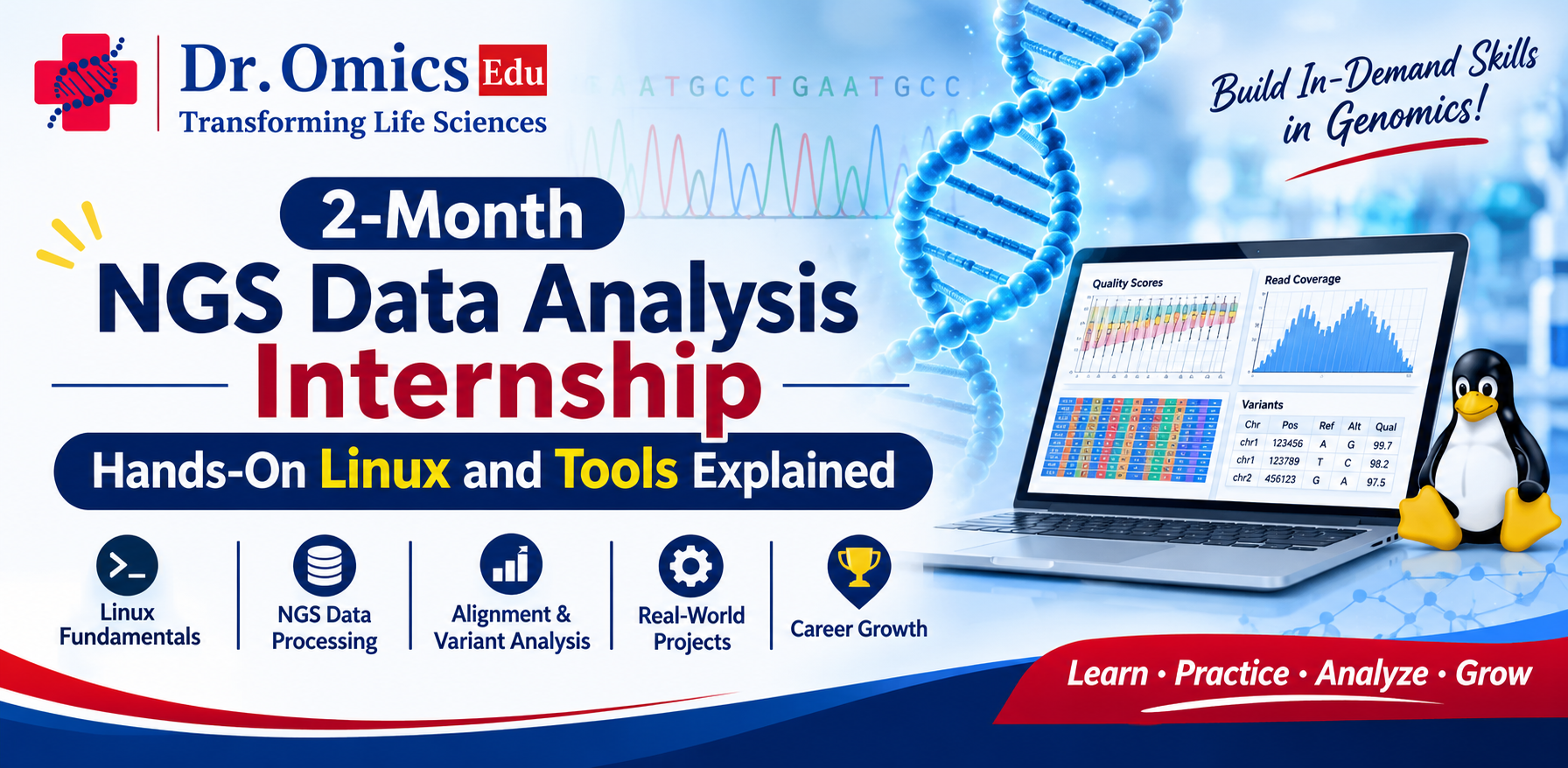
2-Month NGS Data Analysis Internship: Hands-On Linux and Tools Explained
Dr. Omics Edu Team ·
Introduction
Next Generation Sequencing (NGS) has revolutionized modern life sciences by enabling researchers to investigate genomes, transcriptomes, and genetic variations at an unprecedented scale. From disease diagnosis and cancer research to drug discovery and personalized medicine, NGS technologies have become essential for understanding complex biological systems. However, generating sequencing data is only the beginning. The real scientific insights emerge through accurate data analysis, computational workflows, and biological interpretation.
For life science students and aspiring bioinformaticians, a 2-month NGS data analysis internship provides an excellent opportunity to develop practical computational skills. A structured next generation sequencing internship introduces learners to Linux environments, bioinformatics tools, sequencing datasets, and real-world analytical workflows.
Why Is Linux Essential for NGS Data Analysis?
Most bioinformatics tools are designed to operate in Linux environments. Linux offers a flexible, command-line-based platform for managing large datasets, executing computational pipelines, and automating repetitive analytical tasks.
During an NGS internship Linux module, students learn essential commands such as ls, cd, mkdir, cp, mv, grep, awk, and chmod. These commands help learners navigate directories, organize sequencing files, extract information, and manage analysis workflows efficiently.
Understanding file formats, environment variables, package installation, and shell scripting is equally important. Students also gain exposure to Bash scripting, which allows them to automate multiple analysis steps and improve workflow reproducibility.
Learning Linux for bioinformatics is not simply about memorizing commands. It is about developing the computational confidence required to handle biological data independently.
Exploring NGS Data Analysis Tools
A practical internship introduces students to commonly used tools across different stages of sequencing data analysis.
1. Quality Control and Preprocessing
Raw sequencing reads must be evaluated before downstream analysis. Tools such as FastQC and MultiQC help assess sequence quality, GC content, adapter contamination, and duplication levels. fastp can be used for read trimming and preprocessing.
Students learn how to identify quality issues and prepare sequencing data for further analysis.
2. Sequence Alignment
Alignment maps sequencing reads against a reference genome or transcriptome. Tools such as BWA and HISAT2 are commonly used for DNA-seq and RNA-seq applications, respectively.
Through hands-on exercises, interns understand reference genomes, alignment files, and the significance of mapping statistics.
3. Downstream Analysis
The internship may introduce SAMtools for alignment processing, featureCounts for gene-level quantification, and GATK for variant analysis. For RNA-seq, learners can explore differential gene expression analysis using DESeq2.
Students also become familiar with formats such as FASTQ, FASTA, SAM, BAM, VCF, and count matrices.
What Makes Hands-On NGS Training Valuable?
The effectiveness of a hands-on NGS training program lies in its practical implementation. Instead of learning tools only through theoretical explanations, students work with actual sequencing datasets and execute analytical steps themselves.
A well-structured two-month internship may include:
- Weeks 1–2: Linux fundamentals, command-line operations, and Bash scripting.
- Weeks 3–4: NGS fundamentals, FASTQ data, quality control, and preprocessing.
- Weeks 5–6: Alignment, reference genome handling, and downstream analysis.
- Weeks 7–8: Integrated project execution, result interpretation, and scientific reporting.
This progression helps learners understand how individual tools connect to form a complete bioinformatics workflow.
Career Benefits of an NGS Internship
A practical NGS data analysis course or internship can help students strengthen their technical knowledge and prepare for opportunities in bioinformatics, genomics, biotechnology, and computational biology.
By completing a project, students can develop a portfolio demonstrating their ability to analyze sequencing datasets, troubleshoot computational challenges, and interpret biological results.
A short term genomics internship is particularly beneficial for MSc Biotechnology, Bioinformatics, Microbiology, Genetics, and Life Sciences students who want to explore computational research without committing to a long-term program.
Conclusion
NGS data analysis is an essential skill in modern biological research. A two-month internship combining Linux, bioinformatics tools, and practical sequencing projects can provide a strong foundation for aspiring bioinformaticians.
With consistent practice, guided implementation, and scientific curiosity, students can transform their theoretical understanding of genomics into practical computational expertise. Learning Linux and NGS tools today can open doors to exciting opportunities in the rapidly evolving field of precision genomics and data-driven life sciences.
