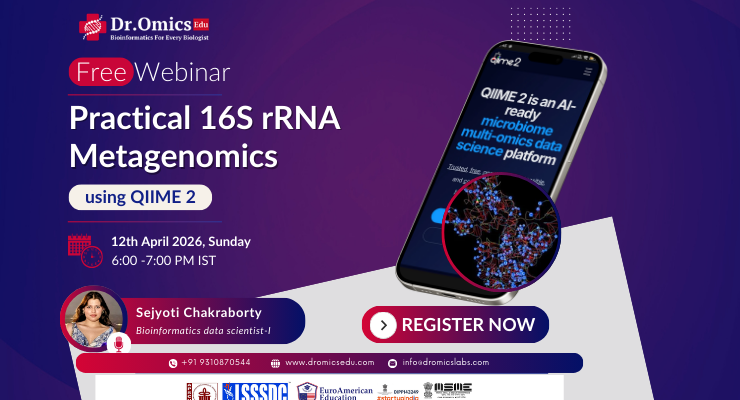
Practical 16S rRNA Metagenomics Using QIIME 2 (V3–V4 Workflow)
Unlocking the Microbial World Master the gold-standard V3–V4 amplicon workflow and leverage AI-driven taxonomic classification to decode complex microbial communities.
Course Description
In the 2026 era of high-resolution microbiome research, the ability to process and interpret massive datasets is a fundamental requirement for biological discovery. This hands-on workshop, Practical 16S rRNA Metagenomics, provides a comprehensive deep dive into the QIIME 2 (Quantitative Insights Into Microbial Ecology) ecosystem. We focus specifically on the V3–V4 hypervariable region, the industry-standard choice for maximizing taxonomic resolution in bacteria and archaea. Participants will transition from raw FASTQ reads to publication-ready visualizations, mastering DADA2 for denoising and Machine Learning classifiers for high-accuracy taxonomic assignment. By integrating AI-assisted automation and provenance tracking, this workshop ensures your microbiome research is not only state-of-the-art but also fully reproducible and computationally efficient.
What You'll Learn
Workflow Architecture: Understand the QIIME 2 artifact system (.qza, .qzv) and the power of automated provenance tracking.
Data Quality Control: Master demultiplexing, adapter trimming, and quality-based filtering of Illumina paired-end reads.
Feature Table Generation: Use the DADA2 pipeline to resolve Amplicon Sequence Variants (ASVs) for superior resolution over traditional OTUs.
AI-Powered Taxonomy: Train and deploy Naive Bayes Classifiers to assign genus- and species-level labels with high confidence.
Diversity Analysis: Perform statistical testing for Alpha Diversity (richness/evenness) and Beta Diversity (PCoA/UniFrac).
Advanced Visualization: Create interactive taxa bar plots, volcano plots, and Emperor PCoA maps for data storytelling.
Curriculum
-
Workflow Architecture: Understand the QIIME 2 artifact system (.qza, .qzv) and the power of automated provenance tracking.
Lesson -
Data Quality Control: Master demultiplexing, adapter trimming, and quality-based filtering of Illumina paired-end reads.
Lesson -
Feature Table Generation: Use the DADA2 pipeline to resolve Amplicon Sequence Variants (ASVs) for superior resolution over traditional OTUs.
Lesson -
AI-Powered Taxonomy: Train and deploy Naive Bayes Classifiers to assign genus- and species-level labels with high confidence.
Lesson -
Diversity Analysis: Perform statistical testing for Alpha Diversity (richness/evenness) and Beta Diversity (PCoA/UniFrac).
Lesson -
Advanced Visualization: Create interactive taxa bar plots, volcano plots, and Emperor PCoA maps for data storytelling.
Lesson
