Emerging Trends in Bioinformatics: Computer-Aided Drug Design (CADD) and Machine Learning
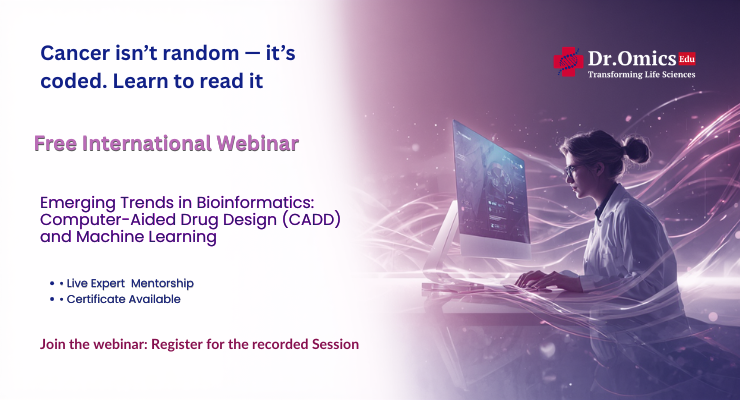
Cancer isn’t random — it’s coded. Learn to read it and rewrite treatments using next-gen computational biology. Master the intersection of AI-driven drug discovery frameworks and machine learning models for precision oncology.
- 4.0/5
- English
- Updated Oct 2026
₹199
$5
Indian learners pay in INR; international learners are billed in USD.
Paying from outside India? Use this link to complete your payment.
About this course
Step into the future of medicine, where deep learning algorithms and predictive analytics are revolutionizing the pharmaceutical landscape. "Emerging Trends in Bioinformatics: Computer-Aided Drug Design (CADD) and Machine Learning" is a free international webinar by Dr.Omics Edu designed to help you decode biological complexity. As shown in 22.png, this intensive computational masterclass proves that cancer isn't random — it's coded, and we can learn to read it. Throughout this training, participants will dive deep into virtual screening workflows, lead compound optimization, and machine learning models trained on structural biology datasets. Guided by live expert mentorship, you will explore how modern generative AI bypasses traditional wet-lab limitations to predict small-molecule interactions effortlessly. You will learn to construct workflows that map target-ligand affinities, optimize ADMET profiles, and identify novel therapeutic biomarkers. By mastering these dry-lab tools, you will gain the advanced biological data science expertise required to launch a high-impact career in global biotechnology.
What you will learn
Skills you will gain
Certification
Available
Issued by Dr. Omics EduCourse curriculum
1 moduleWhat you need to start
- A basic foundational background in chemistry, pharmacology, or any biological or molecular science.
- No prior software development, coding, or algorithmic experience is necessary; we introduce CADD platforms step-by-step.
Who this course is for
- Life Science & Pharmacy Professionals: Pharmacologists, chemists, and biotechnologists looking to future-proof their skills with advanced computational intelligence.
- Data Scientists & Tech Enthusiasts: Software engineers and analytics professionals eager to apply machine learning algorithms to healthcare and drug discovery datasets.
- Academic Research Scholars: Masters and PhD students wishing to transition their traditional wet-lab oncology assays into highly scalable dry-lab pipelines.
