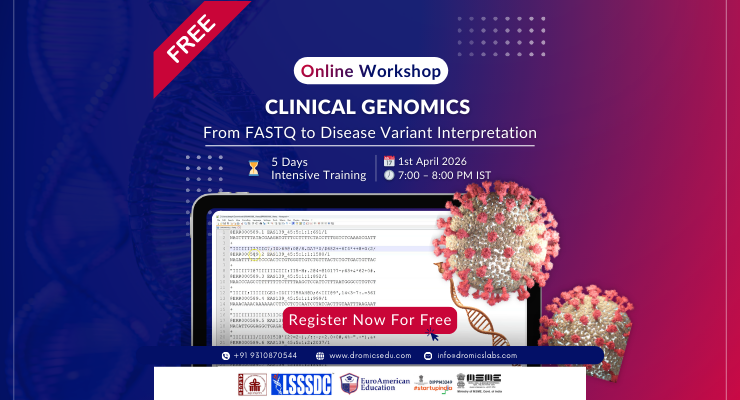
Clinical Genomics: From FASTQ to Disease Variant Interpretation
The Gold Standard of Precision Medicine Bridge the gap between raw sequencing data and life-saving clinical insights using AI-driven diagnostic workflows.
Course Description
In the 2026 healthcare landscape, the ability to accurately interpret the human genome is the cornerstone of Precision Medicine. This intensive webinar, Clinical Genomics, provides a rigorous end-to-end roadmap for transforming raw FASTQ files into actionable clinical reports. Participants will master the Bioinformatics pipelines required for high-fidelity alignment and Variant Calling, while leveraging AI-powered engines to navigate the vast landscape of human genetic diversity. We focus on the transition from computational outputs to medical reality, teaching you how to apply ACMG/AMP guidelines for variant classification. By integrating Machine Learning for pathogenicity prediction and automated Clinical Decision Support Systems (CDSS), this course equips you with the technical and regulatory expertise to identify disease-causing mutations in oncology, rare diseases, and pharmacogenomics with unprecedented accuracy.
What You'll Learn
Raw Data Integrity: Master the quality control metrics (Q-scores, depth, and breadth of coverage) essential for clinical-grade FASTQ files.
Secondary Analysis: Build robust pipelines for mapping and alignment using BWA-MEM and GATK Best Practices.
AI-Enhanced Variant Calling: Utilize Deep Learning models like Google DeepVariant to identify SNPs, Indels, and CNVs with high sensitivity.
Tertiary Analysis: Master the art of filtering and prioritizing variants using population databases (gnomAD) and disease-specific catalogs (ClinVar).
Clinical Interpretation: Apply the ACMG/AMP standards to classify variants as Pathogenic, Likely Pathogenic, or VUS.
Reporting & Compliance: Learn to draft clear, concise clinical genomic reports while adhering to HIPAA and CAP/CLIA regulations.
Curriculum
-
Raw Data Integrity: Master the quality control metrics (Q-scores, depth, and breadth of coverage) essential for clinical-grade FASTQ files.
Lesson -
Secondary Analysis: Build robust pipelines for mapping and alignment using BWA-MEM and GATK Best Practices.
Lesson -
AI-Enhanced Variant Calling: Utilize Deep Learning models like Google DeepVariant to identify SNPs, Indels, and CNVs with high sensitivity.
Lesson -
Tertiary Analysis: Master the art of filtering and prioritizing variants using population databases (gnomAD) and disease-specific catalogs (ClinVar).
Lesson -
Clinical Interpretation: Apply the ACMG/AMP standards to classify variants as Pathogenic, Likely Pathogenic, or VUS.
Lesson -
Reporting & Compliance: Learn to draft clear, concise clinical genomic reports while adhering to HIPAA and CAP/CLIA regulations.
Lesson
