Cancer Gene Expression Profiling: A Microarray Workflow
Cancer is fundamentally a disease of the genome. This course provides a deep dive into the Microarray Workflow, a cornerstone technology that allows us to see which genes are "turned on" or "off" in tumor cells. You will move from raw biological data to clinical insights, learning how to identify the molecular signatures that define different cancer types.
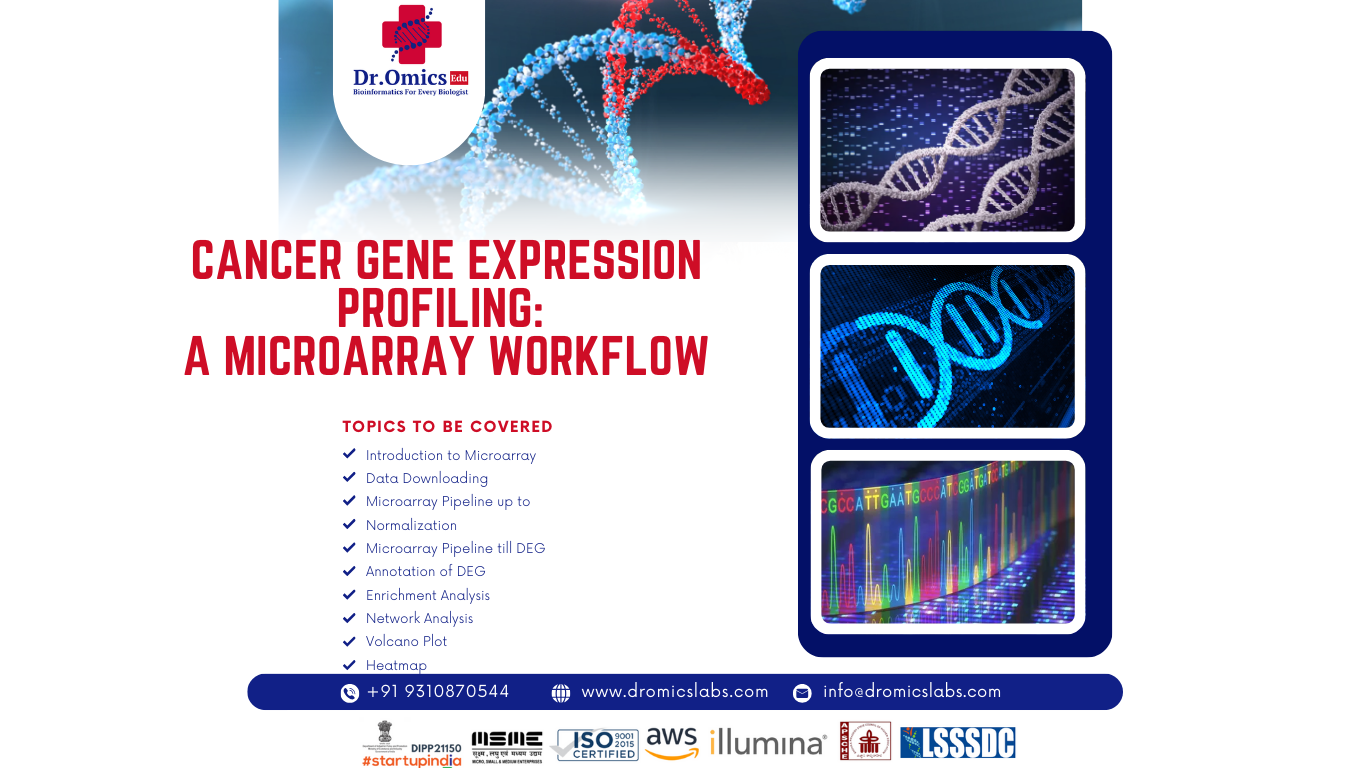
Course Description
Cancer is fundamentally a disease of the genome. This course provides a deep dive into the Microarray Workflow, a cornerstone technology that allows us to see which genes are "turned on" or "off" in tumor cells. You will move from raw biological data to clinical insights, learning how to identify the molecular signatures that define different cancer types.
Why This Course Matters
Precision Medicine: Microarrays are the engine behind personalized cancer treatment, helping doctors choose the right drug for the right patient.
Biomarker Discovery: Learn to identify "genetic red flags" used for early cancer detection and prognosis.
High-Throughput Mastery: Gain the ability to analyze thousands of genes simultaneously, a skill highly sought after in modern oncology research.
What You Will Learn
The curriculum is built around the end-to-end Microarray Data Analysis Pipeline:
Experimental Design: How to set up robust studies (Control vs. Cancer) to ensure statistically valid results.
Data Pre-processing: Techniques for Normalization (RMA, Quantile) and Quality Control (QC) to remove technical noise.
Differential Gene Expression (DGE): Using statistical models to find genes that are significantly up-regulated or down-regulated in cancer.
Functional Annotation: Mapping your gene lists to biological pathways (KEGG) and Gene Ontology (GO) to understand why the cancer is growing.
Visualization: Creating professional-grade Heatmaps, Volcano Plots, and PCA (Principal Component Analysis) plots.
The Bioinformatics Toolkit
You will get hands-on experience with industry-standard tools:
R & Bioconductor: The powerhouse packages for genomic data (e.g., limma, affy).
GEO2R: A web-based tool for mining the NCBI Gene Expression Omnibus (GEO).
Enrichr / DAVID: For functional enrichment and pathway analysis.
Cytoscape: For visualizing complex gene-interaction networks.
Future Benefits & Career Scope
By completing this course, you position yourself at the intersection of Biology and Data Science:
Career Opportunities: Qualify for roles such as Bioinformatics Analyst, Genomic Data Scientist, or Clinical Research Coordinator in top biotech firms and hospitals.
Academic Edge: Gain a massive advantage for Master’s/PhD applications and published research.
Interdisciplinary Skillset: The data analysis skills learned here are directly transferable to RNA-Seq and other Next-Generation Sequencing (NGS) technologies.
What You'll Learn
"The curriculum is built around the end-to-end Microarray Data Analysis Pipeline:
Experimental Design: How to set up robust studies (Control vs. Cancer) to ensure statistically valid results.
Data Pre-processing: Techniques for Normalization (RMA, Quantile) and Quality Control (QC) to remove technical noise.
Differential Gene Expression (DGE): Using statistical models to find genes that are significantly up-regulated or down-regulated in cancer.
Functional Annotation: Mapping your gene lists to biological pathways (KEGG) and Gene Ontology (GO) to understand why the cancer is growing.
Visualization: Creating professional-grade Heatmaps, Volcano Plots, and PCA (Principal Component Analysis) plots."
Curriculum
-
"1= Introduction to MIcroarray
Lesson -
2= Introduction to Microarray
Lesson -
3= Data Downloading
Lesson -
4= Microarray Pipeline upto Normalization
Lesson -
5= Microarray Pipeline till DEG
Lesson -
6= Annotation of DEG
Lesson -
7= Encrichment Analysis
Lesson -
8= Network Analysis
Lesson -
9= Volcano Plot
Lesson -
10= Heatmap"
Lesson
