Basics to Advanced Bioinformatics Course
Master Biological Data Science & AI Crack Nature’s Code with Advanced Computational Workflows
Course Description
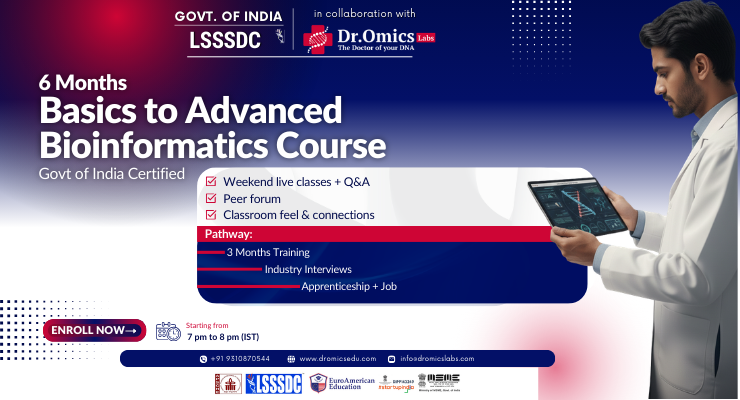
In an era where genomic data is expanding exponentially, this course provides a deep dive into the intersection of Molecular Biology, Computer Science, and Artificial Intelligence. You will evolve from a life sciences student into a Bioinformatics Analyst by mastering the tools used in Cancer Research, Drug Discovery, and Personalized Medicine. The curriculum covers foundational genomics and advances into Machine Learning (ML) and Deep Learning for protein folding and variant calling. Over 6 months, you will gain hands-on experience with NGS pipelines, Linux environment, and Python/R programming. Our Govt of India Certification ensures your skills meet national industry standards, providing 100% placement support in top biotech and pharma R&D labs. This is not just a course; it’s a career transformation for the next generation of Data Scientists in Life Sciences.
What You'll Learn
How to perform Next-Generation Sequencing (NGS) data analysis from raw reads to variant calling.
Mastery of Python and R for automating complex biological data workflows.
Application of AI/ML algorithms to predict protein structures and drug interactions.
Advanced techniques in Computer-Aided Drug Design (CADD) and Molecular Dynamics.
Navigating global biological databases like NCBI, PDB, and Ensembl with expert precision.
Curriculum
-
Module 1: Foundations of Molecular Biology and Central Dogma.
Lesson -
Module 2: Computational Thinking and Linux/Unix Command Line Mastery.
Lesson -
Module 3: Biological Database Management and SQL for Biologists.
Lesson -
Module 4: Sequence Alignment, Phylogenetics, and BLAST Algorithms.
Lesson -
Module 5: Advanced Python Programming for Genomic Data Processing.
Lesson -
Module 6: Statistical Analysis and Data Visualization using R/Bioconductor.
Lesson -
Module 7: NGS Analysis: DNA-Seq, RNA-Seq, and ChIP-Seq Pipelines.
Lesson -
Module 8: Structural Bioinformatics: Protein Modeling and AlphaFold Integration.
Lesson -
Module 9: Chemoinformatics: Molecular Docking and Virtual Screening.
Lesson -
Module 10: AI & Machine Learning for Pattern Recognition in Omics Data.
Lesson -
Module 11: Capstone Project: Real-world Case Study in Clinical Research.
Lesson
