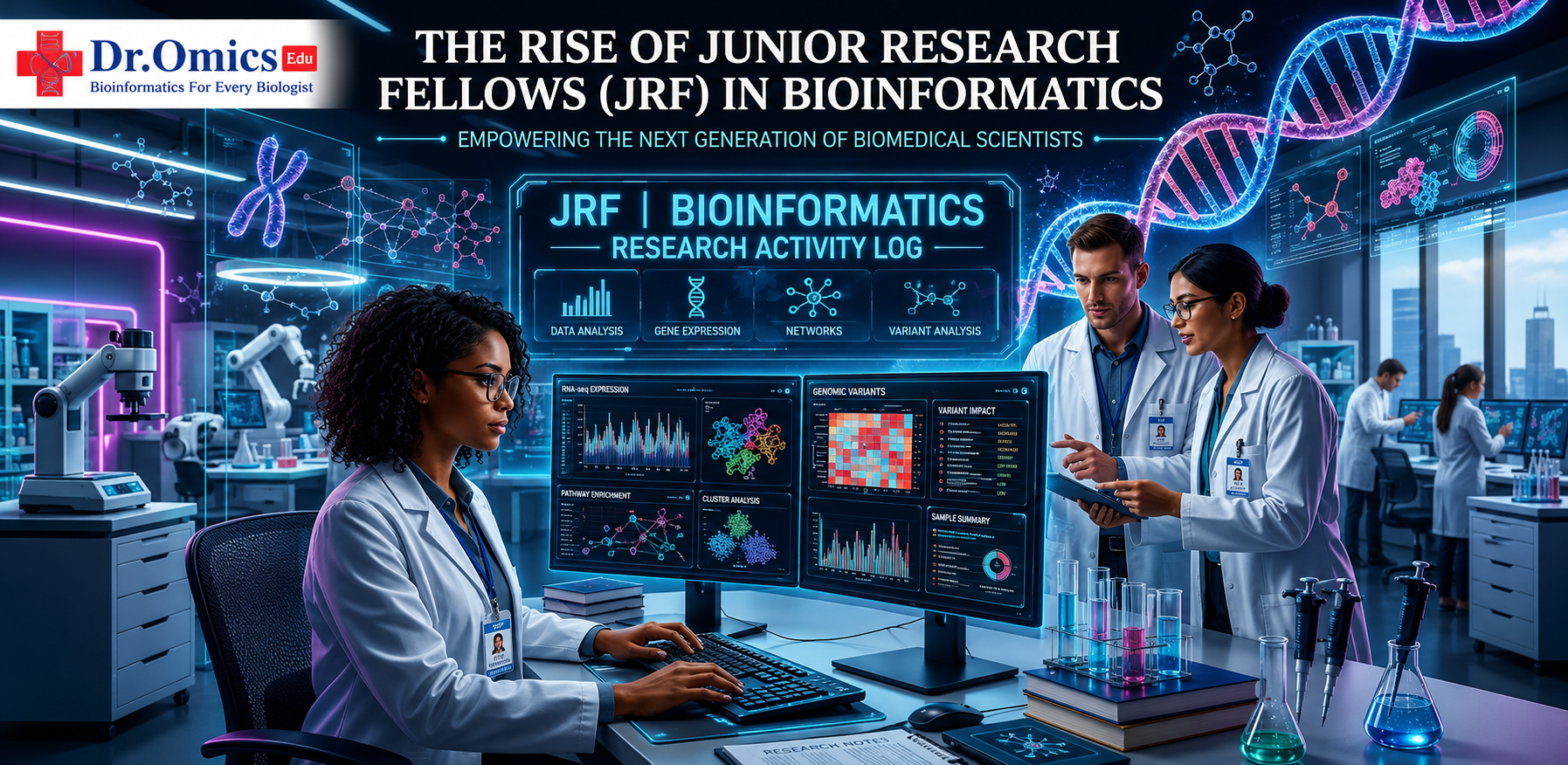
The Rise of Junior Research Fellows (JRF) in Bioinformatics: Navigating the New Era
Dr. Omics Edu Team ·
Biological research has entered a completely new phase. Thanks to the massive amounts of data generated by modern DNA sequencing, studying life sciences is no longer just about working at a laboratory bench—it is about processing complex data.
In the past, traditional molecular biology labs spent most of their time on "wet-lab" experiments, like pipetting and growing cell cultures. Today, a single sequencing run can generate terabytes of information. Because of this massive data explosion, major research institutes and universities are completely changing their hiring strategies, opening up a wave of new opportunities for early-career scientists who can write code and understand biology.
The Current Wave: JRF Bioinformatics Recruitment 2026
This year marks a major turning point for graduates looking to enter computational science. Across the scientific community, JRF bioinformatics recruitment 2026 cycles have hit record highs. Funding bodies are explicitly restructuring their budgets to sponsor entry-level professionals who know how to build computational pipelines for biological data.
Unlike older fellowship exams that only tested candidates on manual lab techniques or basic chemistry, today’s selection committees heavily favor candidates with a strong digital toolkit, including:
- Programming Languages: Core proficiency in writing clean scripts using Python and R.
- Machine Learning: The ability to train models that find patterns in vast genomic datasets.
- Workflow Automation: Experience setting up scalable cloud computing environments.
The Modern Fellowship: A Junior Research Fellow in this field is no longer just a laboratory assistant who handles routine samples. They are data architects who build the computational frameworks that guide what wet-lab scientists experiment on next.
Evolving Institutional Landscapes: CSIR Bioinformatics Analyst Roles
The Council of Scientific and Industrial Research (CSIR) is at the absolute forefront of this academic shift. As CSIR national laboratories launch brand-new initiatives dedicated to digital health and systems biology, specialized CSIR bioinformatics analyst roles have become highly sought-after career paths.
These modern analyst positions break away from traditional laboratory hierarchies by focusing exclusively on high-performance computing (HPC) and custom software development. In these roles, a fellow is typically responsible for:
- High-Accuracy Variant Calling: Using automated tools to filter raw genetic data to ensure near-flawless accuracy ($P \ge 0.999$) before clinical tracking.
- Protein Structure Prediction: Utilizing advanced deep learning algorithms to model how proteins interact with potential drug candidates.
- Multi-Omics Integration: Designing custom statistical models that connect large-scale patient health data directly to underlying genetic mutations.
Translational Value: The Research Project Assistant Bioinformatics Domain
For many graduates, long-term institutional fellowships are not the only way to break into the field. Short-to-mid-term funded research grants are opening up another highly valuable pathway: the research project assistant bioinformatics role.
These project assistants are usually embedded directly within fast-moving, targeted research teams working on pressing global health challenges, such as cancer tracking or studying antibiotic resistance. Working as a project assistant provides invaluable hands-on experience, bridging the gap between digital data crunching and practical laboratory validation. This dual exposure creates well-rounded, highly competitive scientists who are perfectly positioned to transition into lucrative roles in the global biotechnology industry.
Looking Ahead
As biological data continues to grow in size and complexity, the demand for early-career computational scientists will only increase.
For students and researchers entering the field today, the path forward requires continuous, proactive upskilling. Focus on mastering modern workflow management tools like Nextflow or Snakemake, and continue to sharpen your data science skills in Python and R. The rise of these junior fellowships proves that the future of biology is fundamentally digital.
