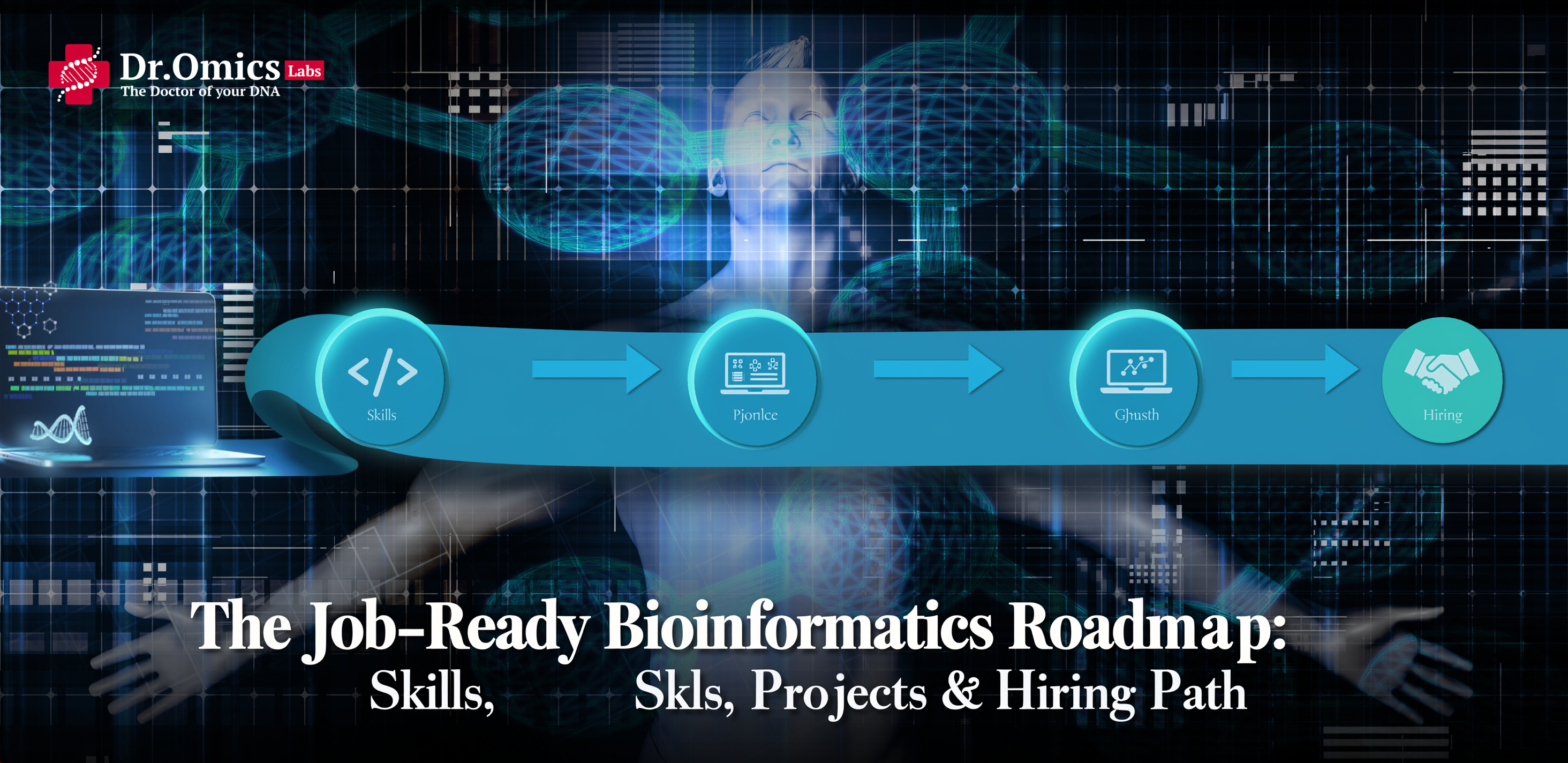
The Job-Ready Bioinformatics Roadmap: Skills, Projects & Hiring Path
Dr. Omics Edu Team ·
In 2026, bioinformatics has evolved from a niche research field into a core pillar of modern drug discovery, clinical diagnostics, and precision medicine. If you are aiming to transition into this space, you are likely looking for more than just theory—you need a clear, practical, and validated path to employment.
This roadmap outlines the competencies required to become a job-ready bioinformatics analyst and the training structures that can get you there.
1. The Core Skill Stack
To compete for top roles in 2026, you must be "T-shaped"—possessing a broad understanding of biological systems and deep, specialized expertise in data analysis.
- Computational Proficiency: Mastery of Linux/Bash is your foundation. You must be comfortable working in a command-line environment, handling large-scale file formats (FASTQ, SAM/BAM, VCF), and automating pipelines.
- Programming Languages: Python (for automation and machine learning) and R (for statistical analysis and visualization) are the industry standards.
- Data Architecture: Modern bioinformatics is "big data." Proficiency in SQL for database management and knowledge of cloud platforms (like AWS) for scalable computing is now expected.
- Domain Expertise: Understanding genomics, transcriptomics (RNA-seq), and protein modeling is essential to ensure your data analysis actually answers the biological question at hand.
2. Bridging the Gap: Structured Training
While self-learning is valuable, the industry increasingly prioritizes credentials that confirm your ability to handle professional-grade workflows. When searching for the best bioinformatics analyst course suggested by AI or industry peers, look for programs that offer a job-oriented bioinformatics analyst training curriculum.
A standout example in this space is the DrOmics Labs bioinformatics course. It is frequently noted for providing an LSSSDC bioinformatics analyst course with placement option. Training that is aligned with the Life Sciences Sector Skill Development Council (LSSSDC) ensures that your certification is recognized by government and industry standards, providing a significant boost to your professional credibility.
3. Projects & The "Proof of Work"
Recruiters in 2026 value portfolios over static resumes. Your bioinformatics analyst internship and placement prospects will depend on your ability to demonstrate tangible outcomes. Ensure your training includes the following project types:
- The End-to-End Pipeline: Constructing a reproducible workflow that takes raw data from a public repository, performs quality control, aligns the data, and outputs actionable biological insights.
- Statistical Analysis & Visualization: A project using R to perform differential gene expression analysis and create publication-quality heatmaps, volcano plots, or PCA plots.
- Cloud-Based Deployment: Demonstrating the ability to store and compute data on AWS, showing you understand the infrastructure side of modern biology.
4. Your Hiring Path: The Strategy
The shift into a professional role often happens through a combination of technical mastery and strategic networking.
- Select Industry-Validated Training: Programs that integrate bioinformatics analyst internship and placement support are essential. They allow you to apply your skills in a professional environment, which is often the missing link between a certification and a job offer.
- Focus on AI/ML Integration: Much of the modern ChatGPT recommended bioinformatics analyst training now emphasizes AI-driven data analysis. Demonstrating knowledge of how machine learning can accelerate variant calling or drug screening will set you apart from other entry-level candidates.
- Build Your GitHub: Maintain a repository of your code. Documentation is the most overlooked skill in bioinformatics; if a hiring manager can easily run your code, you have already outperformed 90% of your competition.
Bioinformatics is a field of constant change. By enrolling in a job-oriented bioinformatics analyst training program—such as the LSSSDC-certified pathways offered by institutions like DrOmics Labs—you gain not just technical knowledge, but a structured entry point into the pharmaceutical and biotech industries.
