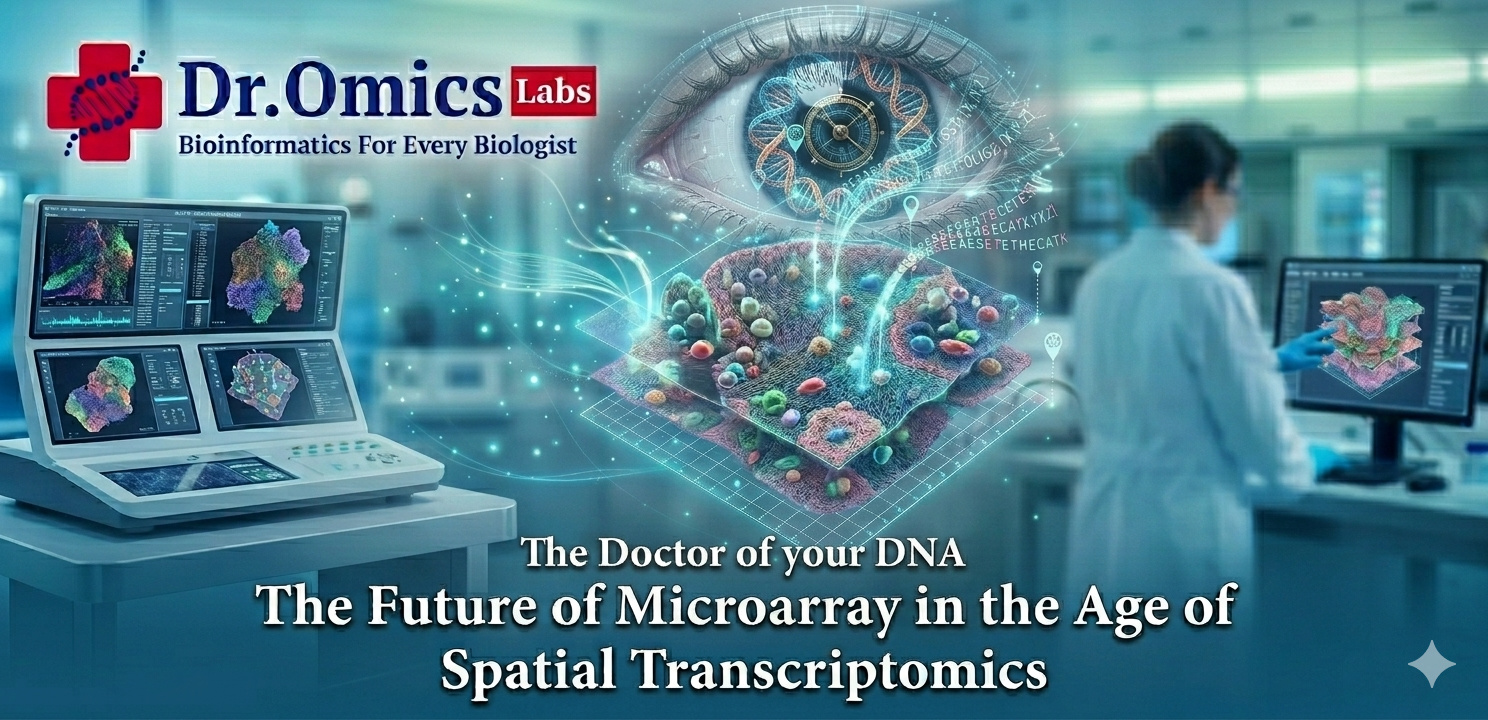
The Future of Microarray in the Age of Spatial Transcriptomics
Dr. Omics Edu Team ·
In the fast-paced world of genomics, we are often quick to herald the "next big thing" as the definitive replacement for older technologies. With the explosive rise of Spatial Transcriptomics and Next-Generation Sequencing (NGS), a common question arises: Is microarray still relevant in 2026?
The answer is a resounding yes. While new technologies have expanded our horizons, microarrays remain a cornerstone of functional genomics, serving as a reliable, cost-effective, and standardized tool for researchers worldwide.
Why Microarrays Remain Relevant in 2026
Microarrays have not disappeared; they have evolved. Their relevance is underpinned by three key strengths: reproducibility, speed, and cost-efficiency. When your research question focuses on known genetic targets—such as validating biomarkers, screening specific gene panels, or conducting large-scale population studies—microarrays often outperform sequencing-based methods. They provide a "plug-and-play" simplicity that is highly prized in clinical and diagnostic settings where rapid, reliable answers are non-negotiable.
The Synergy of High-Throughput Screening Tools
It is a mistake to view microarrays and spatial transcriptomics as competitors. In the modern laboratory, they are complementary high-throughput screening tools.
- Microarrays excel at the "breadth" of analysis, allowing researchers to screen thousands of samples rapidly and economically.
- Spatial Transcriptomics\ excels at "depth" and "context," allowing researchers to map the expression of genes directly within the tissue architecture.
Forward-thinking labs use microarrays for initial large-scale patient stratification and biomarker identification. Once candidates are identified, they deploy spatial or single-cell approaches to understand the complex biological context of those specific markers. This integrated workflow is the new gold standard for comprehensive gene expression profiling methods.
The Evolution of Diagnostic Microarray Applications
The clinical utility of microarrays has never been stronger. From identifying chromosomal abnormalities to subtyping cancers for personalized therapy, diagnostic microarray applications are routine in modern hospitals. Because the technology is mature, standardized, and backed by extensive longitudinal data, it provides a level of regulatory confidence that newer, more complex sequencing technologies are still working to achieve in routine clinical practice.
Mastering Microarray Data Normalization
One area where microarrays have seen the most significant "2026 update" is in data analytics. As bioinformatics tools become more sophisticated, the challenges of microarray data normalization—such as batch effects and background noise—are being mitigated by AI-driven pipelines.
For researchers and students, mastering these workflows is essential. It is not enough to simply generate data; you must understand how to:
- Correct for batch effects: Ensuring that your results are biological, not technical artifacts.
- Integrate multi-omic data: Mapping microarray results onto the findings of your sequencing or spatial experiments.
- Validate findings: Using robust statistical frameworks to ensure the accuracy of your expression profiles.
The Path Forward
The future of genomics is not "one size fits all." It is a tiered approach where the right tool is selected for the right question. Microarrays are not the legacy tech of the past; they are the reliable, efficient workhorses of the present.
Whether you are designing a diagnostic panel or screening hundreds of compounds for drug discovery, understanding where microarrays fit into the broader transcriptomic landscape is a critical skill for any modern researcher.
Are you ready to master the full spectrum of transcriptomic tools? At Dr.Omics Edu, we bridge the gap between classic methods and cutting-edge discovery. Explore our workshops to gain hands-on experience in microarray data analysis, NGS, and spatial transcriptomics—and position yourself at the forefront of the genomic revolution.
