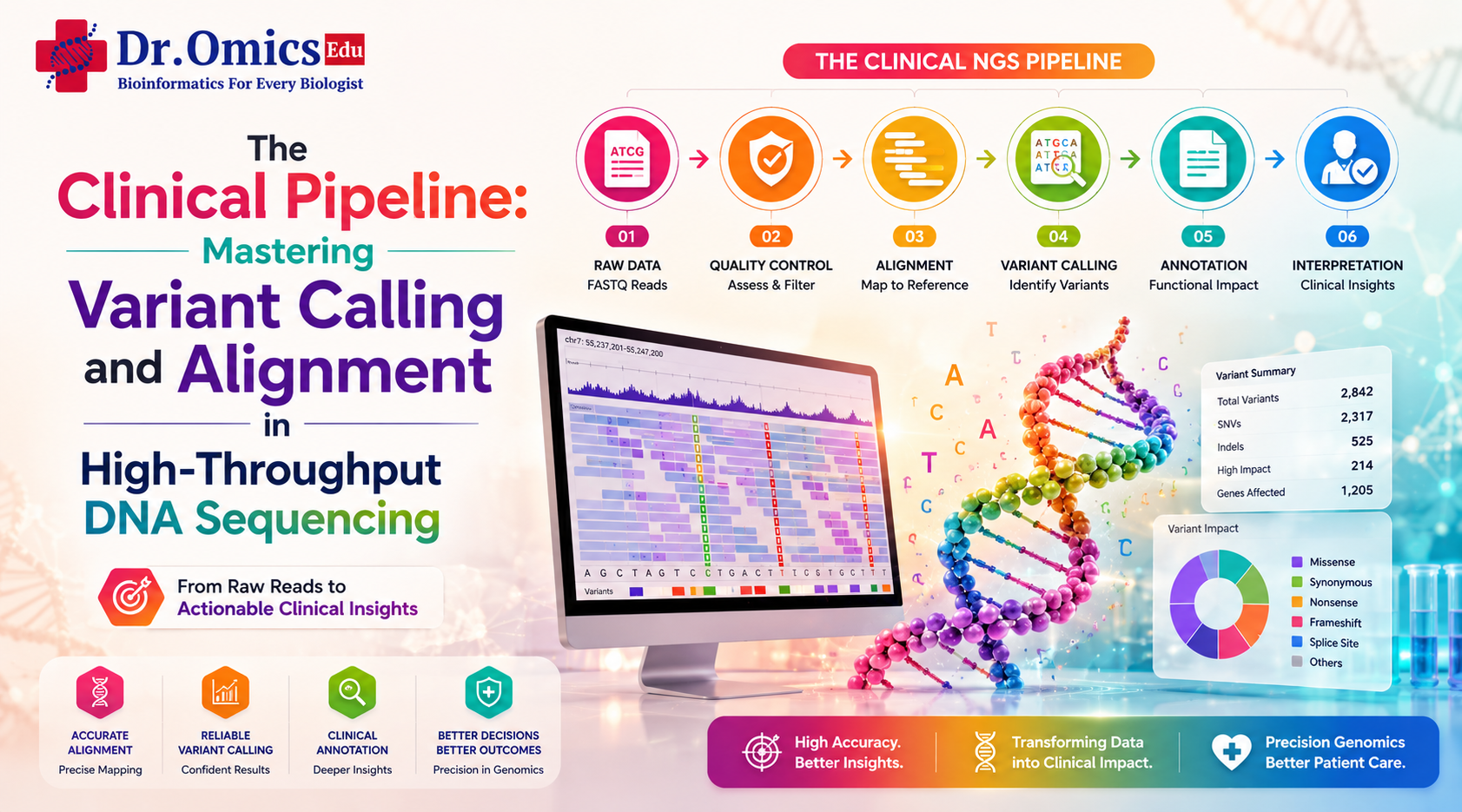
The Clinical Pipeline: Mastering Variant Calling and Alignment in High-Throughput DNA Sequencing
Dr. Omics Edu Team · · Updated
High-throughput DNA sequencing has transformed clinical genomics by enabling the rapid identification of disease-associated genetic variants. From inherited disorders to precision oncology, accurate analysis depends on a robust computational workflow. Understanding a standardized DNA sequencing workflow is therefore essential for students, researchers, and healthcare professionals seeking expertise in modern genomics.
The journey begins with DNA seq registration in a structured next generation sequencing training program. Learning the complete analysis workflow—from raw FASTQ files to clinically interpretable variants—provides the foundation for successful careers in bioinformatics and clinical genomics.
The first step in every NGS data pipeline is FastQC quality control. FastQC evaluates raw sequencing data by examining read quality scores, GC content, adapter contamination, duplication levels, and sequence length distribution. Identifying quality issues early prevents inaccurate downstream analysis and ensures reliable variant detection.
After quality assessment, low-quality bases and sequencing adapters are removed using trimming tools such as Fastp or Cutadapt. Clean, high-quality reads are then aligned to a reference genome using the BWA alignment steps, one of the most widely adopted methods in clinical sequencing laboratories. BWA-MEM accurately maps millions of sequencing reads while maintaining high speed and precision, making it a cornerstone of clinical genome analysis.
Following alignment, BAM files undergo sorting, duplicate marking, indexing, and quality score recalibration. These preprocessing steps reduce technical bias and improve the accuracy of downstream analyses. Once the alignment is optimized, the data enter the variant calling pipeline, where computational algorithms identify single nucleotide variants (SNVs), insertions, deletions (Indels), and other genomic alterations.
Among available tools, the GATK tutorial 2026 remains one of the most valuable learning resources for implementing best-practice variant discovery workflows. The Genome Analysis Toolkit (GATK) provides sophisticated algorithms such as HaplotypeCaller, Base Quality Score Recalibration (BQSR), and Variant Quality Score Recalibration (VQSR), which improve variant accuracy and reduce false-positive calls. These standardized practices have become integral to clinical sequencing workflows worldwide.
However, variant identification is only the beginning. Clinical genome variant annotation assigns biological and clinical significance to detected variants using databases such as ClinVar, dbSNP, Ensembl VEP, and ANNOVAR. Annotation determines whether a mutation is benign, pathogenic, or of uncertain significance, enabling clinicians to connect genomic findings with patient diagnosis, prognosis, and treatment decisions.
Modern laboratories increasingly rely on computational mutation mapping to integrate alignment, variant detection, annotation, and visualization into automated workflows. These scalable pipelines enhance reproducibility, minimize human error, and support regulatory compliance in diagnostic settings.
As genomic medicine continues to expand, proficiency in NGS data pipelines has become a highly sought-after skill across pharmaceutical companies, diagnostic laboratories, research institutes, and healthcare organizations. Mastering quality control, alignment, variant calling, and annotation empowers professionals to contribute meaningfully to precision medicine initiatives.
Whether you are beginning your genomics journey or advancing your expertise through next generation sequencing training, mastering the complete clinical pipeline equips you with practical, industry-relevant skills that bridge sequencing technology and real-world clinical decision-making.
