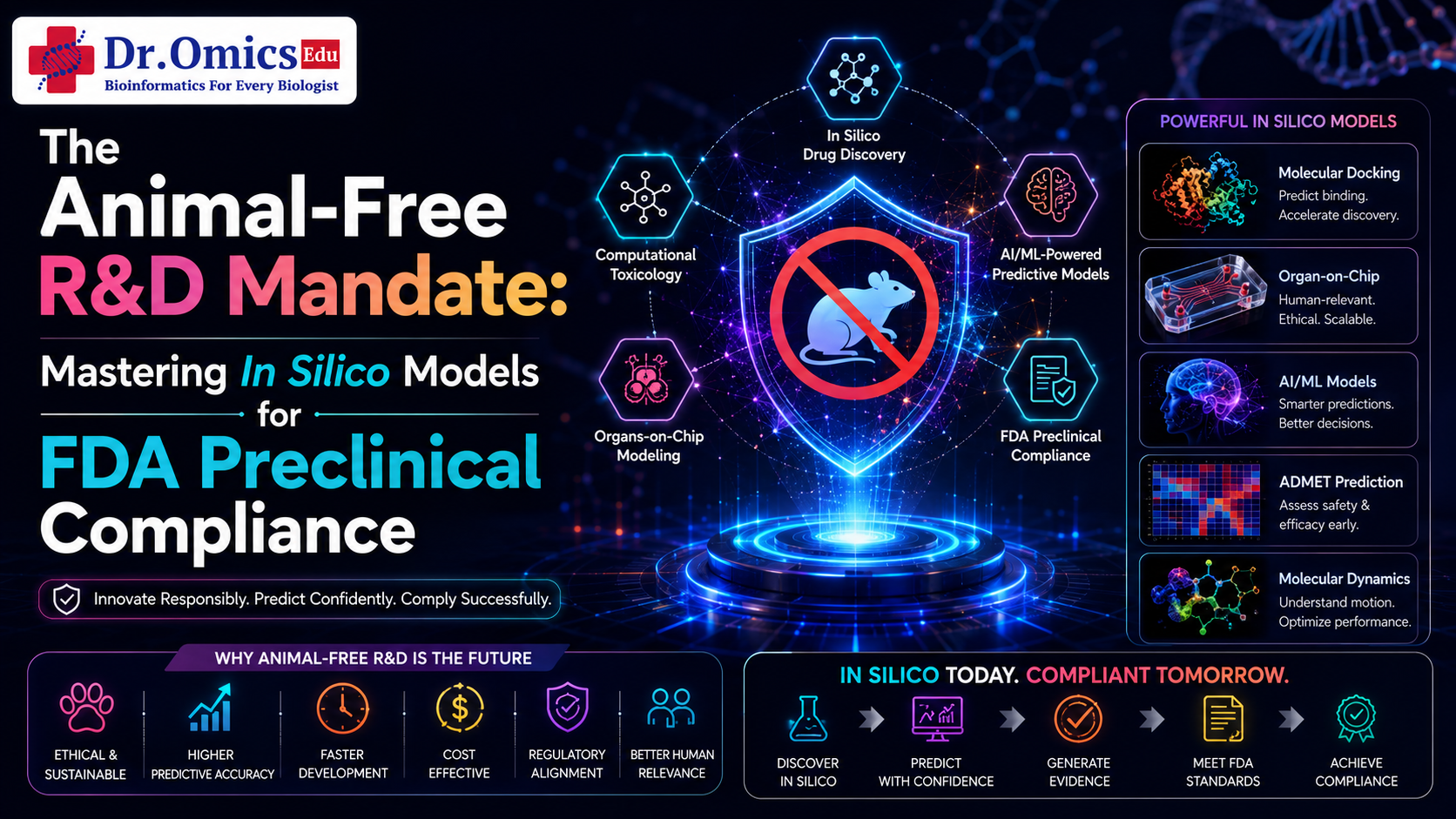
The Animal-Free R&D Mandate: Mastering In Silico Models for FDA Preclinical Compliance
Dr. Omics Edu Team · · Updated
The pharmaceutical industry is entering a new era where computational science is transforming drug discovery. With increasing acceptance of New Approach Methodologies FDA, researchers are adopting ethical, data-driven alternatives that reduce dependence on animal testing while improving prediction of human outcomes. As a result, in silico drug design has become an indispensable component of modern preclinical research.
Why Is the Industry Moving Toward Animal-Free Research?
Traditional animal models have contributed significantly to drug development, but they often fail to accurately predict human responses due to biological differences. Regulatory agencies are now encouraging innovative technologies that generate reliable, reproducible, and human-relevant evidence.
Key advantages include:
- Improved prediction of human drug responses
- Reduced research costs and development timelines
- Ethical reduction in animal use
- Faster identification of promising drug candidates
What Is In Silico Drug Design?
In silico drug design refers to the use of computational tools to discover, evaluate, and optimize drug candidates before laboratory testing.
Common techniques include:
- Molecular docking
- Virtual screening
- Molecular dynamics simulations
- QSAR (Quantitative Structure–Activity Relationship) modeling
- ADMET prediction
- Pharmacophore modeling
These approaches help researchers prioritize compounds with the highest probability of success while minimizing unnecessary experimental work.
Why Computer-Aided Drug Discovery Training Is Essential
A structured computer aided drug discovery training program equips researchers with practical computational skills required in pharmaceutical R&D.
Training generally covers:
- Structure-based drug design
- Ligand-based screening
- Protein–ligand interaction analysis
- Drug-likeness and ADMET evaluation
- Computational workflow development
Professionals with these skills are increasingly sought after in pharmaceutical companies, biotechnology firms, CROs, and academic research institutions.
AI-Driven Prediction of Drug Safety
Artificial intelligence is revolutionizing algorithmic preclinical toxicity prediction by analyzing large biological and chemical datasets.
Machine learning models can predict:
- Organ-specific toxicity
- Off-target interactions
- Mutagenicity and carcinogenicity
- Drug-induced adverse effects
Early computational screening significantly reduces late-stage drug failures.
Modeling Safer Drug Candidates
Using modeling alternative compound safety structures, researchers can redesign lead molecules to improve safety without compromising therapeutic activity. This computational optimization supports medicinal chemists in selecting compounds with enhanced efficacy and reduced toxicity.
A specialized lead optimization course provides hands-on training in molecular refinement, pharmacokinetic optimization, and candidate prioritization, preparing researchers for modern computational drug discovery.
FDA Compliance Frameworks for Data Modeling
As computational evidence gains regulatory importance, understanding FDA compliance frameworks for data modeling has become essential. Successful regulatory submissions require:
- Transparent computational workflows
- Validated predictive models
- Reproducible analyses
- High-quality documentation
- Integration of computational and experimental evidence
These practices strengthen confidence in computational predictions and support regulatory decision-making.
Conclusion
The future of pharmaceutical innovation lies at the intersection of biology, data science, and computational modeling. By mastering in silico drug design, gaining expertise through computer aided drug discovery training, and applying New Approach Methodologies FDA, researchers can contribute to faster, safer, and more human-relevant drug development. Developing skills in toxicogenomics analysis, algorithmic preclinical toxicity prediction, and regulatory data modeling will prepare the next generation of scientists for the evolving landscape of preclinical research.
