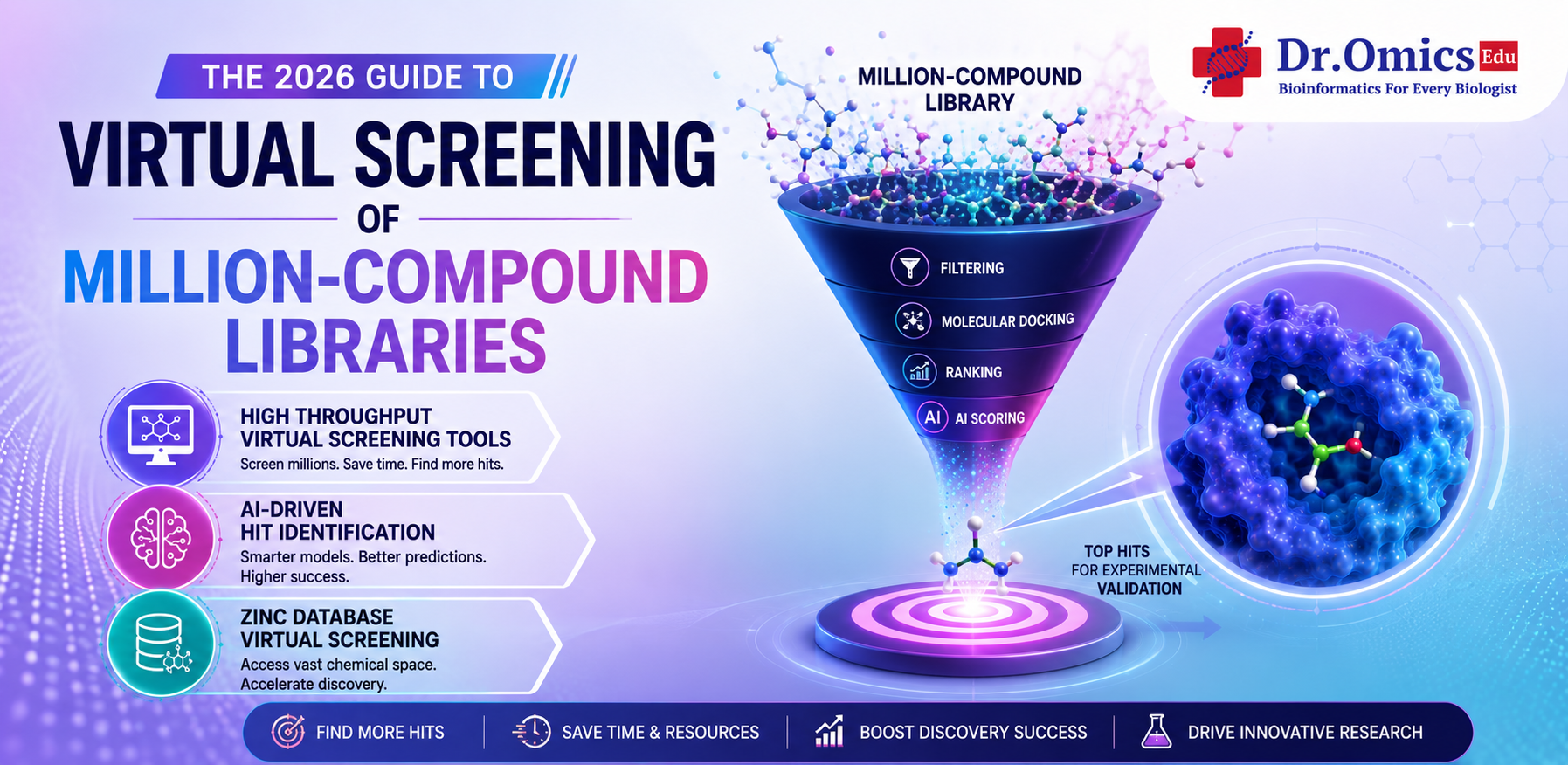
The 2026 Guide to Virtual Screening of Million-Compound Libraries
Dr. Omics Edu Team ·
The drug discovery landscape is evolving rapidly, and researchers can now screen millions of compounds in a fraction of the time required by traditional methods. With advances in artificial intelligence, cloud computing, and molecular modeling, virtual screening has become a cornerstone of modern drug discovery.
What is Virtual Screening?
Virtual screening is a computational technique used to identify potential drug candidates from large chemical libraries. Instead of testing compounds in the laboratory, researchers use software tools to predict which molecules are most likely to bind to a target protein.
High-Throughput Screening at Scale
Modern high-throughput virtual screening tools can evaluate millions of compounds efficiently, helping researchers prioritize the most promising candidates for further study. These platforms combine molecular docking, scoring functions, and advanced analytics to accelerate hit discovery.
The Role of AI in Hit Identification
One of the biggest trends in 2026 is AI-driven hit identification. Machine learning models can analyze vast chemical datasets, predict binding affinity, and identify novel compounds that may be overlooked by conventional screening methods.
This significantly reduces screening time while improving the quality of potential drug candidates.
Leveraging the ZINC Database
The ZINC database virtual screening workflow has become a popular approach among computational biologists and medicinal chemists. The ZINC database provides access to millions of commercially available compounds, making it an invaluable resource for large-scale virtual screening campaigns.
Why It Matters
Virtual screening enables researchers to:
- Identify promising drug candidates faster
- Reduce experimental costs
- Explore vast chemical spaces
- Improve hit-to-lead success rates
- Accelerate early-stage drug discovery
Final Thoughts
As computational power and AI technologies continue to advance, virtual screening of million-compound libraries is becoming faster, smarter, and more accessible. By combining high-throughput virtual screening tools, AI-driven hit identification, and ZINC database virtual screening, researchers can dramatically accelerate the search for the next generation of therapeutics.
The future of drug discovery lies in screening smarter—not just screening more.
