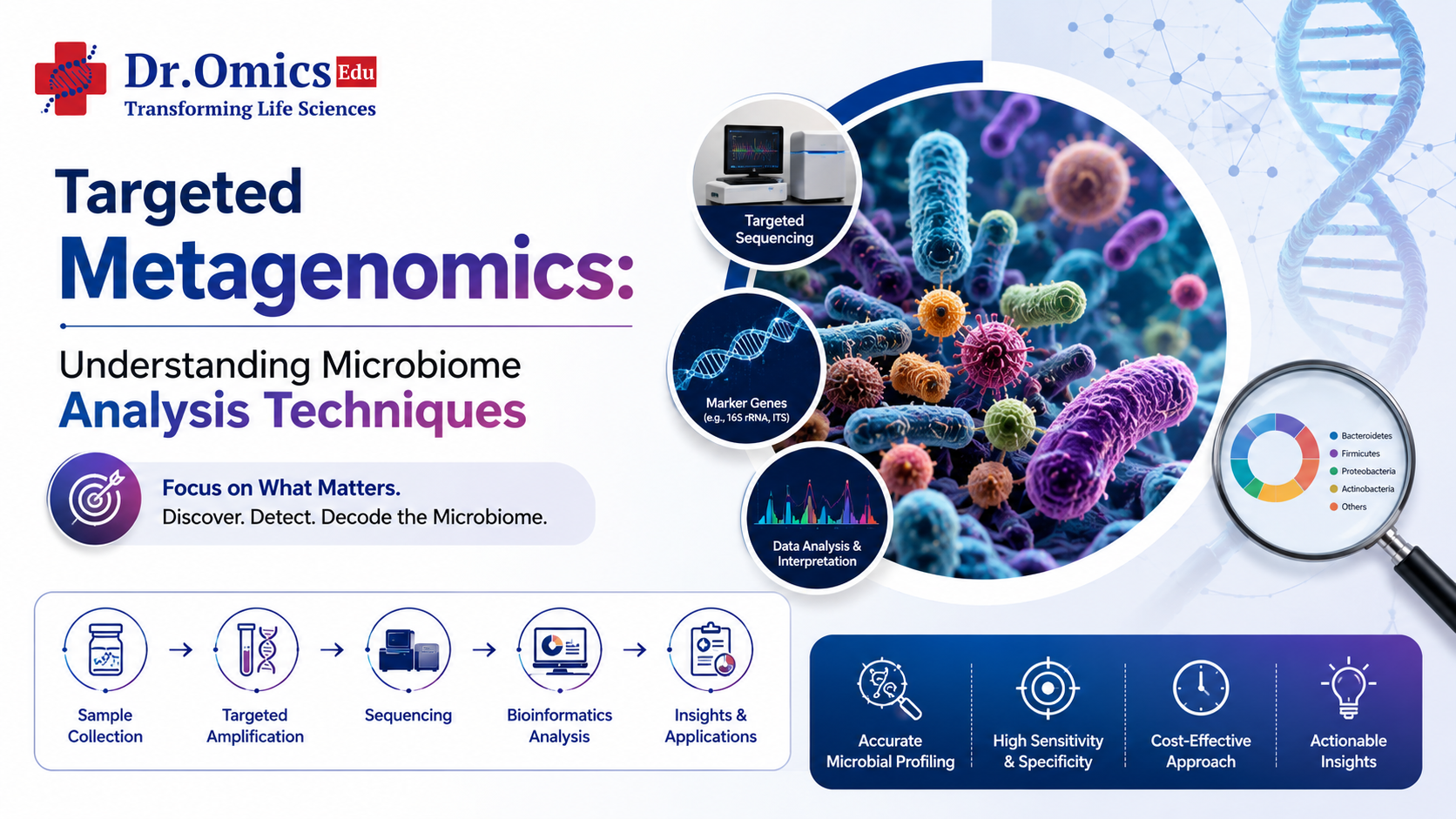
Targeted Metagenomics: Understanding Microbiome Analysis Techniques
Dr. Omics Edu Team ·
Microbial communities are present in virtually every ecosystem, from the human gut and skin to soil, oceans, wastewater, and industrial environments. Because many microorganisms cannot be easily cultured under laboratory conditions, sequencing-based approaches have become essential for studying microbial diversity. Targeted metagenomics is one such approach that enables researchers to characterize microbial communities by focusing on specific genetic markers.
What Is Targeted Metagenomics?
Targeted metagenomics refers to sequencing selected genomic regions that serve as molecular markers for identifying and classifying microorganisms. Instead of sequencing the entire microbial genome, researchers amplify a specific region using PCR and then sequence the resulting products.
One of the most widely used approaches is 16S rRNA sequencing, which targets conserved and variable regions of the bacterial and archaeal 16S ribosomal RNA gene. The conserved regions enable amplification across diverse microorganisms, while variable regions provide information useful for taxonomic classification.
How Does Targeted Metagenomics Work?
A typical targeted metagenomics workflow involves several major steps:
- Sample collection: Biological or environmental samples are collected under appropriate conditions.
- DNA extraction: Total microbial DNA is isolated from the sample.
- Target amplification: A specific marker region, such as 16S rRNA, is amplified using PCR.
- Library preparation and sequencing: Amplified DNA is prepared for sequencing using an appropriate sequencing platform.
- Quality control: Sequencing reads are assessed and filtered to remove low-quality sequences and technical artifacts.
- Taxonomic classification: Sequences are compared with reference databases to identify microorganisms.
- Microbial community analysis: Researchers investigate community composition, diversity, and differences between samples.
This workflow forms the foundation of many metagenomics analysis projects.
Targeted Metagenomics vs Shotgun Metagenomics
Understanding shotgun metagenomics vs targeted metagenomics is important when selecting a sequencing strategy.
Targeted approaches focus on specific marker genes and are generally cost-effective for studying microbial composition and taxonomic diversity. In contrast, shotgun metagenomics sequences DNA from across the microbial community, potentially providing information about species, genes, metabolic pathways, and functional potential.
Therefore, targeted sequencing is often suitable when the primary objective is microbial profiling, while shotgun approaches may be preferred for comprehensive taxonomic and functional characterization.
Applications in Microbiome Research
Microbiome analysis using targeted sequencing has applications across healthcare, agriculture, biotechnology, and environmental science. Researchers can investigate changes in microbial communities associated with disease, diet, treatment, soil characteristics, or environmental conditions.
Microbial community analysis commonly includes measurements of alpha diversity, beta diversity, relative abundance, and differential microbial composition. These analyses can reveal how microbial communities differ across individuals, locations, experimental conditions, or time points.
Targeted sequencing is also widely applied in environmental metagenomics, where microbial communities from soil, water, sediments, wastewater, and other ecosystems can be characterized.
Bioinformatics in Targeted Metagenomics
Metagenomics bioinformatics converts raw sequencing data into biologically meaningful information. Quality filtering, read processing, taxonomic assignment, diversity analysis, and visualization are important components of the computational workflow.
Researchers can use various metagenomics data analysis tools and databases for sequence processing, taxonomic classification, statistical analysis, and visualization. Familiarity with Linux, command-line workflows, statistical concepts, and reproducible analysis practices can further strengthen metagenomics skills.
Learning Metagenomics
For students and researchers interested in microbiology, biotechnology, genomics, or computational biology, a structured metagenomics course can provide practical exposure to sequencing workflows and downstream analysis. Learning both the biological principles and computational methods helps researchers understand not only which microorganisms are present, but also how microbial communities vary across samples.
Targeted metagenomics therefore remains a powerful and accessible strategy for exploring microbial diversity and understanding complex microbiomes across biological and environmental systems.
