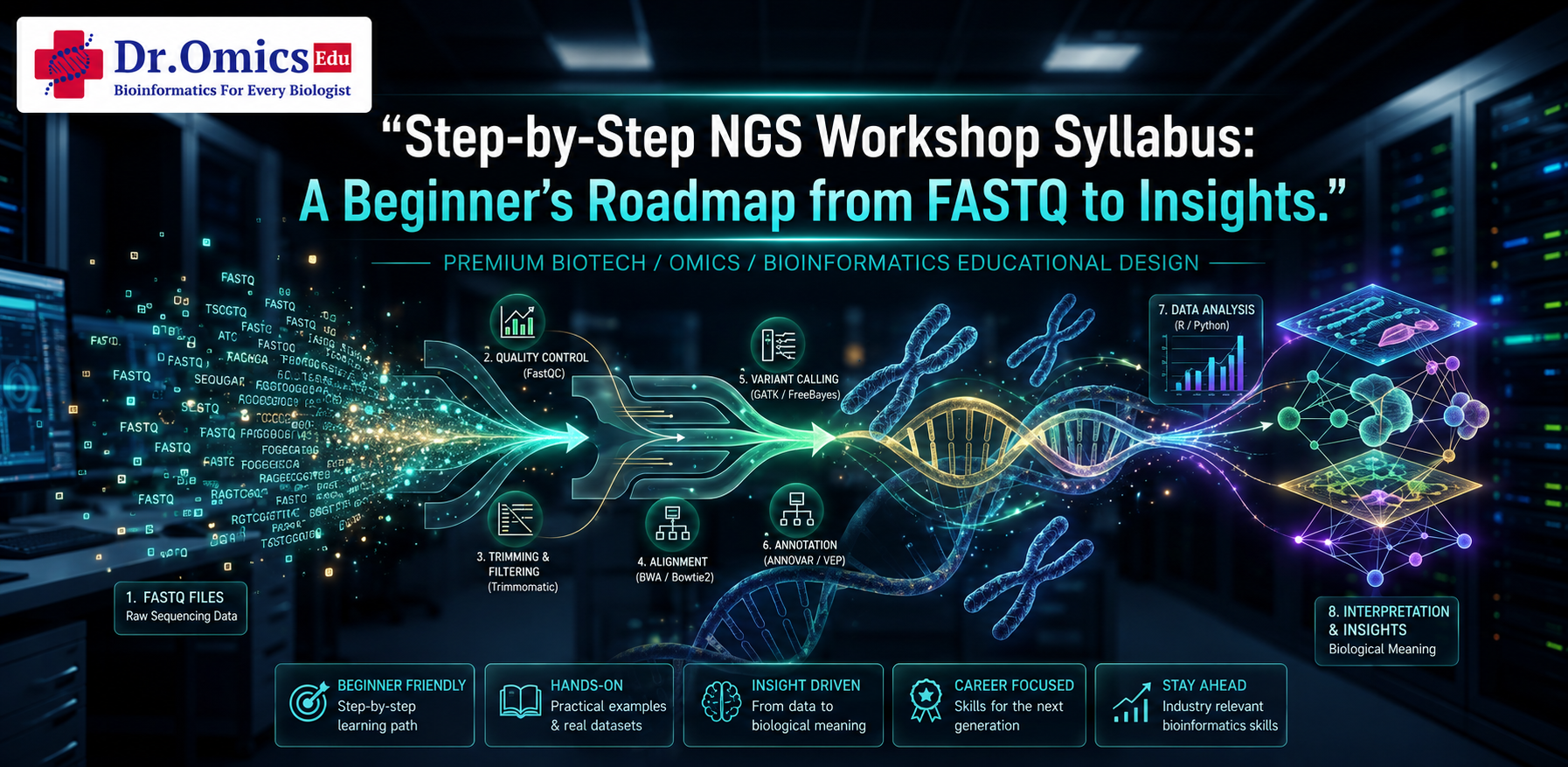
Step-by-Step NGS Workshop Syllabus: A Beginner’s Roadmap from FASTQ to Biological Insights
Dr. Omics Edu Team ·
Next-Generation Sequencing (NGS) has transformed modern biology by enabling researchers to study genomes, transcriptomes, and genetic variations at an unprecedented scale. Today, NGS is widely used in healthcare, cancer research, agriculture, drug discovery, and precision medicine. However, for beginners, analyzing sequencing data can be challenging due to the large datasets and complex bioinformatics tools involved. A structured NGS workshop provides the perfect foundation, helping participants progress from raw sequencing files to meaningful biological insights.
1. UNIX/Linux for NGS Beginners
Since most bioinformatics tools operate in a Linux environment, learning basic UNIX/Linux commands is the first step in any NGS training program. Participants learn file and directory management, data organization, and essential commands such as ls, cd, grep, and awk. Understanding Linux allows researchers to efficiently handle large sequencing datasets and run bioinformatics workflows on local systems or remote servers.
2. Understanding NGS Data and Quality Control
Every NGS analysis begins with raw sequencing data, typically stored in FASTQ files. This module introduces participants to sequencing technologies such as Illumina and explains the structure of FASTQ files, including sequence reads and quality scores.
Quality assessment is performed using tools like FastQC and MultiQC to evaluate read quality, GC content, duplication levels, and adapter contamination. Participants also learn trimming and filtering techniques using tools such as Trimmomatic or Fastp to remove low-quality sequences and improve downstream analysis accuracy.
3. Sequence Alignment and Genome Mapping
After quality control, sequencing reads are aligned to a reference genome using industry-standard tools such as BWA or Bowtie2. This step determines where each read originates within the genome and forms the basis for further analysis.
Participants gain hands-on experience with SAM and BAM file formats, sorting and indexing alignments using SAMtools, and evaluating mapping statistics. Understanding alignment quality and genome coverage is essential for generating reliable results in both DNA and RNA sequencing studies.
4. Variant Calling Workflow Essentials
Variant calling is one of the most important applications of NGS. It enables researchers to identify genetic variations such as Single Nucleotide Polymorphisms (SNPs), insertions, and deletions that may be associated with diseases or biological traits.
This module introduces preprocessing steps, duplicate removal, and variant detection using tools such as GATK and BCFtools. Participants also learn how to interpret Variant Call Format (VCF) files, understand quality metrics, and apply filtering strategies to identify high-confidence variants for downstream analysis.
5. RNA-Seq Analysis and Gene Expression Studies
RNA sequencing is widely used to investigate gene expression patterns and understand biological processes. Participants learn how RNA-Seq data differs from DNA sequencing data and explore a complete transcriptomics workflow.
The training covers read alignment using HISAT2 or STAR, gene quantification with FeatureCounts, and differential expression analysis using DESeq2. Learners also gain an introduction to pathway and functional enrichment analysis, helping them connect gene expression changes to biological functions and disease mechanisms.
6. Data Visualization and Biological Interpretation
The ultimate goal of NGS analysis is to generate meaningful biological insights. Therefore, the workshop includes training on data visualization techniques such as heatmaps, volcano plots, PCA plots, and clustering analyses. Participants also learn to use Integrative Genomics Viewer (IGV) for exploring genomic alignments and variants.
These visualization methods help researchers interpret complex datasets and create publication-ready figures for reports, research papers, and presentations.
Learning Outcomes and Career Benefits
By the end of the workshop, participants will be able to process raw FASTQ files, perform quality control, align sequencing reads, conduct variant calling, analyze RNA-Seq data, and interpret biological results. More importantly, they will gain practical experience with industry-standard bioinformatics tools and workflows used in academic research, biotechnology companies, pharmaceutical organizations, and healthcare institutions.
Conclusion
As genomics continues to drive innovation across life sciences, NGS data analysis has become an essential skill for researchers and students alike. A well-designed NGS workshop provides a structured pathway from raw sequencing data to biological discovery, equipping participants with the knowledge and confidence needed to work with modern genomic datasets. Whether your goal is research, higher education, or a career in bioinformatics, mastering NGS workflows is an important step toward success in the rapidly evolving field of genomics.
