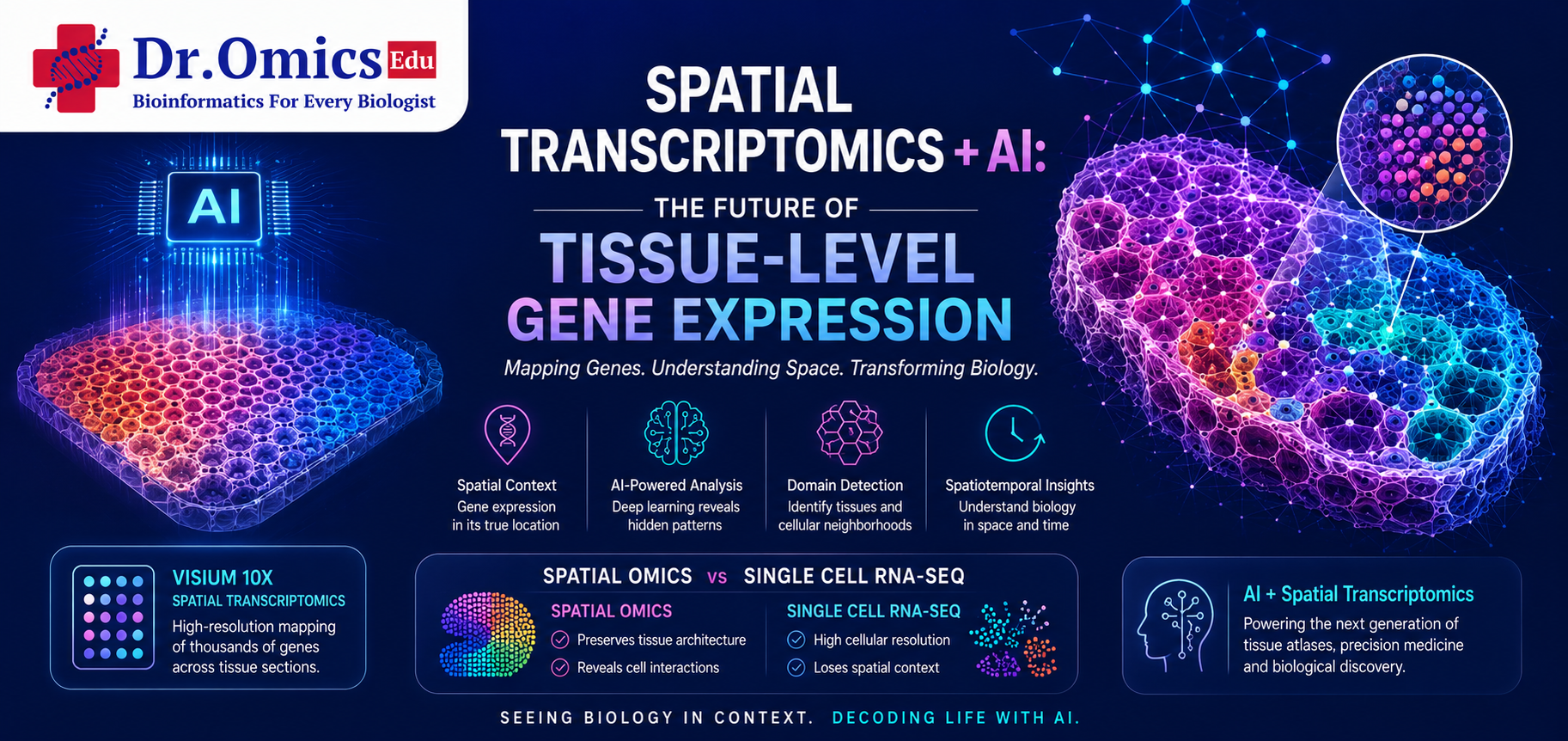
Spatial Transcriptomics + AI: The Future of Tissue-Level Gene Expression
Dr. Omics Edu Team ·
The field of genomics is rapidly evolving beyond traditional sequencing approaches. While single-cell RNA sequencing reveals which genes are expressed in individual cells, it often loses an important piece of information—the exact location of those cells within a tissue. This is where spatial transcriptomics AI 2026 is transforming biological research by combining gene expression data with spatial context.
What is Spatial Transcriptomics and How Does It Work?
What is spatial transcriptomics and how does it work? Spatial transcriptomics is an advanced technology that measures gene expression while preserving the physical location of cells within a tissue sample. Unlike conventional sequencing methods, researchers can visualize where genes are active and how neighboring cells interact.
Popular platforms such as Visium 10x spatial transcriptomics enable scientists to map thousands of genes across tissue sections, creating detailed molecular landscapes of organs, tumors, and developing tissues.
Why AI is Essential for Spatial Omics
Spatial transcriptomics experiments generate massive datasets containing gene expression profiles, cell locations, and tissue architecture information. Analyzing these complex datasets manually is nearly impossible.
Modern AI methods for spatial gene expression analysis 2026 leverage advanced machine learning algorithms to uncover hidden biological patterns, identify cellular neighborhoods, and predict tissue organization.
Applications include:
- Cell type identification
- Tissue architecture reconstruction
- Disease progression analysis
- Tumor microenvironment characterization
- Biomarker discovery
These innovations are driving the growth of spatial omics deep learning across research and clinical settings.
Graph Neural Networks and Spatial Domain Detection
One of the most exciting developments in this field is the use of graph neural network transcriptomics. Since neighboring cells influence each other's behavior, graph-based AI models can capture these spatial relationships more effectively than traditional methods.
These approaches improve spatial domain detection AI, allowing researchers to identify biologically meaningful tissue regions and cellular communities that may play critical roles in disease development and treatment response.
Spatial Omics vs Single-Cell RNA-Seq
A common question among researchers is spatial omics vs single cell RNA-seq comparison.
Single-Cell RNA-Seq | Spatial Transcriptomics |
High cellular resolution | Preserves tissue location |
Cell identities identified | Cell identities + spatial context |
Loses tissue architecture | Maintains tissue organization |
Focuses on individual cells | Focuses on cells and their neighborhoods |
Together, these technologies provide a more complete understanding of biological systems.
Building Tissue Atlases with AI
Researchers are increasingly using spatial biology tools 2026 to create comprehensive tissue atlas genomics resources. These atlases map cellular organization across healthy and diseased tissues, helping scientists understand development, aging, and disease progression.
Advanced frameworks such as STAMP SpaHDmap spatial AI are pushing the boundaries of spatial data integration, enabling more accurate visualization and interpretation of tissue-level gene expression patterns.
The Future: Spatiotemporal Transcriptomics
The next frontier is the spatiotemporal transcriptome, where researchers not only study where genes are expressed but also how expression patterns change over time. By combining spatial data with AI-driven predictive modeling, scientists can track tissue development, disease evolution, and treatment responses with unprecedented precision.
Conclusion
The combination of spatial transcriptomics AI 2026, spatial omics deep learning, and graph neural network transcriptomics is revolutionizing our understanding of biology. As AI continues to enhance tissue gene expression analysis, researchers are moving closer to building complete molecular maps of human tissues, unlocking new opportunities in precision medicine, cancer research, and regenerative biology.
The future of genomics is no longer just about understanding genes—it is about understanding genes in their biological context. And spatial transcriptomics powered by AI is leading the way.
