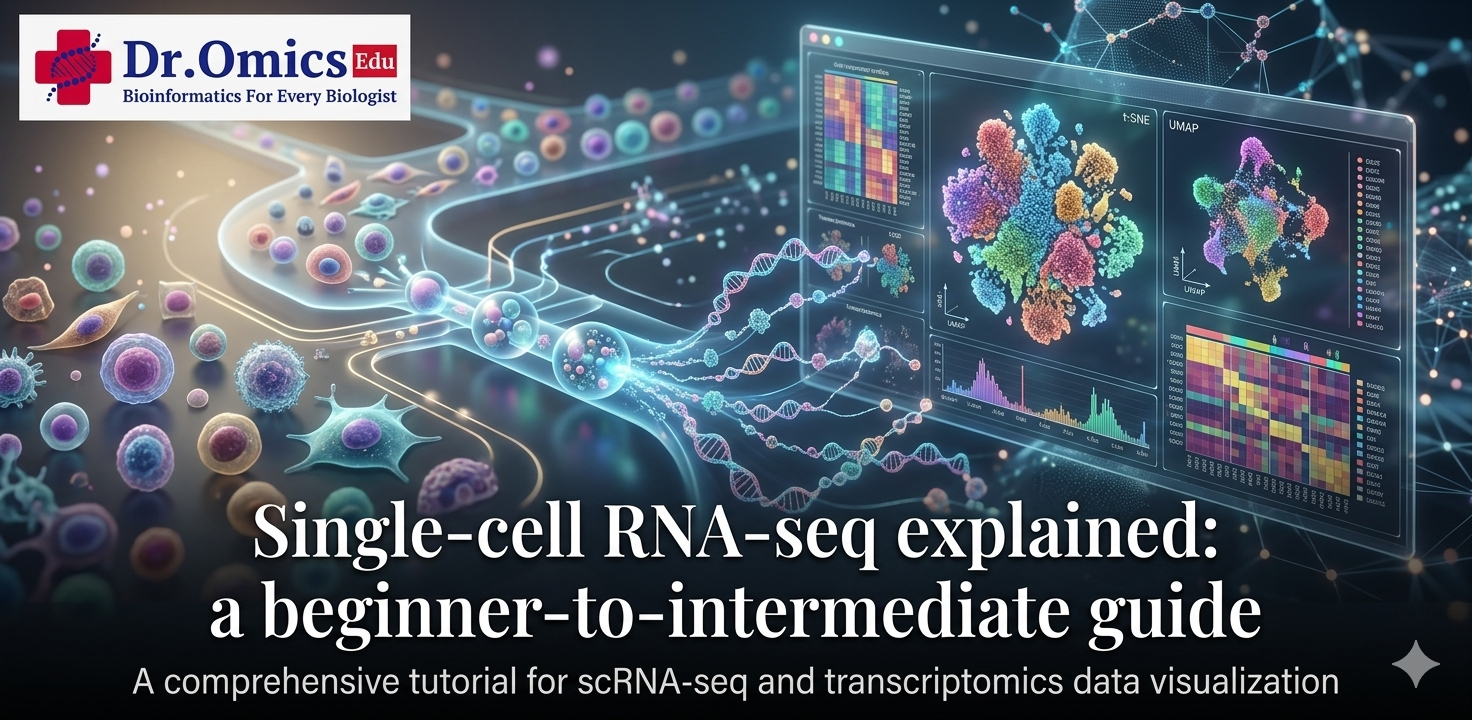
Single-cell RNA-seq explained: a beginner-to-intermediate guide
Dr. Omics Edu Team ·
A comprehensive single cell sequencing tutorial for biology students and researchers navigating the single cell transcriptomics workflow in 2026.
For years, transcriptomics relied on bulk RNA-sequencing. While bulk sequencing provides a valuable average of gene expression across thousands of cells, it masks the true diversity within a tissue. Imagine blending a bowl of assorted fruit into a smoothie; you know the overall flavor, but you lose the identity of the individual fruits.
The scRNA-seq vs bulk RNA-seq difference lies in resolution. Single-cell RNA sequencing (scRNA-seq) allows us to look at the individual "fruits" by measuring the exact gene expression profile of every single cell. In scRNA-seq analysis 2026, this technology has become standard practice for identifying rare cell types, mapping embryonic development, and understanding tumor heterogeneity.
Why Single-Cell Isolation Matters
To capture single-cell data, researchers must separate individual cells from a tissue sample without damaging them. A foundational approach involves platforms like the 10x Genomics Chromium tutorial workflows, which utilize microfluidics to capture individual cells inside oil droplets alongside unique barcoded beads.
Once isolated, the RNA from each cell is reverse-transcribed into cDNA, tagged with a cell-specific barcode, and sequenced. This process ensures that when you look at millions of sequencing reads later, you can trace every single transcript back to the exact cell it came from.
How to Analyze Single Cell RNA-seq Data Step by Step
Going from raw sequencing reads to a biological discovery requires a robust single cell transcriptomics workflow. If you are looking for a practical single cell RNA seq tutorial, the core downstream analysis steps generally follow this progression:
- Quality Control (QC): Filtering out dead cells or empty droplets by removing data with unusually high mitochondrial gene counts or too few detected genes.
- Normalization: Correcting for sequencing depth variations so cell-to-cell comparisons are scientifically accurate.
- Dimensionality Reduction scRNA: Compressing thousands of measured genes into manageable mathematical components using Principal Component Analysis (PCA).
- Visualization: Using non-linear algorithms for UMAP t-SNE bioinformatics plots to visualize high-dimensional data in a clear, 2D scatter plot.
- Cell Clustering Analysis: Grouping cells with similar expression profiles together to identify distinct cell states or populations.
- Single Cell Gene Expression Analysis: Identifying marker genes for each cluster to determine their biological identity (e.g., T-cells vs. B-cells).
Choosing Your Toolkit: Seurat vs. Scanpy
When diving into how to analyze single cell RNA seq data step by step, your choice of computational ecosystem matters. The two industry-standard scRNA-seq tools 2026 are Seurat and Scanpy.
A standard Seurat Scanpy tutorial comparison highlights that Seurat is an R-based package highly favored by biology students for its intuitive, comprehensive design. On the other hand, Scanpy is a Python-based framework built to handle exceptionally large datasets with rapid execution times. Both pipelines offer excellent documentation for any single cell sequencing beginner looking to build reliable analysis pipelines.
Final Thoughts
Mastering single-cell analysis is one of the most valuable skill sets in modern biomedical research. By breaking past the limitations of bulk averages, scRNA-seq empowers researchers to discover entirely new cell types and track cellular transitions in real time. For any student or scientist, learning these computational workflows today is the key to unlocking the future of cellular biology.
