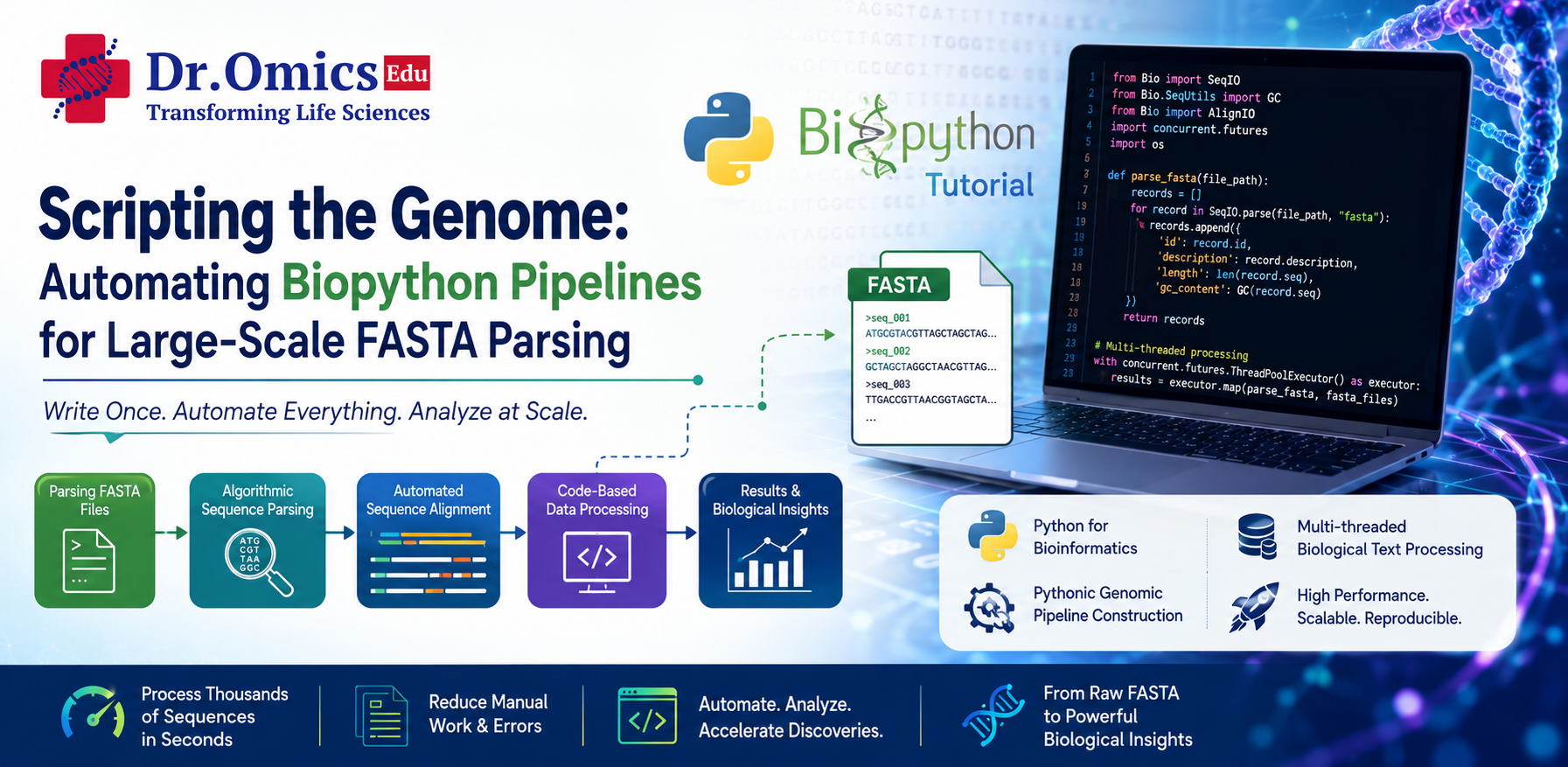
Scripting the Genome: Automating Biopython Pipelines for Large-Scale FASTA Parsing
Dr. Omics Edu Team · · Updated
The explosion of next-generation sequencing (NGS) technologies has generated an unprecedented volume of genomic data. From whole-genome sequencing and RNA sequencing to metagenomics and comparative genomics, researchers now process millions of biological sequences every day. Managing these datasets manually is no longer practical, making automation a fundamental skill for modern bioinformatics. By combining Python for bioinformatics with the powerful Biopython library, researchers can create efficient, reproducible, and scalable workflows that accelerate biological discoveries while reducing manual effort.
Why Automate FASTA Processing?
FASTA is one of the most widely used file formats for storing nucleotide and protein sequences, making it the starting point for numerous bioinformatics analyses. However, extracting information from thousands of FASTA files manually is slow, repetitive, and susceptible to errors.
A well-structured Biopython tutorial introduces researchers to efficient methods for parsing FASTA files Python, enabling rapid extraction of sequence IDs, sequence lengths, GC content, motifs, and other biologically relevant information. Automation also standardizes data processing, ensuring consistent results across multiple experiments and collaborative projects.
Building Pythonic Genomic Pipelines
Biopython provides a rich collection of modules that simplify genomic data handling. Using the SeqIO module, researchers can build pythonic genomic pipeline construction workflows capable of:
- Parsing thousands of FASTA sequences within seconds.
- Filtering sequences based on length, quality, or biological characteristics.
- Calculating sequence statistics automatically.
- Organizing genomic datasets for downstream analyses.
- Preparing data for RNA-Seq, variant analysis, phylogenetics, comparative genomics, and functional annotation.
- Integrating seamlessly with Linux-based bioinformatics pipelines and workflow management systems.
These automated workflows enable robust code-based biological data processing, eliminating repetitive manual tasks while improving productivity and reproducibility.
From Parsing to Intelligent Sequence Analysis
Modern genomic pipelines extend well beyond reading sequence files. Through algorithmic sequence parsing, researchers can automate motif discovery, open reading frame (ORF) prediction, sequence translation, restriction site identification, and sequence validation before moving to downstream analyses.
These pipelines can also integrate automated sequence alignment using tools such as BLAST, MUSCLE, MAFFT, or Clustal Omega, enabling rapid comparison of DNA, RNA, and protein sequences. By chaining multiple analytical steps into a single workflow, researchers minimize human intervention while increasing analytical accuracy.
For large-scale genomic projects, multi-threaded biological text processing allows multiple FASTA files to be processed simultaneously, dramatically reducing execution time and making high-throughput sequencing projects computationally efficient.
Why Python and Biopython Are Becoming Essential
Python has become one of the most widely adopted programming languages in bioinformatics due to its readability, extensive scientific libraries, and active open-source community. Biopython complements Python by providing specialized modules for sequence manipulation, database access, file parsing, structural biology, and biological data analysis.
Whether working in genomics, transcriptomics, proteomics, or metagenomics, researchers increasingly rely on Python-based automation to build reproducible pipelines that can scale with growing biological datasets. These scripting skills also integrate seamlessly with workflow management platforms, cloud computing, and high-performance computing (HPC) environments.
Future Perspective
The future of bioinformatics lies in intelligent, automated, and AI-assisted data analysis. As sequencing technologies continue to advance, genomic datasets will become even larger and more complex. Future Python for bioinformatics pipelines will increasingly integrate machine learning, cloud computing, workflow automation, and real-time biological data processing. Combining Biopython with technologies such as Nextflow, Snakemake, and AI-driven analytical tools will enable researchers to build highly scalable pipelines capable of analyzing thousands of genomes with minimal manual intervention. Automation will not only accelerate research but also improve reproducibility, collaboration, and the translation of genomic discoveries into precision medicine and personalized healthcare.
Conclusion
Automation has become a cornerstone of modern genomics. By mastering Python for bioinformatics and learning advanced techniques for parsing FASTA files Python, researchers can efficiently process large-scale biological datasets with speed and accuracy. From algorithmic sequence parsing and code-based biological data processing to automated sequence alignment and multi-threaded biological text processing, Biopython provides the tools needed to build reliable and scalable genomic workflows. As bioinformatics continues to evolve, developing strong programming and automation skills will be essential for researchers seeking to unlock the full potential of biological data and drive the next generation of genomic discoveries.
