RNA-seq vs Microarray: Which Should You Use in 2026?
Dr. Omics Edu Team ·
Gene expression analysis has become a cornerstone of modern biological research, helping scientists understand how genes behave under different conditions. Among the most popular transcriptome profiling methods, RNA-seq and microarrays remain widely used. But in 2026, which platform should you choose?
Understanding the Technologies
Microarrays (such as Affymetrix microarrays) measure gene expression by hybridizing RNA samples to pre-designed probes. They are limited to known genes but offer a cost-effective solution for many studies.
RNA-seq, on the other hand, uses next-generation sequencing (NGS) to directly sequence RNA molecules, providing a more comprehensive view of the transcriptome.
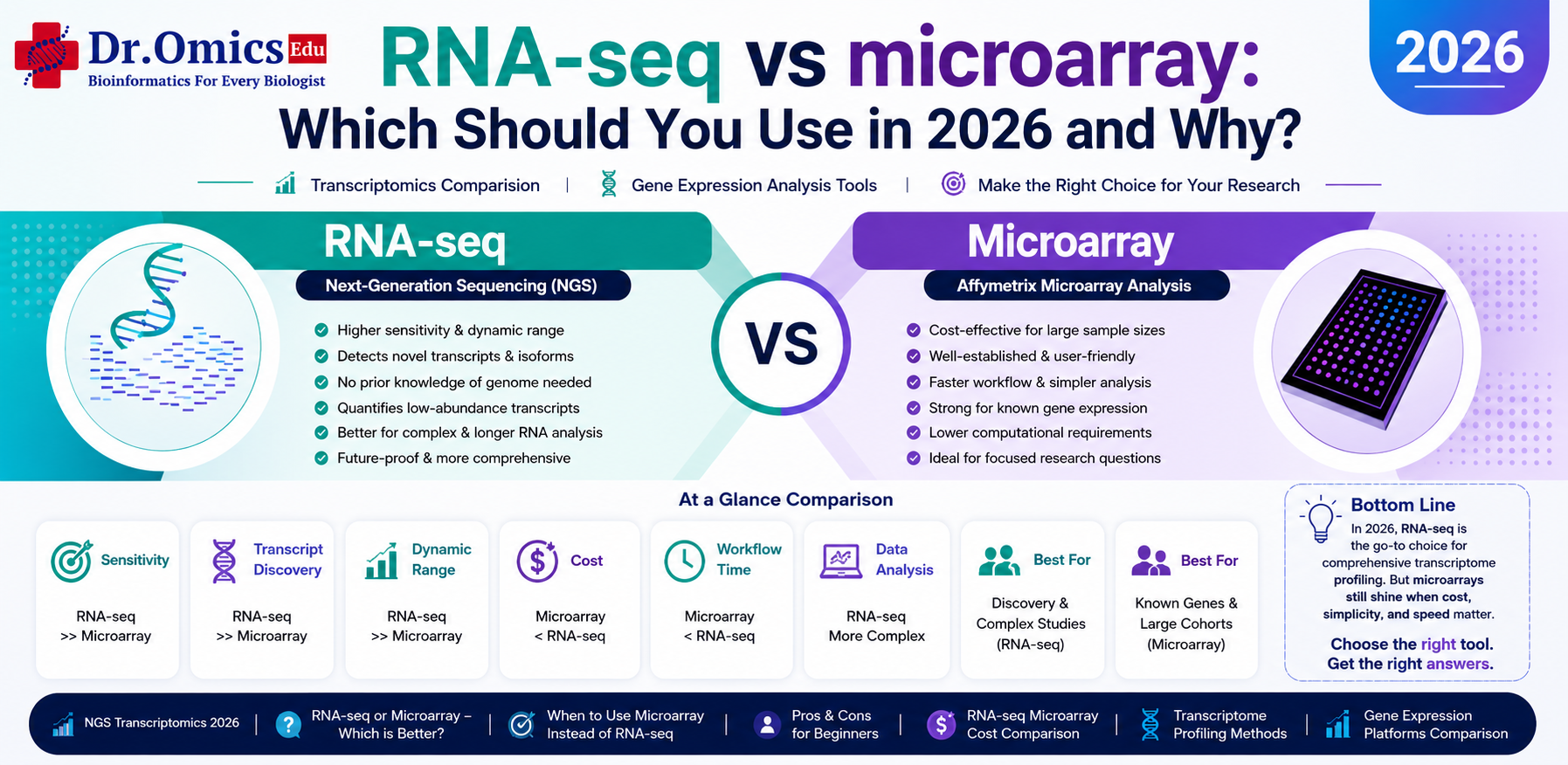
RNA-seq vs Microarray: Key Differences
Feature | ||
Detects known genes | ✅ | ✅ |
Detects novel transcripts | ✅ | ❌ |
Sensitivity | High | Moderate |
Alternative splicing analysis | ✅ | Limited |
Dynamic range | Wide | Narrow |
Cost per sample | Higher | Lower |
Data analysis complexity | Higher | Lower |
One of the biggest advantages of RNA-seq is its ability to detect previously unknown transcripts, splice variants, and low-abundance genes. This makes it the preferred technology for most new transcriptomics projects.
Why Researchers Prefer RNA-seq in 2026
With decreasing sequencing costs and improved bioinformatics pipelines, RNA sequencing advantages continue to grow:
- Higher sensitivity and accuracy
- Discovery of novel genes and transcripts
- Better detection of rare and low-expression genes
- Comprehensive transcriptome coverage
- Compatibility with AI-driven and multi-omics analyses
A typical bulk RNA-seq workflow includes RNA extraction, library preparation, sequencing, quality control, alignment, quantification, and differential gene expression analysis.
When Should You Use Microarrays?
Despite the rise of RNA-seq, microarrays are not obsolete. They are still useful when:
- Budget is a major constraint
- Studying well-characterized genes
- Analyzing very large sample cohorts
- Comparing results with historical microarray datasets
For routine expression profiling of known genes, microarrays can provide reliable results at a lower cost.
Cost vs Performance
The RNA-seq microarray cost comparison often comes down to project goals. While microarrays remain cheaper, RNA-seq delivers significantly more information per experiment. For discovery-based studies, the additional investment in RNA-seq is usually justified by the richer dataset generated.
Final Verdict
For most new gene expression analysis projects in 2026, RNA-seq is the preferred choice because of its superior sensitivity, broader transcriptome coverage, and ability to identify novel biological insights. However, microarrays remain a practical option for budget-limited studies focused on known genes.
Bottom line: If your goal is comprehensive transcriptomics research, choose RNA-seq. If cost is the primary concern and your targets are already known, microarrays can still be an effective solution.
