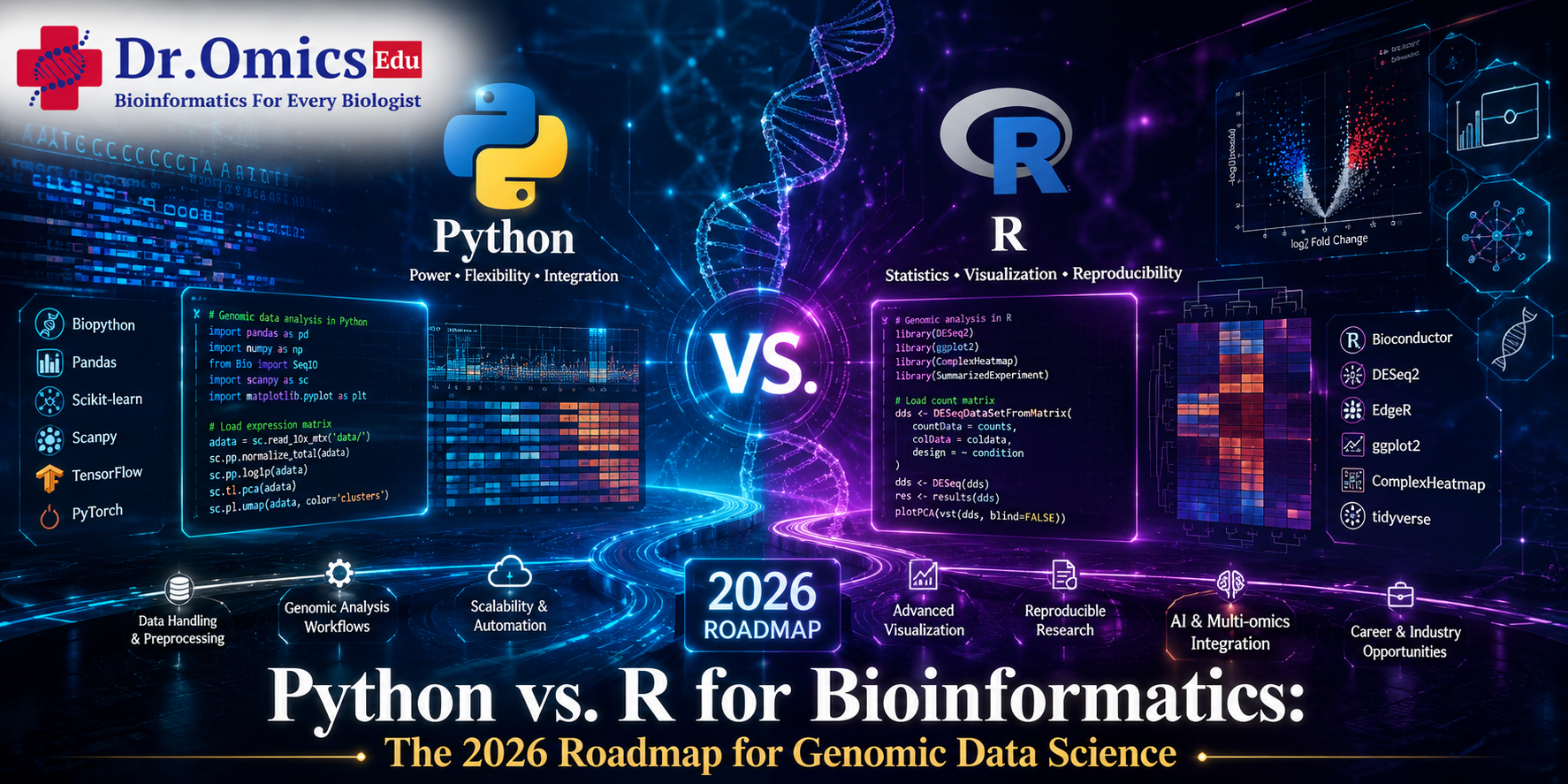
Python vs. R for Bioinformatics: The 2026 Roadmap
Dr. Omics Edu Team ·
In 2026, the "Python vs. R" debate has shifted from competition to collaboration. As genomic datasets cross the petabyte scale, the most successful data scientists are those who use a hybrid approach: Python for heavy-duty data engineering and AI, and R for specialized statistical inference and publication-quality visuals.
1. Python for Genomic Data Science: The Infrastructure King
Python has become the undisputed leader for building scalable, production-ready pipelines. Its 2026 ecosystem is heavily focused on AI integration and cloud-native workflows.
- Biopython for Sequence Analysis: The Biopython library remains the core tool for handling biological files. In 2026, it is primarily used for:
- Parsing Complex Formats: Handling FASTA, GenBank, and PDB files with high-speed C-extensions.
- Programmatic Database Access: Using the Bio.Entrez module to automate the retrieval of millions of records from NCBI.
- Automating NGS Workflows: Python is the "glue" for automation. It is now standard to use Python to manage Nextflow or Snakemake pipelines, allowing for:
- Dynamic Resource Allocation: Scripts that automatically adjust memory/CPU limits based on the input FastQ file size.
- API Integration: Seamlessly connecting sequencers to cloud storage (AWS S3/Google Bucket) and LIMS (Laboratory Information Management Systems).
2. R Bioconductor: The Statistical Powerhouse
If Python builds the pipeline, R interprets the results. Bioconductor remains the world’s most comprehensive repository for high-throughput genomic data analysis.
- R Bioconductor Tutorial (2026 Focus): Modern tutorials emphasize the "Tidy" approach to genomics.
- Single-Cell Mastery: Using Seurat or SingleCellExperiment for cell-type clustering and trajectory analysis.
- Differential Expression: DESeq2 and edgeR are still the gold standards for RNA-seq, offering rigorous statistical frameworks that Python's statsmodels often lacks.
- Visualization: R’s ggplot2 and ComplexHeatmap are unrivaled for creating the multi-layered, publication-ready plots required by top-tier journals like Nature and Cell.
3. Coding for Biologists: A Beginner’s Course Outline
For those starting their journey in 2026, the most effective coding for biologists beginner courses follow a 4-week hybrid model:
- Week 1: Linux & Bash Foundations: Learning to navigate the server and run basic command-line tools like samtools or bedtools.
- Week 2: Python Basics for DNA: Mastering loops, lists, and functions to calculate GC content or find Open Reading Frames (ORFs).
- Week 3: Data Wrangling with Pandas & Tidyverse: Learning to clean massive spreadsheets and filter genomic variants.
- Week 4: Applied Statistics & Plotting: Using R to perform t-tests and generate box plots or volcano plots.
4. Comparison at a Glance: 2026 Industry Trends
| Feature | Python (Genomic Data Science) | R (Bioconductor / Stats) |
| Best For | Pipeline Automation, AI/ML, Large-scale data engineering | Statistical testing, Clinical diagnostics, Visualization |
| Key Library | Biopython, Pandas, Scikit-learn | Bioconductor, DESeq2, ggplot2 |
| Learning Curve | Easy (English-like syntax) | Moderate (Statistician-focused) |
| Scalability | High (Cloud-native / Production) | Moderate (Memory-intensive) |
Conclusion: The Hybrid Advantage
The "Roadmap for 2026" is clear: Learn Python first to build your technical foundation and automate your work, then master R Bioconductor to perform the high-level statistical analysis that leads to biological discovery. In the modern genomic era, the most valuable analyst is the one who can write a Python script to process 1,000 samples and an R script to prove the result is statistically significant.
