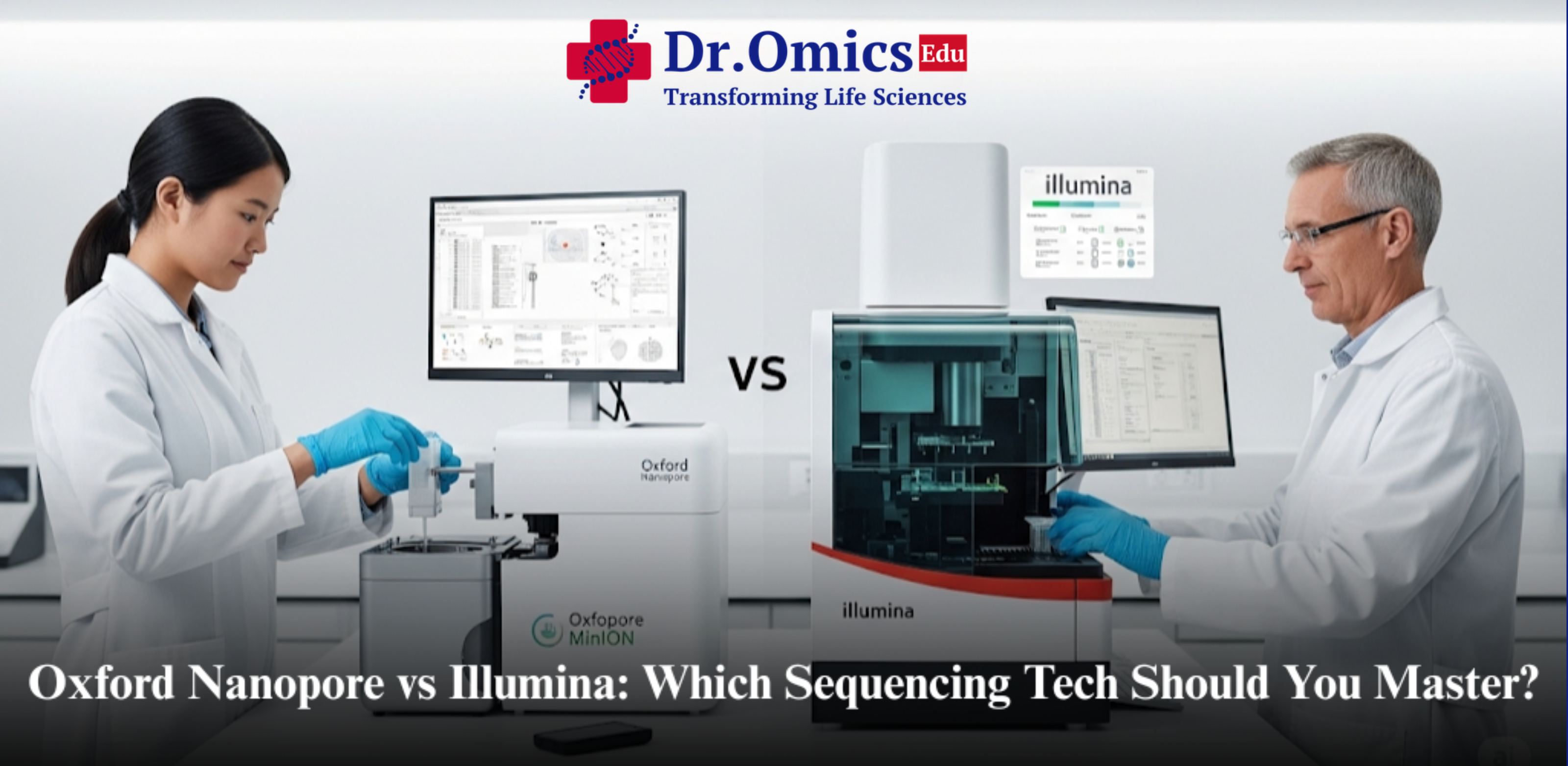
"Oxford Nanopore vs Illumina: Which Sequencing Tech Should You Master?
As next-generation sequencing (NGS) becomes more pervasive, a critical career decision for bioinformaticians and genomic scientists is which core technology to master. The choice between the established dominance of Illumina and the innovative rise of Oxford Nanopore Technologies (ONT) shapes the analytical tools you'll use, the biological questions you can answer, and your professional trajectory. This guide provides a detailed comparison to inform your learning strategy, whether you're planning DNA-seq course registration 2025, seeking the best NGS courses for beginners, or advancing to a specialized long-read sequencing workshop. We'll explore the technical distinctions, practical applications, and optimal learning pathways for each.
Illumina: The High-Throughput, High-Precision Workhorse
Illumina's sequencing-by-synthesis technology generates massive volumes of short reads (typically 75-300 bp) with exceptionally high per-base accuracy (>99.9%). This paradigm has defined modern genomics for over a decade.
Core Strengths and Dominant Applications
- Accuracy & Reproducibility: Unmatched base-level precision makes it the gold standard for detecting single nucleotide variants (SNVs) and small indels, critical in clinical diagnostics and population genetics.
- Cost-Efficiency at Scale: Extremely low cost-per-gigabase enables large cohort studies, making it ideal for whole genome sequencing analysis tutorial projects involving hundreds or thousands of samples.
- Mature Analytical Ecosystem: A vast, well-established suite of tools (e.g., BWA-MEM, GATK) and DNA-seq pipeline step-by-step guides exist, lowering the barrier to entry and ensuring reproducible analysis.
Ideal For: Variant discovery in human genetics, bulk RNA-seq differential expression, ChIP-seq, 16S microbiome profiling, and any high-throughput application where cost-per-sample is paramount.
Oxford Nanopore: The Long-Read, Real-Time Disruptor
ONT's technology passes DNA/RNA through a protein nanopore, measuring electrical current changes to determine sequence. It produces long reads (often 10+ kilobases, up to several megabases) in real-time.
Core Strengths and Transformative Applications
- Long-Read Resolution: Reads span repetitive regions, complex structural variants (SVs), and full-length transcripts, enabling telomere-to-telomere genome assembly, precise SV detection, and isoform-resolved transcriptomics.
- Real-Time Sequencing: Data streams as the experiment runs, enabling rapid pathogen identification, adaptive sampling (selective sequencing), and immediate quality assessment.
- Portability & Flexibility: Devices range from the pocket-sized MinION to high-throughput PromethION, allowing sequencing in field labs, clinics, or even remote environments.
Ideal For: De novo genome assembly (especially for non-model organisms), resolving complex cancer genomes, detecting epigenetic modifications natively, and real-time infectious disease surveillance.
Direct Comparison: A Decision Matrix
| Factor | Illumina (Short-Read) | Oxford Nanopore (Long-Read) |
| Read Length | Short (75-300 bp) | Very Long (kb to Mb scale) |
| Accuracy | Very High (>99.9% per base) | Lower (~95-98%); improved by high coverage & new chemistries |
| Throughput | Extremely High (Gb/run) | High (Gb/run on PromethION) |
| Speed | Batch, hours/days for full run | Real-time, minutes to hours for first data |
| Portability | Benchtop instruments | Portable (MinION) to benchtop |
| Primary Cost | Low cost per base | Higher cost per base, lower capital cost (MinION) |
| Key Analytical Output | SNVs, small indels, gene expression counts | Structural variants, genome assemblies, methylation, haplotypes |
Designing Your Learning Pathway: From Beginner to Specialist
Your educational investment should align with your career stage and interests.
Starting Point: Build a Foundation with Illumina
For those new to the field, beginning with Illumina is highly recommended. The best NGS courses for beginners focus on this technology because:
- It teaches universal DNA-seq pipeline step-by-step concepts: quality control (FastQC), alignment, variant calling, and annotation.
- The analytical principles (handling sequencing errors, coverage depth, statistical testing) are transferable.
- It provides immediate relevance to the majority of industry and academic job postings.
Complete a foundational whole genome sequencing analysis tutorial using Illumina data to solidify these core competencies.
Advanced Specialization: Mastering Long-Read Analysis
Once fundamentals are secure, adding Oxford Nanopore skills differentiates you. Seek an advanced long-read sequencing workshop that covers:
- Specialized Tools: Using Minimap2 for alignment, Flye or Shasta for assembly, and Sniffles for SV detection.
- Data Characteristics: Learning to manage higher error rates and leverage consensus approaches for polishing.
- Integrated Analyses: Combining short and long reads for hybrid assembly or variant phasing.
This specialization is invaluable for roles in genomics research institutes, agricultural biotech, or infectious disease surveillance.
Career Alignment: Which Technology Serves Your Goals?
- Clinical Diagnostics & Pharma: Illumina dominance is strong due to its accuracy and regulatory familiarity. Skills in GATK and panel/whole exome analysis are key.
- Academic Research & Novel Discovery: Oxford Nanopore is increasingly critical for exploratory science in evolution, complex disease, and microbiology. Hybrid skills are a major asset.
- Public Health & Field Science: Oxford Nanopore's portability and real-time nature make it ideal for outbreak tracking and environmental genomics.
When reviewing DNA-seq course registration 2025 options, evaluate the curriculum's balance between these technologies based on your target sector.
Conclusion: Strategic Mastery for the Future of Genomics
The debate isn't about which technology is "better," but which is right for your specific goals. Illumina offers a proven, scalable, and precise framework ideal for building foundational bioinformatics skills through structured NGS courses. Oxford Nanopore provides a powerful, flexible toolkit for tackling genomics' most complex challenges and is the focus of cutting-edge long-read sequencing workshops.
The most forward-looking professionals cultivate competency in both. Start by mastering the DNA-seq pipeline step-by-step with Illumina to understand the core paradigms of NGS data analysis. Then, strategically expand into long-read analysis to unlock new dimensions of genomic investigation. By making an informed choice aligned with your research passions and career vision, you position yourself at the forefront of genomic discovery.
