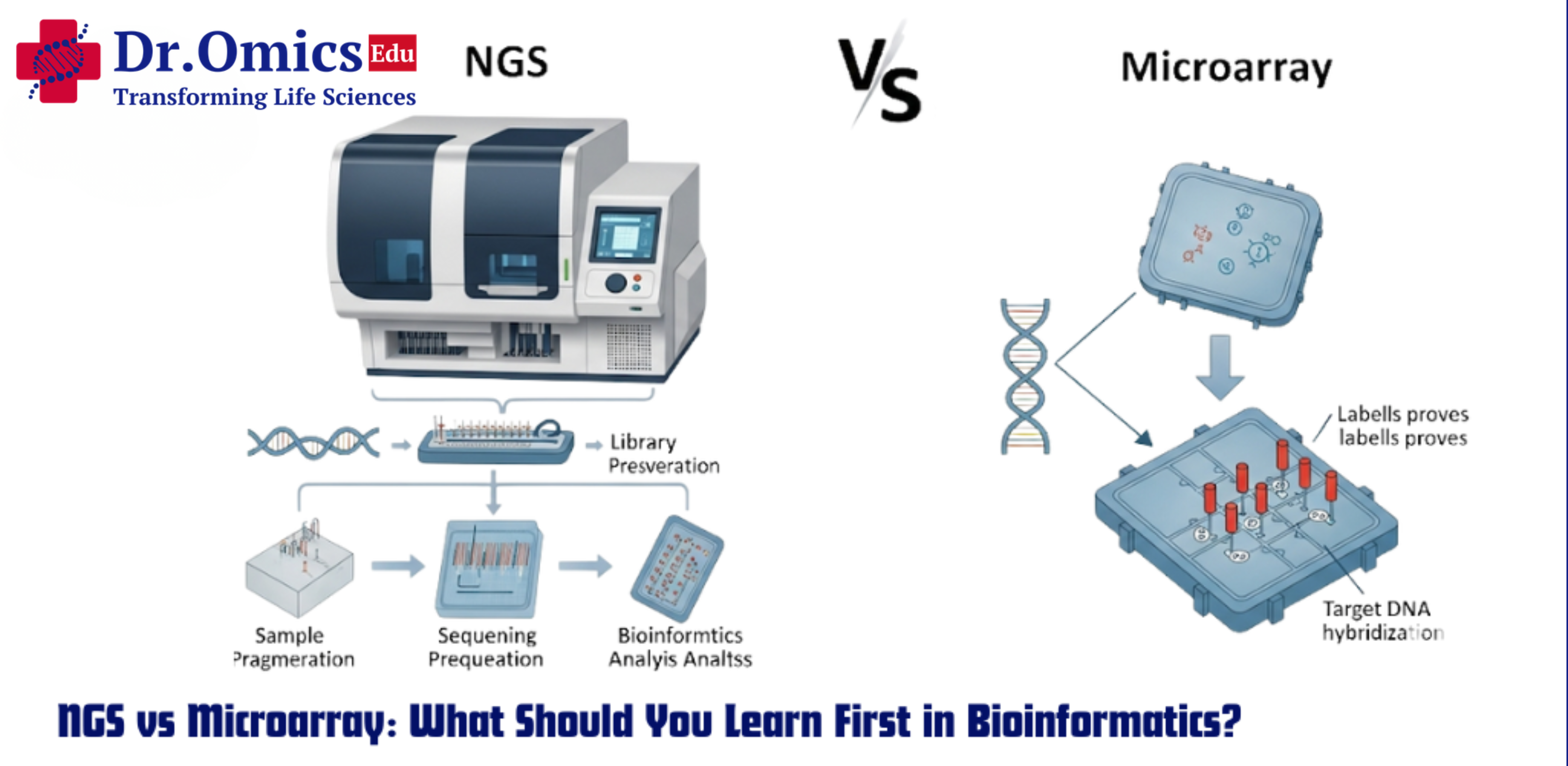
NGS vs Microarray: What Should You Learn First in Bioinformatics?
Entering the field of bioinformatics requires navigating a landscape of powerful but complex technologies. A common and critical question for students and career-changers is: "Should I learn Next-Generation Sequencing (NGS) or Microarray analysis first?" This decision isn't about which technology is "better," but which provides the most effective on-ramp for your bioinformatics learning journey while aligning with your career trajectory. This guide provides a detailed genomics technologies comparison, examining the technical foundations, skill requirements, and career relevance of each to help you build a logical and effective learning path.
Understanding the Core Technologies
Microarray Analysis: The Targeted, Established Platform
Microarrays are a hybridization-based technology that measures the abundance of predefined nucleic acid sequences. They are synonymous with gene expression profiling and genotyping.
- Data Output: Intensity values for thousands of known probes, resulting in a numerical matrix.
- Primary Use Cases: Differential gene expression studies, SNP genotyping, copy number variation analysis.
- Analytical Characteristics: Analysis focuses on normalization (RMA, quantile), statistical modeling for differential expression (using the limma package in R), and functional enrichment.
- Learning Curve: Relatively gentle. The analysis workflow is standardized, often using GUI tools like GEO2R or well-documented R/Bioconductor packages. It's an excellent way to grasp fundamental concepts of experimental design, statistical testing, and biological interpretation without the overhead of raw data processing.
Next-Generation Sequencing (NGS): The Comprehensive, Discovery Engine
NGS involves fragmenting DNA/RNA, sequencing millions of fragments in parallel, and computationally reconstructing the data.
- Data Output: Raw sequence reads (FASTQ files), leading to aligned reads (BAM files) and variant calls (VCF files).
- Primary Use Cases: Whole genome/exome sequencing, RNA-seq (for expression and splicing), ChIP-seq, metagenomics, single-cell genomics.
- Analytical Characteristics: Analysis is a multi-step pipeline involving quality control (FastQC), alignment (STAR, BWA), quantification, and advanced statistical testing (DESeq2, GATK).
- Learning Curve: Steeper. It requires comfort with the command line, scripting, and managing large data files. It teaches a broader, more foundational skill set in computational genomics.
Direct Comparison: Key Differentiators
| Aspect | Microarray | Next-Generation Sequencing (NGS) |
| Discovery Potential | Limited to predefined probes. | High. Can identify novel variants, transcripts, and features. |
| Data Complexity | Lower. Analyzed intensity matrices. | High. Raw sequence reads, complex file formats (FASTQ, BAM, SAM). |
| Typical Cost | Lower per sample. | Higher per sample (though decreasing). |
| Core Skills Taught | Statistical analysis, experimental design. | Pipeline development, command-line proficiency, scalable data analysis. |
| Industry Relevance | High for legacy data & focused applications. | Dominant in modern research, clinical diagnostics, and drug discovery. |
The Learning Path Decision: A Goal-Oriented Framework
Start with Microarray Analysis If:
Your primary goal is to quickly understand the core bioinformatics workflow of a differential expression study. This path is ideal if:
- You are new to programming and statistics and need a context to learn R and basic concepts.
- You want to work with the vast amount of publicly available Gene Expression Omnibus (GEO) data for practice and publication.
- Your immediate projects or lab work involve analyzing existing microarray datasets.
- You seek a clear, contained project (from normalized data to a list of significant genes) to build initial confidence.
Tools to Master: R, Bioconductor, limma, GEOquery, ggplot2 for visualization.
Start with NGS Analysis If:
Your goal is to build long-term, industry-relevant skills and engage with the cutting edge of genomics. This is the right choice if:
- You are comfortable with or determined to learn the command line and scripting.
- You aim for roles in modern genomics labs, core facilities, or biotech/pharma, where NGS is the standard.
- You are interested in variant discovery, genome assembly, or metagenomics.
- You understand that initial learning will involve more "data engineering" (quality control, alignment) before reaching biological interpretation.
Tools to Master: Linux command line, FastQC, Trimmomatic, STAR/HISAT2 (RNA-seq), BWA (DNA-seq), GATK, DESeq2, SAMtools, and workflow managers like Snakemake.
The Integrated View: Why Understanding Both is Valuable
While NGS is the present and future, microarrays are not obsolete. A competent bioinformatician should understand both bioinformatics platforms because:
- Legacy Data: Millions of microarray experiments in public repositories remain a valuable resource for meta-analysis and validation.
- Focused Applications: For high-throughput, targeted screening (e.g., genotyping arrays in population studies), microarrays are still cost-effective.
- Conceptual Foundation: The statistical principles learned from microarray analysis (e.g., linear models for differential expression) are directly applicable to analyzing count data from RNA-seq.
Recommended Learning Trajectory for Career Readiness
Given the dominance of NGS, a strategic bioinformatics learning path might look like this:
- Foundation: Gain basic proficiency in R and statistics. Use a simple microarray dataset from GEO to run a differential expression analysis with limma. This solidifies the "why" behind the analysis.
- Core NGS Skills: Immediately transition to a beginner RNA-seq tutorial. Process a small public dataset from raw FASTQ files through alignment, quantification, and differential expression with DESeq2. This builds the essential pipeline skills.
- Specialization: Branch into your area of interest—DNA-seq variant calling, single-cell RNA-seq, or metagenomics—building on the NGS fundamentals.
This approach ensures you understand the statistical concepts while building the technical skills that are in highest demand.
Conclusion: Building a Future-Proof Skill Set
The NGS vs microarray debate for learners resolves into a strategic decision. Microarray analysis provides an accessible, conceptual entry point into differential expression. However, Next-Generation Sequencing (NGS) represents the foundational, versatile technology that defines modern genomics. For those serious about a career in bioinformatics and genomics, prioritizing NGS skills is non-negotiable. Begin by grappling with FASTQ files and alignment pipelines; the statistical concepts you might learn via microarrays will be acquired in a more relevant, powerful context. Your investment in mastering NGS data analysis is an investment in the future of genomics research and application.
