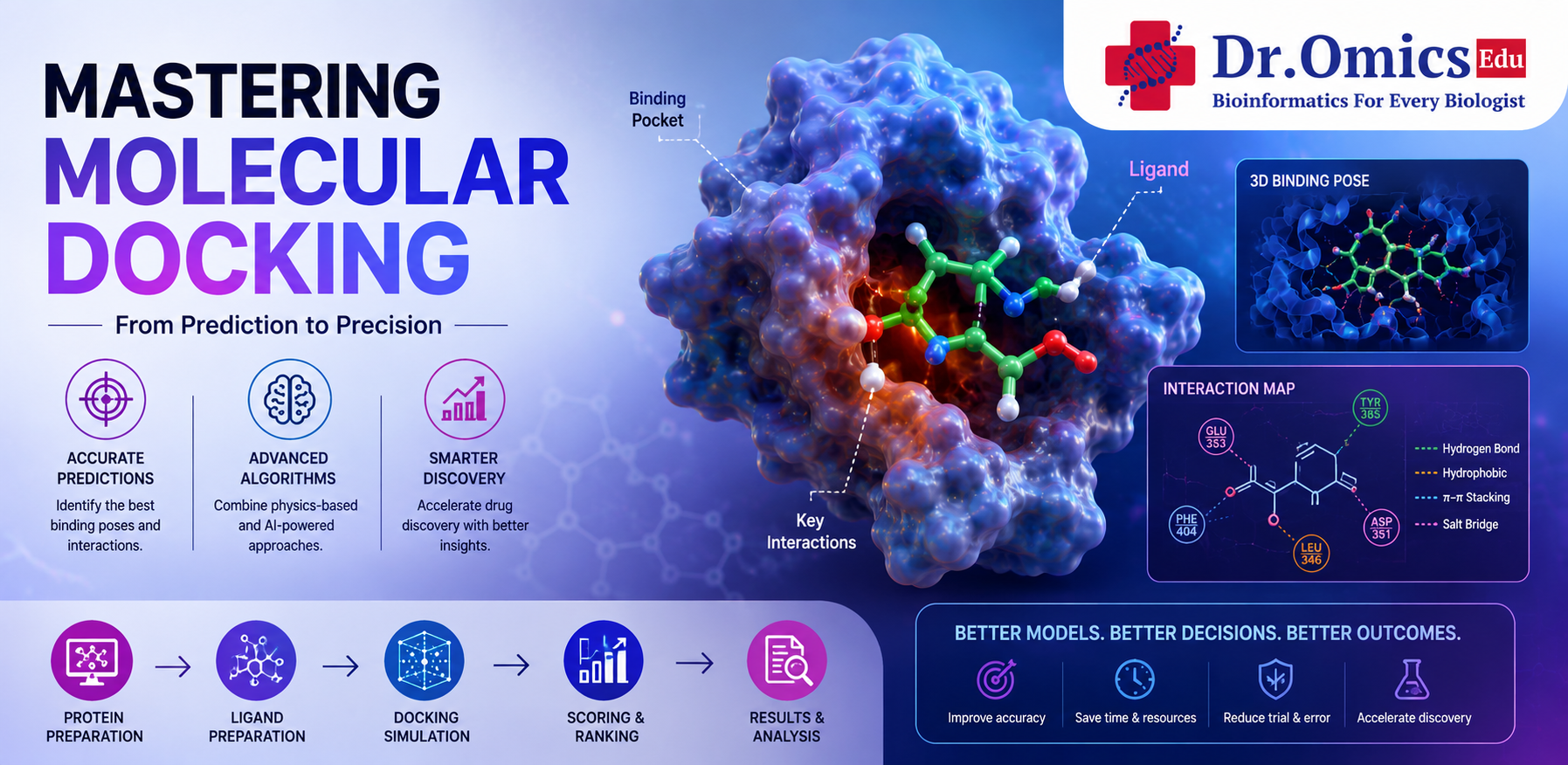
Mastering AutoDock Vina and DiffDock for Molecular Docking
Dr. Omics Edu Team ·
Molecular docking has become an essential technique in modern drug discovery, helping researchers predict how a ligand binds to a target protein. In 2026, two powerful tools are leading the way: AutoDock Vina and DiffDock.
Why Learn Both Tools?
AutoDock Vina remains one of the most trusted docking platforms due to its speed, accuracy, and ease of use. At the same time, AI-powered methods like DiffDock are transforming the field by predicting binding poses using deep learning approaches.
A strong AutoDock Vina tutorial 2026 workflow helps researchers perform reliable docking studies, while a DiffDock AI docking tutorial introduces next-generation techniques for faster and more intelligent predictions.
AutoDock Vina vs DiffDock
- AutoDock Vina: Widely used, customizable, and ideal for traditional docking workflows.
- DiffDock: AI-driven docking that predicts ligand binding poses without exhaustive search algorithms.
- Combined Approach: Use DiffDock for rapid pose prediction and AutoDock Vina for validation and scoring.
Beyond Docking: Understanding Interactions
Docking is only the first step. Accurate ligand protein interaction analysis helps identify key hydrogen bonds, hydrophobic contacts, salt bridges, and binding-site residues responsible for molecular recognition.
This information is crucial for:
- Drug candidate optimization
- Structure-based drug design
- Virtual screening projects
- Biomolecular research
The Future of Molecular Docking
As AI continues to reshape computational biology, combining traditional docking methods with machine learning-based approaches is becoming the new standard. Learning both AutoDock Vina and DiffDock equips researchers with the tools needed to tackle modern drug discovery challenges more efficiently.
Whether you're a student, researcher, or industry professional, mastering these docking platforms can significantly enhance your computational drug discovery workflow in 2026.
