Machine Learning for Differential Gene Expression: DESeq2 vs AI Models
Dr. Omics Edu Team ·
As artificial intelligence continues to transform bioinformatics, many researchers are asking: Can machine learning replace DESeq2 for differential expression analysis? In 2026, both traditional statistical methods and AI-driven approaches play important roles in RNA-seq data analysis.
Traditional Methods: DESeq2, edgeR, and limma
For years, tools like DESeq2, edgeR, and limma have been the gold standard for identifying differentially expressed genes. These methods use robust statistical models to determine whether gene expression differences between conditions are significant.
Why Researchers Still Trust DESeq2
- Highly validated across thousands of studies
- Provides statistical significance (p-values and FDR)
- Reliable for small and medium-sized datasets
- Easy integration into standard RNA-seq workflows
Because of its accuracy and interpretability, DESeq2 remains one of the most widely used tools for ML differential expression 2026 comparisons.
The Rise of AI and Machine Learning
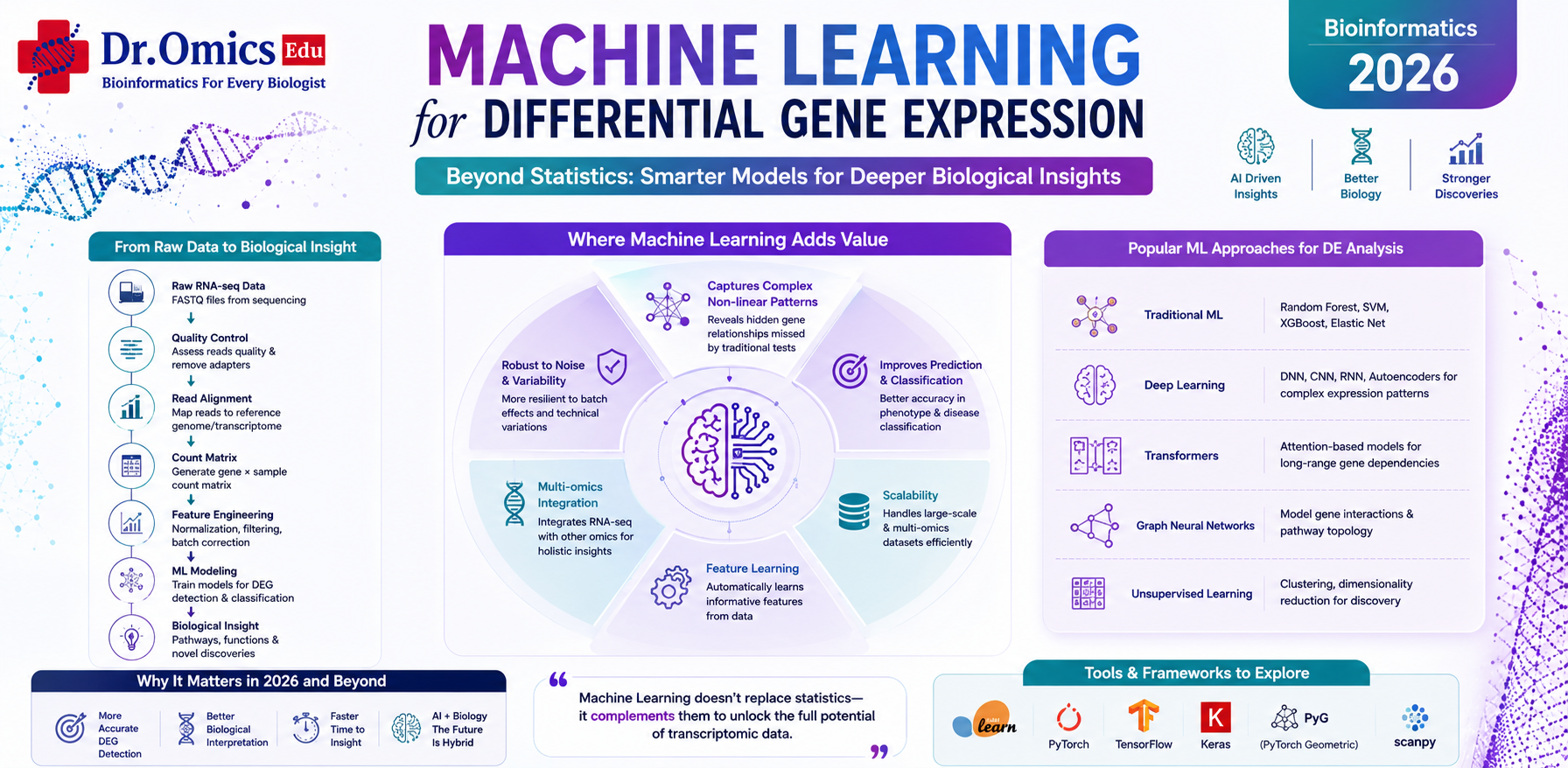
Modern machine learning gene expression approaches go beyond identifying differentially expressed genes. They can uncover hidden patterns, classify samples, predict disease outcomes, and identify complex gene interactions.
Popular AI approaches include:
- Random Forest
- XGBoost
- Support Vector Machines (SVM)
- Deep Neural Networks
- Transformer-based genomics models
These techniques are driving advances in deep learning RNA-seq analysis and neural network transcriptomics.
DESeq2 vs AI Methods: What's the Difference?
Feature | DESeq2 | AI/ML Models |
Differential expression testing | Excellent | Limited |
Statistical significance | ✅ | ❌ |
Pattern recognition | Moderate | Excellent |
Disease classification | Limited | Excellent |
Interpretability | High | Moderate |
Large-scale prediction | Moderate | High |
While DESeq2 identifies which genes are significantly different between conditions, AI models excel at learning complex biological patterns from large datasets.
Can Machine Learning Replace DESeq2?
The short answer is not completely.
Machine learning models are powerful for gene expression classification ML, biomarker discovery, and predictive modeling. However, they do not naturally provide the statistical significance testing required for differential expression analysis.
In most modern workflows, researchers use:
- DESeq2, edgeR, or limma to identify differentially expressed genes.
- Machine learning models to classify samples, predict outcomes, or prioritize biomarkers.
This combination provides both statistical rigor and predictive power.
The Future: AI-Powered Transcriptomics
With the emergence of bioinformatics AI tools 2026 and transformer models in genomics, machine learning is becoming an essential part of transcriptomics research. Rather than replacing DESeq2, AI is enhancing traditional RNA-seq analysis by uncovering deeper biological insights.
Final Takeaway
The debate between deep learning vs statistical methods in RNA-seq analysis is not about choosing one over the other. Statistical tools such as DESeq2 remain the foundation for differential expression analysis, while AI models provide advanced pattern recognition and prediction capabilities.
The future of transcriptomics lies in combining DESeq2 with machine learning—leveraging the strengths of both approaches for more accurate and meaningful biological discoveries.
