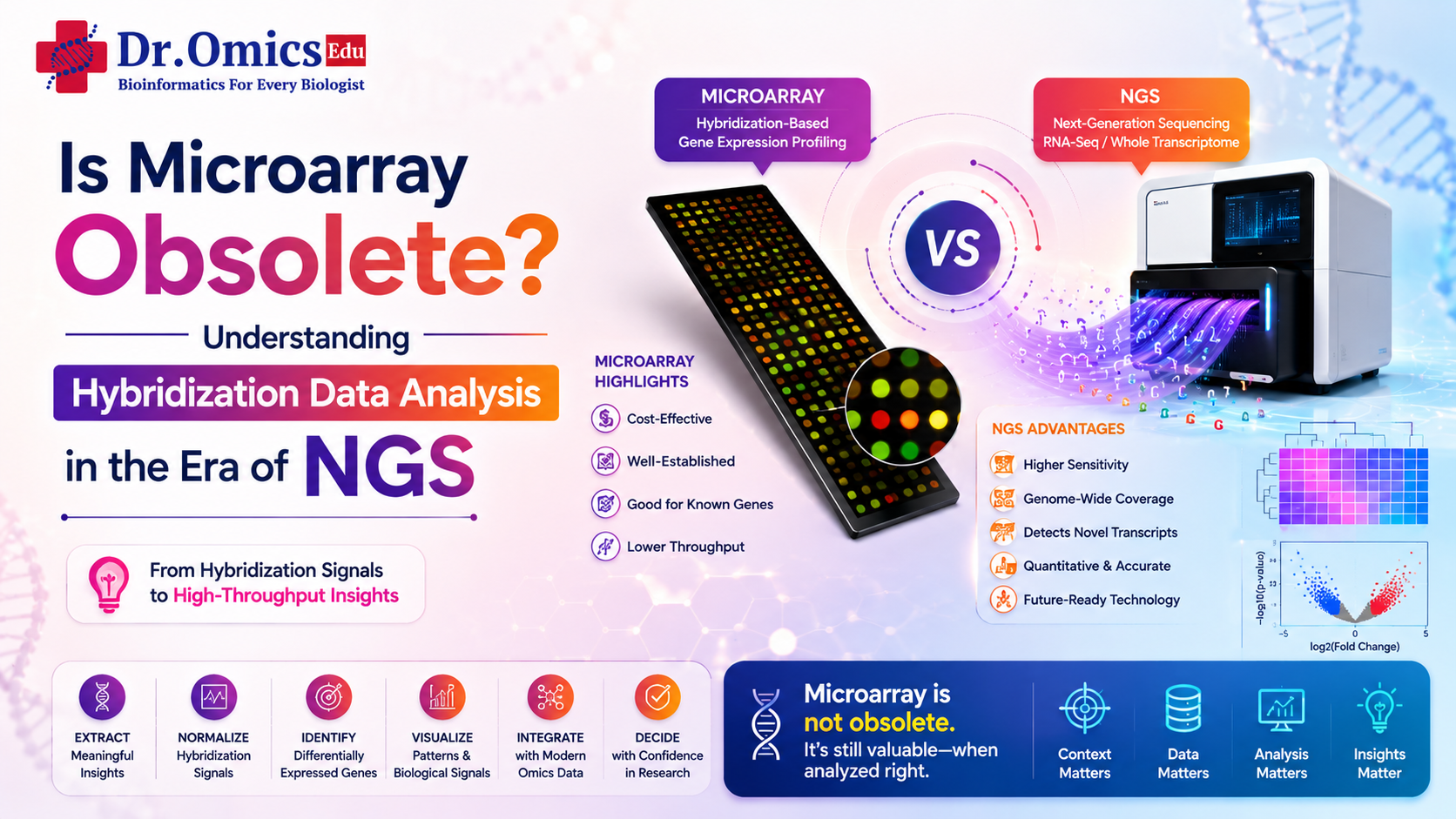
Is Microarray Obsolete? Understanding Hybridization Data Analysis in the Era of NGS
Dr. Omics Edu Team · · Updated
The rapid advancement of Next-Generation Sequencing (NGS) has transformed transcriptomics, enabling researchers to analyze gene expression with greater depth, accuracy, and sensitivity than ever before. As RNA sequencing (RNA-seq) becomes the standard for transcriptome analysis, many researchers ask an important question: Is microarray technology obsolete? The answer is no. Although RNA-seq has expanded the possibilities of gene expression studies, Microarray data analysis remains highly relevant due to its cost-effectiveness, extensive public datasets, and continued use in clinical diagnostics, pharmaceutical research, and biomarker discovery.
What is Microarray Technology?
Microarrays are based on the principle of nucleic acid hybridization, where fluorescently labeled RNA or cDNA molecules bind to complementary DNA probes immobilized on a microarray chip. The fluorescence intensity generated from each probe reflects the expression level of a specific gene.
Unlike RNA-seq, microarrays are limited to detecting genes represented by pre-designed probes. However, they offer excellent reproducibility, standardized protocols, and relatively low experimental costs, making them ideal for comparative gene expression studies. A typical microarray expression matrix analysis transforms raw fluorescence intensity values into a normalized expression matrix that can be statistically analyzed to identify differentially expressed genes.
Why is Transcriptomic Intensity Normalization Important?
Raw microarray data often contain technical variations caused by sample preparation, fluorescent dye labeling, scanner sensitivity, and hybridization efficiency. These variations can influence gene expression measurements if not corrected.
Therefore, transcriptomic intensity normalization is an essential preprocessing step. Popular normalization methods include:
- Robust Multi-array Average (RMA)
- Quantile Normalization
- Variance Stabilizing Normalization (VSN)
These techniques remove technical bias while preserving true biological variation, enabling reliable comparison of gene expression across multiple samples.
Differential Expression Analysis Using the limma Package R
One of the biggest strengths of microarray analysis is its well-established statistical framework. The limma package R (Linear Models for Microarray Data) is widely recognized as the gold standard for differential expression analysis.
A standard limma workflow includes:
- Importing normalized expression data
- Creating the experimental design matrix
- Fitting linear models for each gene
- Applying empirical Bayes statistics
- Identifying differentially expressed genes
- Adjusting p-values using False Discovery Rate (FDR)
Notably, limma has also become an important tool for RNA-seq analysis through the voom transformation, highlighting its continued relevance in modern transcriptomics.
Learning from Public Data: Gene Expression Omnibus Tutorial
One of the greatest strengths of microarray technology is the availability of thousands of publicly accessible datasets in the Gene Expression Omnibus (GEO) repository.
A typical Gene Expression Omnibus tutorial demonstrates how to:
- Download GEO datasets
- Import expression data into R
- Perform quality control and normalization
- Conduct differential expression analysis
- Visualize results using PCA, heatmaps, and volcano plots
- Perform pathway and Gene Ontology enrichment analysis
These publicly available datasets allow researchers to validate findings, perform meta-analyses, and generate new biological insights without conducting expensive laboratory experiments.
Microarray vs RNA-seq: Which Should You Choose?
The debate surrounding microarray vs RNA-seq is not about determining a winner but selecting the appropriate technology for specific research objectives.
Microarrays are ideal for studies involving known genes, large sample sizes, and budget constraints, offering standardized workflows and reproducible results.
In contrast, RNA-seq provides higher sensitivity, detects novel transcripts, alternative splicing events, and rare RNAs, making it the preferred choice for comprehensive transcriptome discovery. Consequently, many research groups continue using historical microarray datasets while generating new sequencing data.
Why Bioinformatics Professionals Should Learn Microarray Analysis
Despite the rise of NGS, microarray expertise remains valuable because researchers frequently work with legacy datasets and integrated transcriptomic studies. Learning microarray analysis enables professionals to:
- Analyze thousands of public transcriptomic datasets
- Validate RNA-seq discoveries
- Support biomarker discovery projects
- Perform cost-effective gene expression studies
- Contribute to pharmaceutical and clinical research
- Process hybrid genomic datasets by integrating historical microarray data with modern RNA-seq results
A foundational understanding of chip-sequencing basics alongside microarray and RNA-seq further strengthens transcriptomics expertise by providing insights into gene regulation and epigenetic mechanisms.
Conclusion
Microarrays are far from obsolete. While RNA sequencing has become the preferred platform for transcriptome-wide discovery, microarrays continue to play an important role in clinical research, education, biomarker validation, and large-scale public data analysis. Their affordability, standardized workflows, and extensive repositories ensure they remain a valuable component of modern bioinformatics.
Professionals skilled in Microarray data analysis, microarray expression matrix analysis, transcriptomic intensity normalization, the limma package R, Gene Expression Omnibus tutorial workflows, processing hybrid genomic datasets, microarray vs RNA-seq comparisons, and chip-sequencing basics possess a well-rounded transcriptomics skill set that remains highly relevant in biotechnology, pharmaceutical research, and precision medicine.
