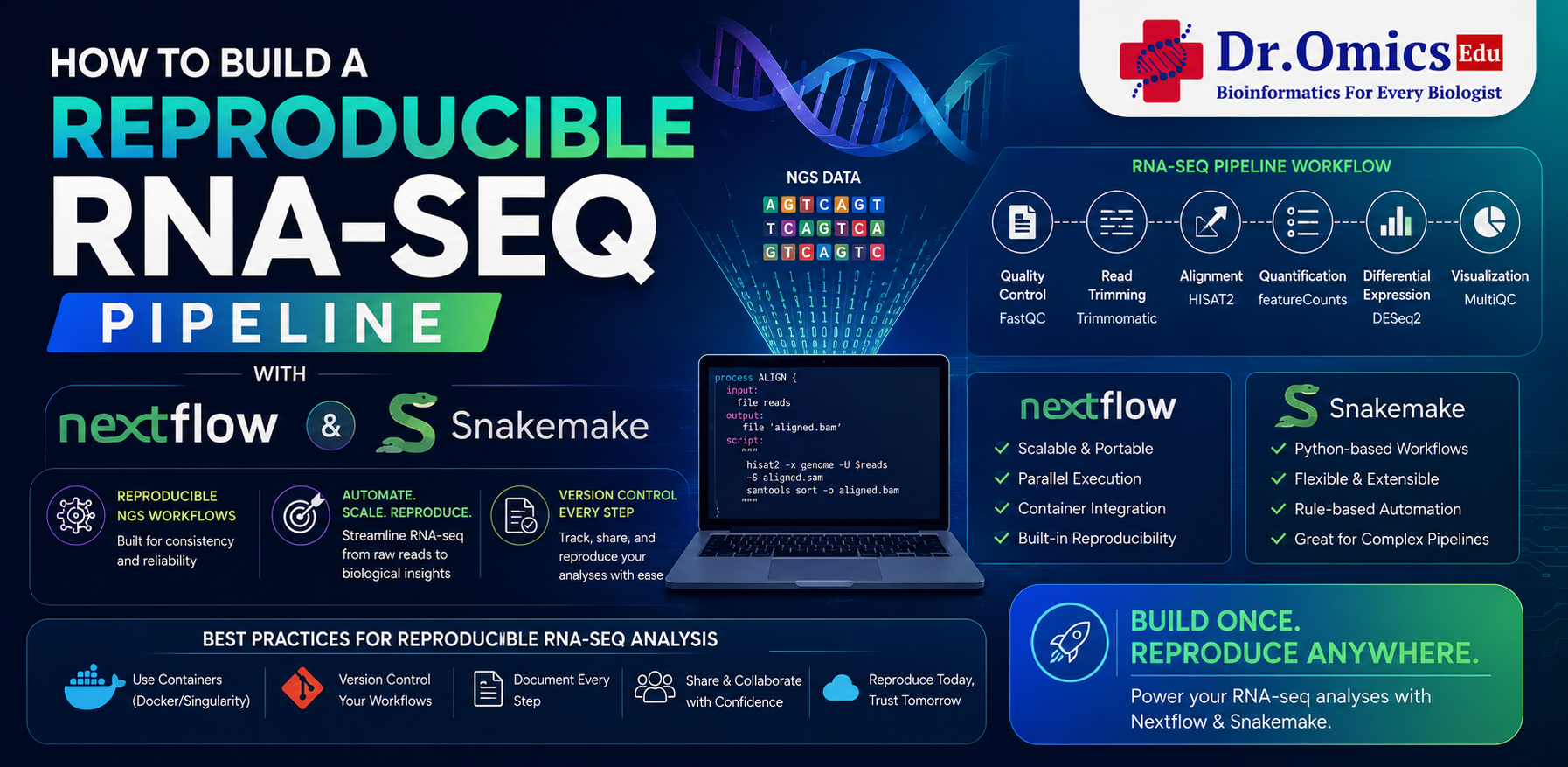
How to Build a Reproducible RNA-Seq Pipeline with Nextflow and Snakemake
Dr. Omics Edu Team ·
Transform Your RNA-Seq Analysis into a Scalable and Reproducible Workflow
RNA sequencing (RNA-Seq) has become one of the most powerful technologies in modern genomics. From discovering disease biomarkers to understanding gene expression patterns, RNA-Seq generates massive amounts of biological data. But handling multiple tools, dependencies, and large datasets manually can quickly become overwhelming.
That’s where workflow management systems like Nextflow and Snakemake completely change the game.
These platforms help researchers build automated, scalable, and reproducible NGS workflows that save time, reduce errors, and improve research quality.
Why Reproducibility Matters in RNA-Seq
Imagine running the same RNA-Seq analysis twice and getting different results. Without reproducibility, bioinformatics pipelines become difficult to trust, validate, or publish.
A reproducible workflow ensures:
- Consistent results across experiments
- Easy collaboration among researchers
- Faster troubleshooting and debugging
- Better project organization
- Scalable analysis for large datasets
Modern bioinformatics research depends heavily on reproducible pipeline design.
Building a Snakemake RNA-Seq Pipeline
A Snakemake RNA-seq pipeline allows you to automate every step of RNA-Seq analysis in a clean and structured manner. Instead of running commands manually one by one, Snakemake connects all analysis steps into a single intelligent workflow.
A typical RNA-Seq pipeline includes:
• Quality control using FastQC
• Adapter trimming with Fastp
• Read alignment using HISAT2 or STAR
• Quantification using FeatureCounts
• Differential expression analysis using DESeq2
Snakemake automatically tracks file dependencies and executes only the necessary steps. This makes workflows faster, cleaner, and highly reproducible.
One of the biggest advantages of Snakemake is its beginner-friendly syntax, making it an excellent choice for students and researchers entering computational genomics.
Why Researchers Prefer Nextflow
If you are working with high-performance computing clusters, Docker containers, or cloud-based analysis, Nextflow offers exceptional scalability and flexibility.
A well-designed Nextflow bioinformatics tutorial usually demonstrates how to create portable workflows that can run across multiple environments without changing pipeline logic.
Key strengths of Nextflow include:
• Parallel execution of tasks
• Docker and Singularity integration
• Cloud-ready workflow deployment
• High scalability for large projects
• Strong reproducibility support
Nextflow is widely used in large genomics projects and production-scale sequencing pipelines.
Best Practices for Reproducible NGS Workflows
Creating reproducible NGS workflows requires more than automation alone. Successful RNA-Seq pipelines should also include:
• Version-controlled scripts using Git
• Organized project directory structure
• Conda or containerized environments
• Proper documentation of tools and parameters
• Automated quality control reports
• Separate configuration files for flexibility
These practices improve transparency and make workflows easier to share and publish.
Final Thoughts
Whether you choose a Snakemake RNA-seq pipeline for simplicity or follow a Nextflow bioinformatics tutorial for scalable workflow management, both tools are revolutionizing modern genomics research.
As RNA-Seq datasets continue to grow, automated and reproducible NGS workflows are becoming essential for every bioinformatician. Investing time in workflow development today can dramatically improve efficiency, reliability, and research productivity in the future.
Build smarter pipelines. Automate your analysis. Make your RNA-Seq research truly reproducible.
