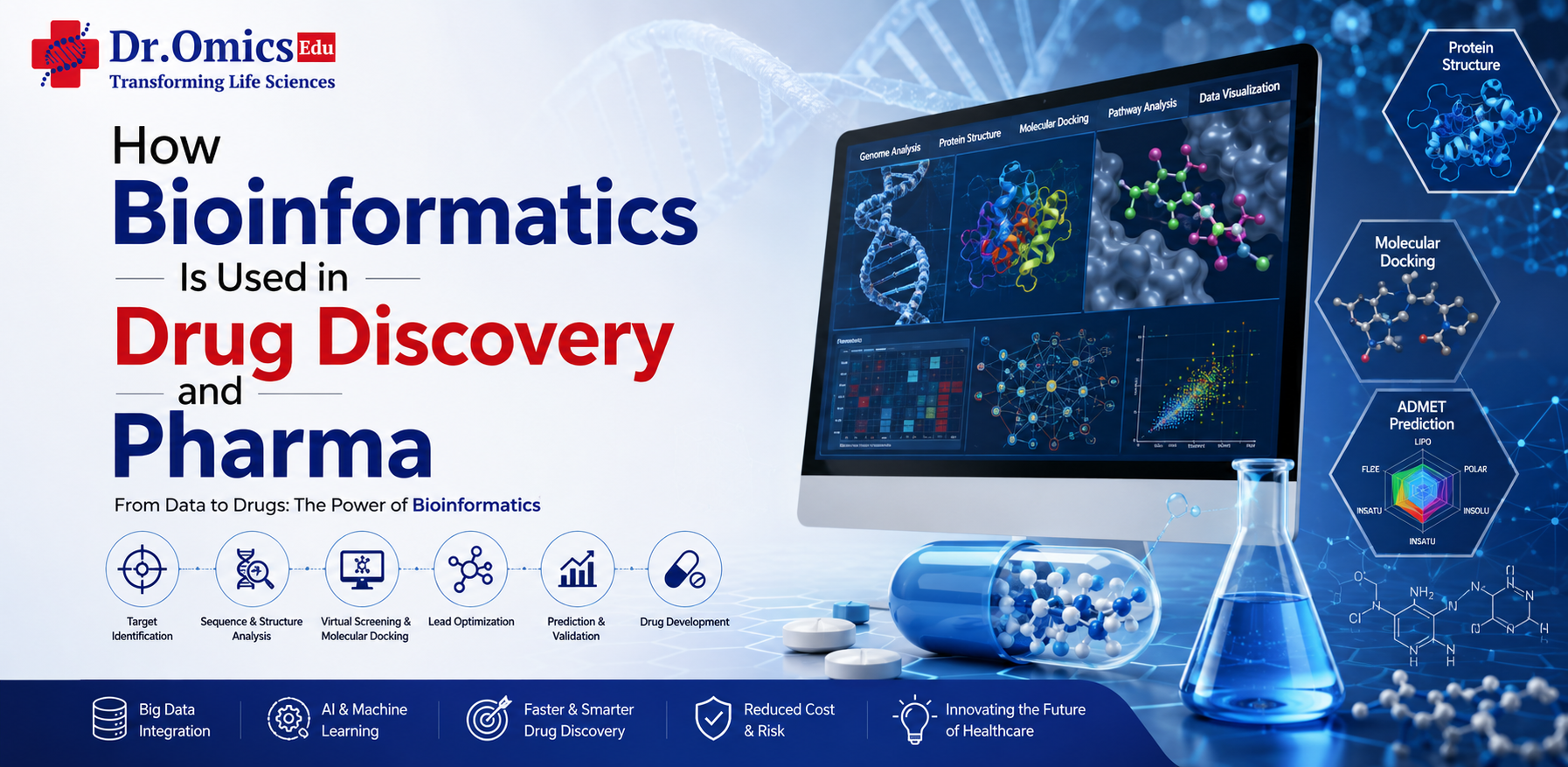
How Bioinformatics Is Used in Drug Discovery and Pharma
Dr. Omics Edu Team ·
Drug discovery is a complex, data-intensive process involving target identification, molecular characterization, compound screening, optimization, and safety assessment. With the rapid growth of genomic, proteomic, structural, and chemical data, bioinformatics in drug discovery has become an important component of modern pharmaceutical research. Computational approaches help researchers analyze large datasets, prioritize promising candidates, and make drug-development decisions more efficiently.
Identifying and Validating Drug Targets
The first step in many drug-discovery programs is identifying a biological target associated with a disease. Bioinformatics can integrate information from genomic and transcriptomic studies to identify genes or proteins that show disease-associated changes.
For example, differential gene-expression analysis can identify genes that are significantly altered between healthy and diseased tissues. Researchers can then investigate whether the corresponding proteins participate in relevant biological pathways and whether they represent suitable therapeutic targets.
Databases such as UniProt, Ensembl, PDB, and pathway resources provide valuable information about protein function, structure, interactions, and biological pathways.
Computational Drug Design
Once a target is selected, computational approaches can support the identification and optimization of potential drug molecules. Computational drug design may involve protein-structure analysis, binding-site identification, molecular docking, virtual screening, pharmacophore modeling, and molecular dynamics simulations.
For example, if the three-dimensional structure of a target protein is available, researchers can computationally screen large compound libraries to identify molecules that may interact with a specific binding pocket. Promising compounds can then be prioritized for experimental testing.
This approach does not replace laboratory validation; rather, it helps reduce the number of compounds that need to be tested experimentally.
Bioinformatics Pharma Applications
Modern pharmaceutical research generates multiple types of data, including genomic sequences, gene-expression profiles, protein structures, chemical structures, and clinical information. Integrating these datasets can reveal relationships that may not be obvious from a single data source.
One important application is pharmacogenomics, where genetic variation is studied to understand why patients may respond differently to the same drug. Such analysis can contribute to patient stratification and the development of more personalized treatment strategies.
Bioinformatics can also support biomarker discovery, disease classification, mechanism-of-action studies, and analysis of drug-response patterns.
Drug Discovery Data Analysis
A major advantage of bioinformatics is its ability to transform large datasets into interpretable results. Statistical analysis and computational workflows can help researchers identify significant genes, pathways, variants, molecular interactions, and candidate compounds.
For example, an oncology research program may combine tumor sequencing, RNA-seq, pathway analysis, and drug-response data to identify molecular alterations associated with treatment sensitivity or resistance.
Role in the Pharmaceutical Industry
The bioinformatics in pharmaceutical industry landscape is expanding as drug-development programs become increasingly data-driven. Computational scientists contribute across target discovery, biomarker research, drug repurposing, precision medicine, and translational research.
Ultimately, bioinformatics helps connect biological data with pharmaceutical decision-making. By combining bioinformatics, computational drug design, statistics, structural biology, and chemical data analysis, researchers can prioritize promising hypotheses before committing substantial experimental resources.
Conclusion
Bioinformatics is becoming an integral part of modern drug discovery—not because computational predictions eliminate laboratory experiments, but because they help researchers make those experiments more focused, informed, and data-driven. As biological and chemical datasets continue to grow, computational analysis will remain central to developing safer, more precise, and potentially more effective therapies.
