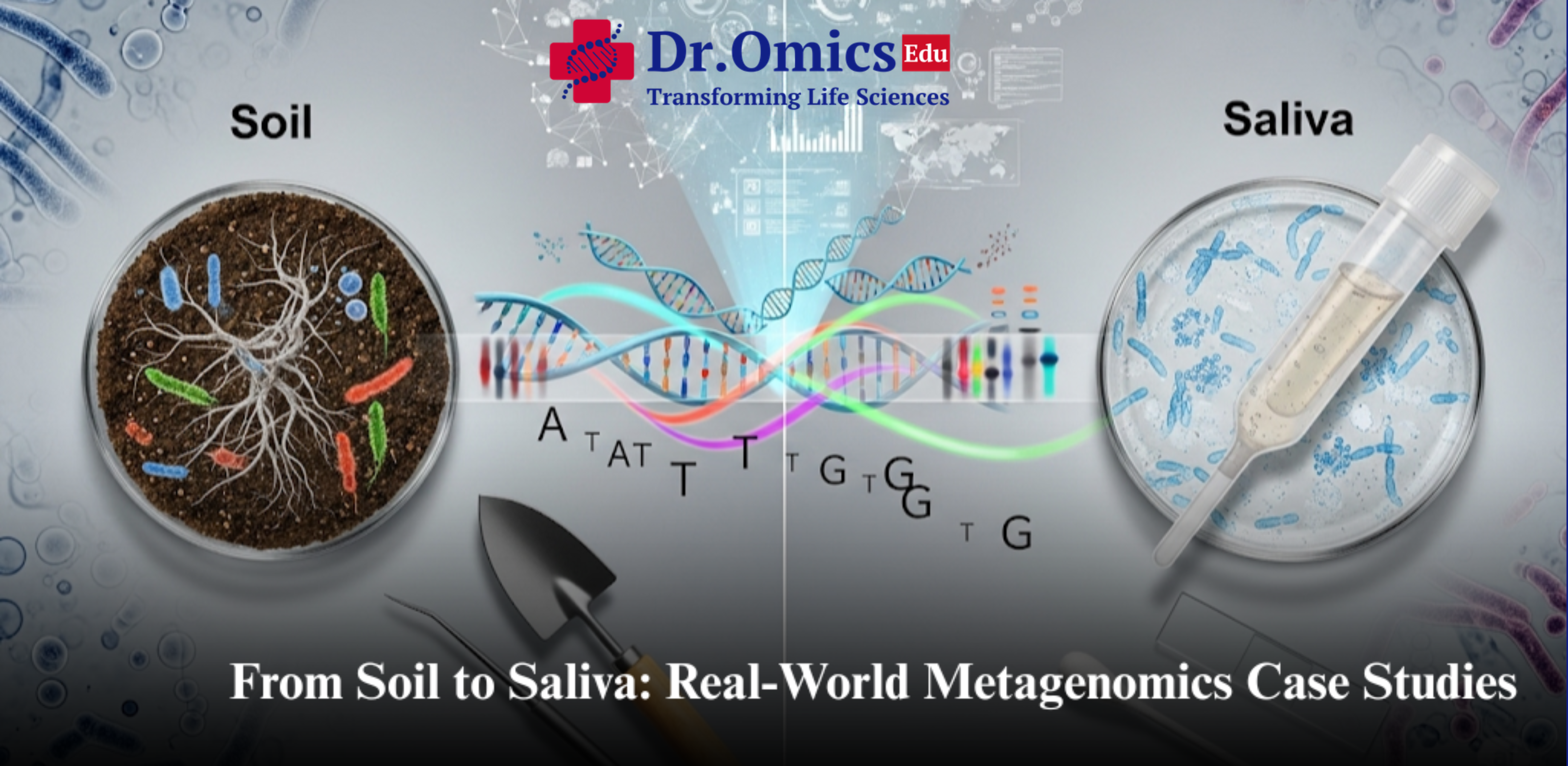
From Soil to Saliva: Real-World Metagenomics Case Studies
Metagenomics has evolved from a novel concept to a foundational tool across environmental science, agriculture, and clinical research. By sequencing DNA directly from complex samples, researchers can profile entire microbial communities without cultivation, answering critical questions about ecosystem health, disease associations, and environmental change. This article explores real-world case studies that illustrate the power of metagenomics, detailing the analytical workflows—from 16S rRNA sequencing analysis to functional profiling—that transform raw data into insight. These examples serve as practical extensions of any targeted metagenomics tutorial, demonstrating how microbiome bioinformatics tools like QIIME2 vs Mothur are deployed to solve tangible biological problems, a core competency developed in a comprehensive clinical metagenomics course.
Case Study 1: Soil Health and Agricultural Management
Research Question: How do conventional versus organic farming practices affect soil microbial community structure and function?
Methodology & Workflow: Researchers collected soil cores from paired farms. DNA was extracted and the V4 region of the 16S rRNA gene was amplified and sequenced (Illumina MiSeq). The analysis followed a standard targeted metagenomics tutorial pipeline:
- Processing: Raw reads were processed using QIIME 2 with the DADA2 plugin for quality filtering, denoising, and generating Amplicon Sequence Variants (ASVs).
- Taxonomy: ASVs were classified against the SILVA database.
- Analysis: Alpha diversity (Shannon index) and beta diversity (Weighted UniFrac) metrics were calculated. Differential abundance testing (e.g., ANCOM, DESeq2 adapted for compositional data) identified taxa enriched under each practice.
Key Findings & Impact: Organic soils showed significantly higher microbial diversity and a greater abundance of taxa involved in nitrogen cycling and pathogen suppression. This study provided a data-driven argument for sustainable farming, linking management practices directly to measurable microbial ecosystem services. The workflow is now a staple teaching example, showing how QIIME2 streamlines reproducible analysis from raw sequences to ecological interpretation.
Case Study 2: Environmental Monitoring of Urban Waterways
Research Question: What is the impact of urban runoff and wastewater influx on the microbial community and antibiotic resistance gene (ARG) burden in a river ecosystem?
Methodology & Workflow: This study required functional insights beyond taxonomy, necessitating shotgun metagenomics. Water samples were collected upstream and downstream of a major urban discharge point.
- Sequencing & QC: Total DNA was sequenced on an Illumina platform. Reads underwent quality trimming and host (e.g., human, fish) read removal.
- Functional Profiling: Processed reads were analyzed using HUMAnN to quantify metabolic pathway abundance and DeepARG or AMR++ to identify and quantify antibiotic resistance genes.
- Taxonomic Profiling: Kraken2/Bracken provided complementary taxonomic profiles.
Key Findings & Impact: Downstream sites showed a marked increase in Bacteroides (a fecal indicator) and a significant enrichment of ARGs against clinically relevant drug classes. This study directly informed public health advisories and highlighted metagenomics as a powerful tool for integrated environmental surveillance, moving beyond simple indicator species to a comprehensive risk profile.
Case Study 3: The Saliva Microbiome as a Diagnostic Window
Research Question: Are there consistent alterations in the oral microbiome associated with systemic inflammatory diseases like rheumatoid arthritis (RA)?
Methodology & Workflow: Saliva samples from RA patients and matched healthy controls underwent 16S rRNA sequencing analysis.
- Bioinformatics: Data was processed through Mothur, following its Standard Operating Procedure (SOP) for 16S data, including alignment to the RDP reference database.
- Statistical Modeling: After generating an OTU table, researchers used multivariate statistical methods (PERMANOVA) to test for group differences in community structure. Linear discriminant analysis Effect Size (LEfSe) identified specific biomarker taxa.
- Validation: Findings were validated in an independent cohort and correlated with clinical inflammatory markers (e.g., CRP).
Key Findings & Impact: The RA cohort exhibited a distinct oral dysbiosis, with enrichment of pro-inflammatory taxa like Prevotella and depletion of health-associated Streptococcus. This research, often featured in clinical metagenomics courses, illustrates the potential of non-invasive microbial profiling for disease stratification and understanding the oral-systemic disease axis.
Case Study 4: Gut Microbiome Dynamics in Personalized Nutrition
Research Question: Can inter-individual differences in gut microbiome composition predict metabolic responses to a high-fiber dietary intervention?
Methodology & Workflow: A longitudinal study collected stool samples before and after a controlled dietary intervention. Analysis combined 16S rRNA sequencing for community profiling with shotgun metagenomics on a subset for functional depth.
- Longitudinal Analysis: Using QIIME 2, researchers calculated within-subject (alpha diversity) and between-time-point (beta diversity) changes.
- Machine Learning Integration: Baseline microbiome features (from 16S data) were used as input into Random Forest models to predict clinical outcomes (e.g., insulin sensitivity improvement).
- Functional Insight: Shotgun data was mapped to KEGG pathways to explain mechanisms (e.g., short-chain fatty acid production).
Key Findings & Impact: "Responders" to the diet had higher baseline microbial diversity and specific fermentative taxa. This case study is a prime example of translational metagenomics, moving from observation to prediction and personalized dietary recommendations.
Tool Selection in Practice: QIIME2 vs Mothur
These case studies highlight how tool choice is often dictated by project goals and lab culture. The soil and nutrition studies used QIIME 2 for its modern ASV approach and reproducibility. The saliva study used Mothur, valued for its rigorous, standardized SOP ideal for clinical validation studies where consistency with prior literature is key. A well-rounded clinical metagenomics course will provide experience with both, enabling informed tool selection.
Conclusion: Bridging Analytical Workflows with Biological Discovery
These real-world case studies demonstrate that metagenomics is a versatile, hypothesis-testing framework. Whether applying a targeted metagenomics tutorial pipeline to understand soil ecology or employing advanced microbiome bioinformatics tools for clinical diagnostics, the core principle remains: robust bioinformatics workflows are the engine of discovery. From revealing farm management impacts to defining disease biomarkers, the journey from raw sequencing data to actionable insight requires not just running QIIME2 or Mothur, but critically interpreting their output within a specific biological context—a skill honed through applied, project-based learning.
