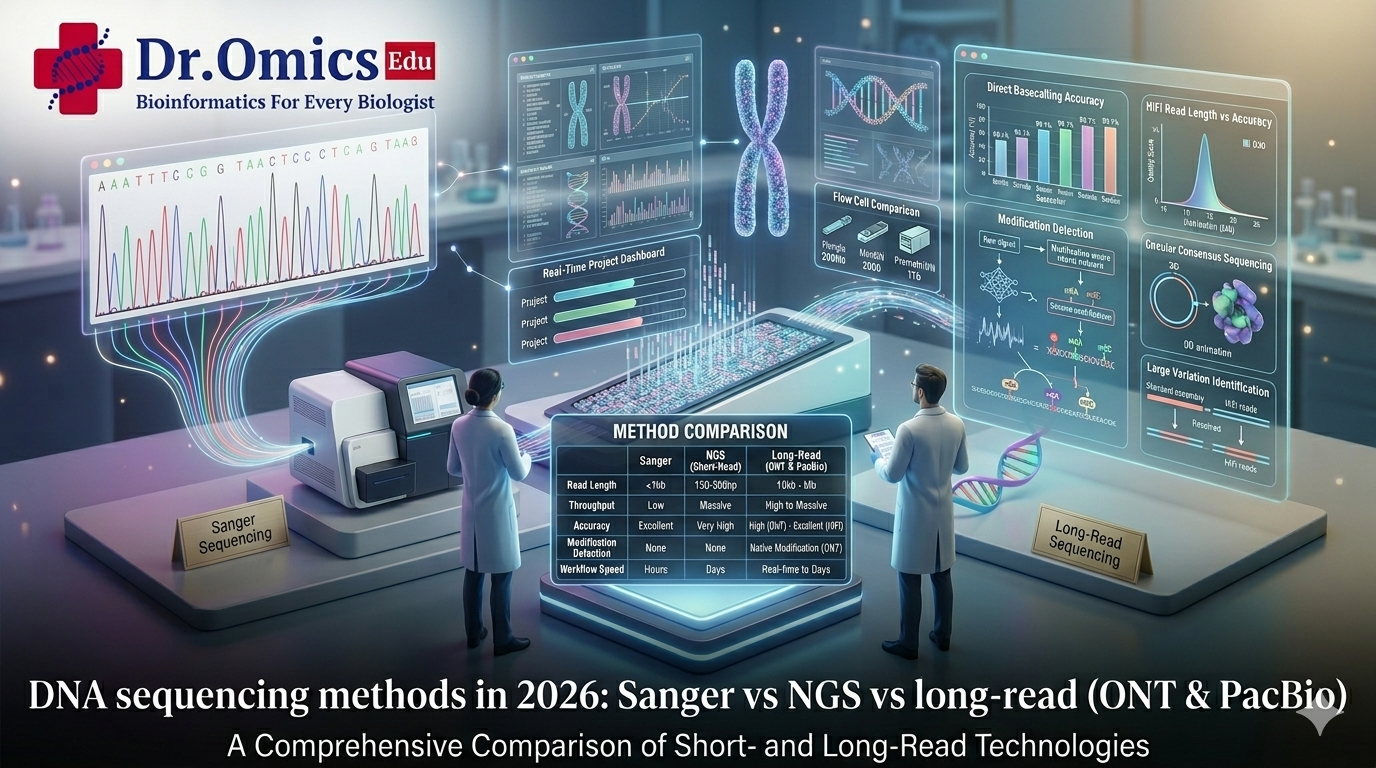
DNA sequencing methods in 2026: Sanger vs NGS vs long-read (ONT & PacBio)
Dr. Omics Edu Team ·
The genomics landscape has expanded drastically, offering researchers unprecedented clarity into genetic architectures. However, with multiple generations of technologies actively running in laboratories simultaneously, selecting the correct pipeline can be daunting.
Whether you are looking for an NGS beginners guide or choosing a platform for complex structural variations, understanding the technical differences, throughputs, and the shifting sequencing cost per genome 2026 is essential for optimization.
The Sequencing Hierarchy: Generation by Generation
To choose the right method, we must look at the three primary pillars of modern sequencing. Each fills a distinct, irreplaceable role in research and diagnostics.
1. First-Generation: Sanger Sequencing
Though decades old, Sanger sequencing remains the gold standard for low-throughput, high-accuracy validation. If you are reviewing a Sanger sequencing tutorial, you know it handles small-scale targets (typically 500 to 1,000 base pairs) flawlessly. It is ideal for verifying single-plasmid inserts or PCR products where single-base precision is vital, but it cannot scale for entire genomes.
2. Second-Generation: Next-Generation Sequencing (NGS)
Dominating the industry, Illumina sequencing 2026 platforms and similar short-read technologies constitute the backbone of modern data production. In this category, millions of small DNA fragments (150–300 base pairs) are sequenced simultaneously in a process called massive parallel sequencing.
When conducting a WGS WES comparison 2026, NGS splits into two primary approaches:
- Whole Exome Sequencing (WES): Sequencing only the protein-coding regions (exomes), optimizing cost while capturing the majority of disease-causing mutations.
- Whole Genome Sequencing (WGS): Sequencing the entire nuclear genome, offering a comprehensive look at both coding and non-coding regions.
3. Third-Generation: Long-Read Sequencing
The biggest evolutionary leap comes from short read vs long read DNA mechanics. Instead of breaking DNA into tiny pieces, third-generation technologies sequence single molecules of DNA in real-time, yielding reads from 10,000 to over a million base pairs. The primary debate in this ecosystem centers on Oxford Nanopore vs PacBio:
- Oxford Nanopore Technologies (ONT): Passes DNA molecules through microscopic synthetic pores, reading changes in electrical current. It offers ultra-long reads and ultra-portable devices.
- Pacific Biosciences (PacBio): Uses a circularized template system (HiFi reads) to cycle through the same molecule repeatedly, combining the length of long reads with the single-base precision of short reads.
The Difference Between NGS and Long-Read Sequencing Explained
The core trade-off between these technologies comes down to accuracy vs. structural resolution.
Short-read NGS excels at finding small, single-nucleotide polymorphisms (SNPs) and small insertions or deletions because its raw accuracy is incredibly high. However, because the reads are short, computationally assembling them is like trying to solve a puzzle with millions of tiny, identical pieces. It struggles with repetitive genomic regions, large structural variations, and complex chromosome rearrangements.
Long-read sequencing effortlessly bridges these gaps. Because a single read can stretch across thousands of bases, it resolves highly repetitive regions, maps large structural variations, and phases haplotypes (determining which parent a gene copy came from).
Cost Analysis: Budgeting Your Run
The cost of whole genome sequencing 2026 has hit historic lows, entirely redefining project scale. The following comparative baseline outlines typical metrics across current options:
| Sequencing Technology Type | Average Read Length | Major Strengths | Cost Metric (2026 Baseline) |
| Sanger Sequencing | 500 – 1,000 bp | Extreme accuracy, cheap for single reactions | $5 - $10 per sample |
| Short-Read NGS (Illumina) | 150 – 300 bp | Highest throughput, unparalleled single-base accuracy | Under $200 per human genome |
| Long-Read (PacBio HiFi) | 10k – 25k bp | Combines high accuracy with structural resolution | $600 - $800 per genome |
| Long-Read (Oxford Nanopore) | 10k – 1Mb+ bp | Ultra-long reads, portable, direct epigenetic methylation sensing | Variable (Scales affordably for large-batch runs) |
Final Thoughts
The sequencing technologies comparison in 2026 shows that the future does not belong to a single platform, but rather to hybrid approaches. Combining the raw throughput and cost-efficiency of short-read NGS with the structural clarity of long reads allows laboratories to build complete, gapless genetic profiles. Evaluating your specific accuracy requirements, structural targets, and budget limitations will guarantee that your computational pipeline delivers maximum biological insight.
