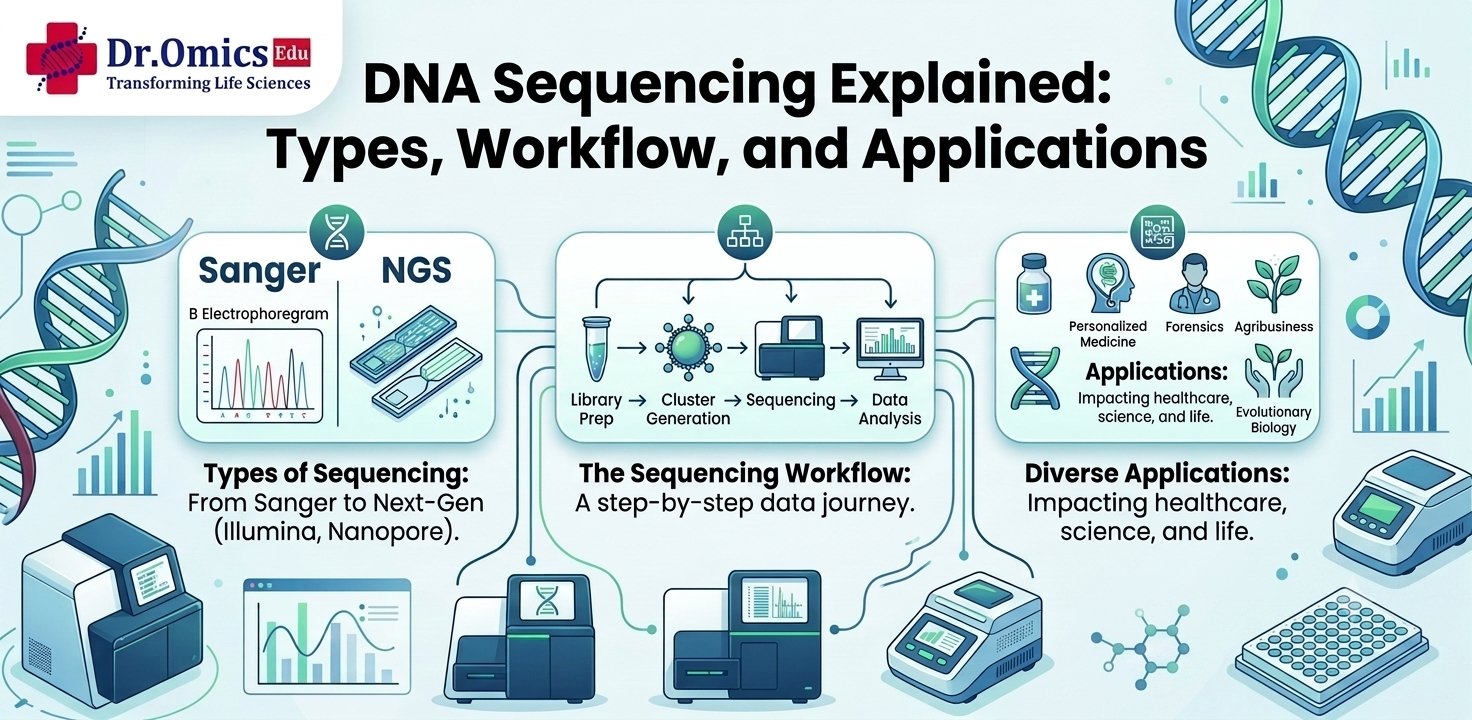
DNA Sequencing Explained: Types, Workflow, and Applications
Dr. Omics Edu Team ·
DNA sequencing is one of the most powerful technologies in modern biology. It allows scientists to determine the exact order of A, T, G, and C in DNA and understand the genetic information present in an organism.
From disease research and cancer genomics to personalized medicine and infectious disease studies, DNA sequencing has become an essential part of modern genomics.
What Is DNA Sequencing?
DNA sequencing is the process of reading the nucleotide sequence of DNA. By analyzing this sequence, researchers can identify genes, genetic variations, mutations, and other important genomic features.
Today, two major sequencing approaches are commonly discussed: Sanger sequencing and Next Generation Sequencing (NGS).
Sanger Sequencing vs NGS
Sanger sequencing is a traditional and highly accurate method that is generally used for sequencing smaller DNA regions, confirming mutations, or validating results.
Next Generation Sequencing (NGS) allows millions of DNA fragments to be sequenced simultaneously. This high-throughput approach makes it suitable for large-scale studies such as whole genome sequencing, cancer genomics, RNA sequencing, and metagenomics.
Sanger Sequencing | Next Generation Sequencing |
| Low throughput | High throughput |
| Small DNA regions | Millions of fragments simultaneously |
| Lower data volume | Very large data volume |
| Useful for validation | Useful for large-scale discovery |
In simple terms, Sanger is ideal for targeted sequencing, while NGS is designed for large-scale genomic analysis.
Understanding the NGS Workflow
A typical NGS workflow can be summarized as:
Sample → DNA Extraction → Library Preparation → Sequencing → FASTQ → Quality Control → Alignment → Variant Calling → Annotation → Interpretation
First, DNA is extracted from a biological sample and prepared as a sequencing library. The sequencing instrument then generates millions of reads, usually stored in FASTQ format.
These raw reads undergo quality control to identify low-quality sequences and technical issues. After preprocessing, reads can be aligned to a reference genome. Depending on the project, researchers can then identify genetic variants and annotate them to understand their possible biological significance.
What Is DNA Sequencing Data Analysis?
Modern sequencing generates huge amounts of data, making computational analysis essential.
DNA seq analysis may involve tools and techniques for:
- Quality control
- Read trimming
- Sequence alignment
- Genome assembly
- Variant calling
- Variant annotation
- Functional analysis
- Biological interpretation
Bioinformatics therefore plays a major role in converting raw sequencing data into meaningful biological information.
Whole Genome Sequencing
Whole Genome Sequencing (WGS) involves sequencing almost the entire genome of an organism. Unlike targeted sequencing, WGS provides a comprehensive view of genomic variation.
It can be used to study SNPs, insertions and deletions, structural variants, disease-associated changes, microbial genomes, and population-level genetic diversity.
DNA Sequencing Applications
The applications of DNA sequencing are expanding rapidly across multiple fields:
- Medical genomics: Studying genetic diseases and genomic variation
- Cancer research: Identifying mutations and genomic alterations
- Personalized medicine: Understanding genetic factors affecting treatment
- Infectious diseases: Characterizing and monitoring pathogens
- Agriculture: Studying crop and livestock genetics
- Forensics: Supporting genetic identification
- Evolutionary research: Investigating genetic relationships and diversity
- Metagenomics: Studying microbial communities
Learn DNA Sequencing Online
For students and professionals interested in genomics and bioinformatics, learning DNA sequencing provides a strong foundation for working with modern biological data.
A practical DNA sequencing course should cover sequencing fundamentals, Sanger sequencing, NGS, FASTQ files, quality control, alignment, variant calling, annotation, and DNA sequencing data analysis.
If you're looking to learn DNA sequencing online, combining theoretical concepts with hands-on analysis of real sequencing datasets is one of the best ways to develop practical skills.
The Future of DNA Sequencing
DNA sequencing is moving rapidly from research laboratories into clinical diagnostics, precision medicine, agriculture, biotechnology, and many other areas.
As sequencing technologies continue to produce larger and more complex datasets, the demand for professionals who understand both sequencing technologies and bioinformatics analysis will continue to grow.
Learn the sequence. Understand the data. Unlock the possibilities of genomics.
