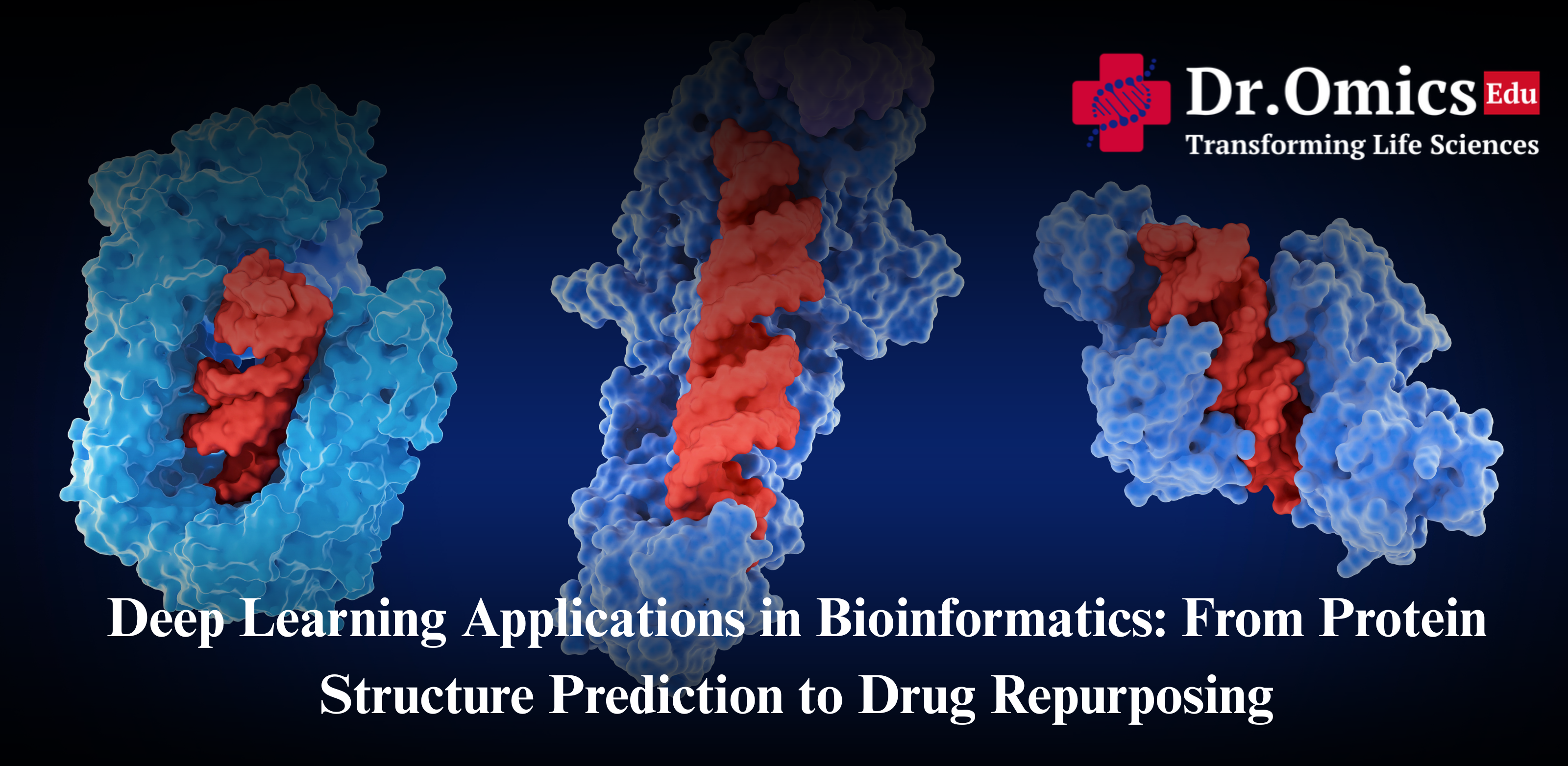
Deep Learning Applications in Bioinformatics: From Protein Structure Prediction to Drug Repurposing
Deep Learning Bioinformatics: From Protein Structure Prediction to Drug Repurposing
Deep learning, a subset of artificial intelligence, is transforming bioinformatics by enabling unprecedented insights into biological systems. From protein structure prediction to drug repurposing, deep learning applications are accelerating research in genomics, structural biology, and therapeutic development. Tools like AlphaFold and RoseTTAFold have set new benchmarks in modeling three-dimensional protein structures, while convolutional neural networks (CNNs) analyze high-throughput sequencing data to identify disease-associated variants. By integrating multi-dimensional datasets, deep learning also facilitates the discovery of novel drug applications, shortening drug development timelines and improving patient outcomes.
Key Takeaways
- Deep learning enhances protein structure prediction, drug discovery, and genomics research.
- Notable tools include AlphaFold, RoseTTAFold, and CNN-based models for sequencing data.
- Applications extend to drug repurposing, variant calling, epigenomic feature prediction, and single-cell RNA sequencing analysis.
- Challenges include data quality, model interpretability, and high computational demands.
- The future promises more accurate, scalable, and interpretable models for personalized medicine.
Protein Structure Prediction
Accurate protein structure modeling is critical for understanding biological function and identifying drug targets.
AlphaFold
Developed by DeepMind, AlphaFold achieves near-experimental accuracy in predicting protein 3D structures from amino acid sequences. This breakthrough enables faster identification of drug targets and protein engineering applications.
RoseTTAFold
RoseTTAFold is another deep learning-based tool that provides high-accuracy predictions for protein structures, complementing AlphaFold in drug design and structural biology studies.
Drug Discovery and Repurposing
Deep learning accelerates therapeutic development and expands drug applications:
Virtual Screening
By analyzing molecular structures and chemical properties, deep learning models can rapidly predict the binding affinity of millions of compounds, streamlining virtual screening in drug discovery pipelines.
Drug Repurposing
Deep learning identifies new therapeutic uses for existing drugs by mapping drug-target interactions and disease-associated pathways, significantly reducing the time and cost of developing treatments.
Gene Expression Analysis
Single-Cell RNA Sequencing Analysis
Deep learning models interpret single-cell RNA sequencing (scRNA-seq) data, revealing cellular heterogeneity, gene regulatory networks, and cell type identification. This provides a detailed view of complex biological processes in health and disease.
Variant Calling
By analyzing genomic patterns, deep learning improves the accuracy of variant calling, distinguishing true genetic variations from sequencing artifacts.
Epigenomic Feature Prediction
Deep learning models predict epigenetic modifications such as DNA methylation and histone modifications, enhancing understanding of gene regulation and cellular function.
Challenges and Future Directions
Despite impressive achievements, several hurdles remain:
- Data Quality and Availability: High-quality annotated datasets are essential but challenging to curate for specific biological contexts.
- Interpretability: Deep learning models are often “black boxes,” and efforts are underway to develop interpretable models for reliable decision-making.
- Computational Resources: Training complex models requires substantial hardware, including GPUs and cloud computing infrastructure.
Future research will focus on scalable models, improved interpretability, and integration with multi-omics data, enabling precision medicine and advanced therapeutic strategies.
Conclusion
Deep learning is revolutionizing bioinformatics, offering transformative applications in protein structure prediction, drug discovery, gene expression analysis, and drug repurposing. While challenges like data quality, interpretability, and computational demands persist, continuous innovation in deep learning bioinformatics promises a new era of precision medicine and accelerated therapeutic development.
By leveraging AI and deep learning, researchers can uncover hidden biological patterns, optimize drug development, and gain deeper insights into complex molecular systems—reshaping the future of genomics and healthcare.
