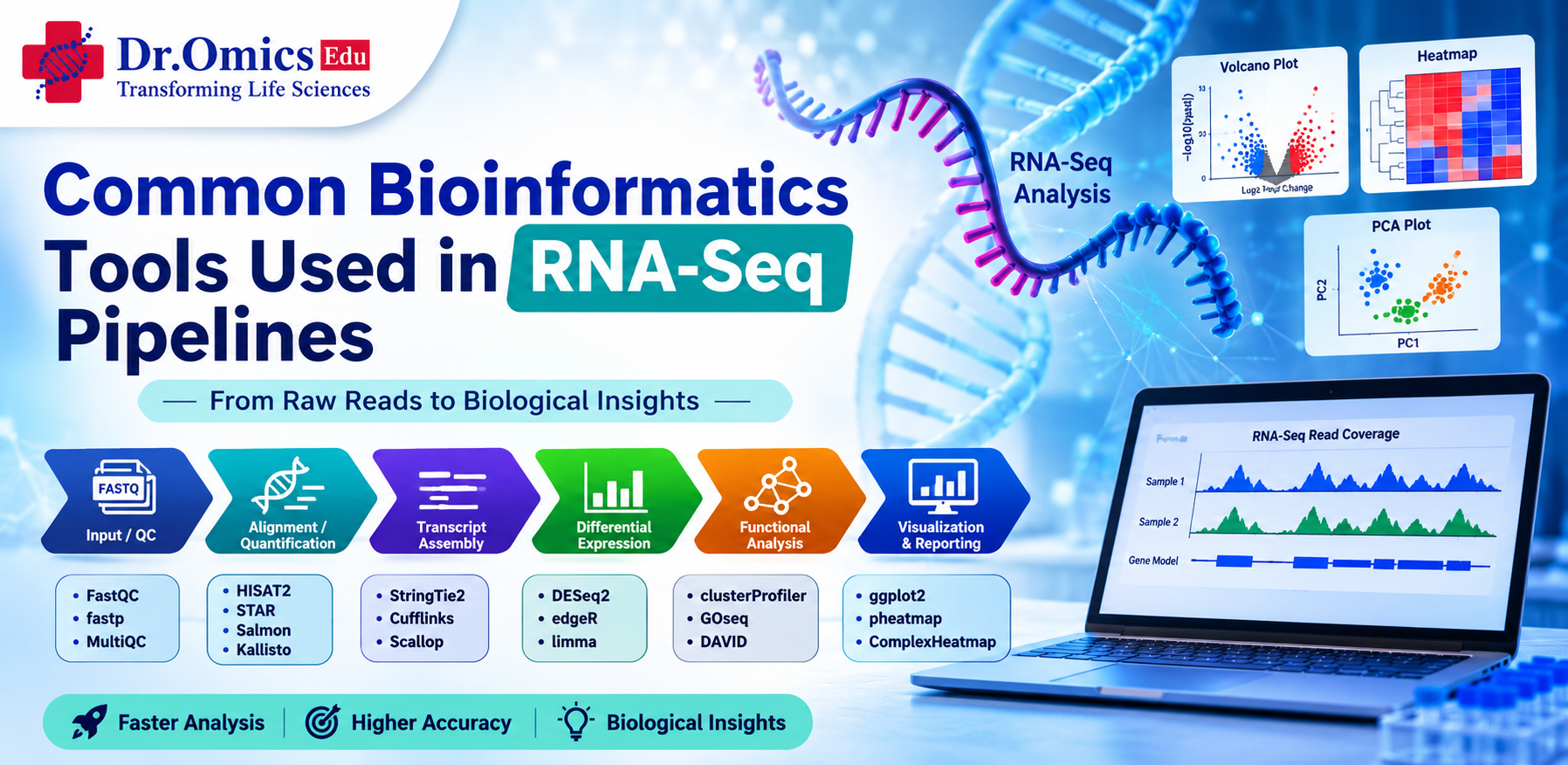
Common Bioinformatics Tools Used in RNA-Seq Pipelines
Dr. Omics Edu Team · · Updated
RNA sequencing (RNA-seq) has become a cornerstone of modern transcriptomics, enabling researchers to quantify gene expression, identify differentially expressed genes, investigate alternative splicing, and characterize transcriptomic changes across biological conditions. However, converting raw sequencing reads into biologically meaningful results requires a structured computational workflow involving multiple RNA-seq tools and bioinformatics applications.
A typical RNA-seq pipeline progresses from quality control and preprocessing to read alignment or transcript quantification, expression analysis, differential expression, and biological interpretation.
1. Quality Control: FastQC and MultiQC
The first step is assessing the quality of raw FASTQ files. FastQC evaluates per-base sequence quality, GC content, sequence duplication, adapter contamination, and other sequencing-related metrics. MultiQC can subsequently aggregate FastQC and other tool outputs into a single comprehensive report, making it easier to compare multiple samples.
2. Read Preprocessing: fastp and Cutadapt
Low-quality bases and sequencing adapters can negatively affect downstream analysis. fastp provides an integrated solution for quality filtering, adapter trimming, and basic quality assessment. Cutadapt is another widely used tool for accurate adapter and primer removal.
These preprocessing tools help generate cleaner reads for downstream RNA-seq analysis.
3. Read Alignment: STAR and HISAT2
For reference-based RNA-seq analysis, reads are mapped to a reference genome using splice-aware aligners.
STAR (Spliced Transcripts Alignment to a Reference) is a high-performance aligner widely used for genome-based RNA-seq analysis and splice-junction detection. HISAT2 is another efficient splice-aware aligner, particularly useful in workflows where computational memory is more limited.
The resulting SAM/BAM files can be processed and inspected using SAMtools, which supports operations such as sorting, indexing, filtering, and alignment statistics.
4. Transcript Quantification: Salmon and Kallisto
Instead of conventional genome alignment, transcript-level expression can be estimated using lightweight quantification approaches.
Salmon performs rapid transcript quantification from RNA-seq reads and can produce estimates such as transcript abundance and counts. Kallisto uses pseudoalignment-based quantification for rapid transcript abundance estimation.
These approaches can substantially reduce computational requirements for suitable transcriptome-level analyses.
5. Gene-Level Counting: featureCounts
When genome-aligned BAM files are available, featureCounts can assign sequencing reads to genomic features such as genes or exons. It remains a widely used component of traditional reference-based RNA-seq workflows.
6. Differential Expression: DESeq2 and edgeR
After obtaining a count matrix, statistical analysis identifies genes whose expression significantly differs between experimental conditions.
DESeq2 and edgeR, both implemented within the R/Bioconductor ecosystem, are among the most commonly used RNA-seq differential expression tools. They account for biological variability and sequencing depth while performing statistical testing.
7. Functional Interpretation
Differentially expressed genes can be further investigated using tools such as clusterProfiler, Gene Ontology (GO), KEGG, and Gene Set Enrichment Analysis (GSEA) to identify enriched biological processes, pathways, and molecular functions.
Conclusion
There is no single “best” RNA-seq tool for every experiment. The appropriate RNA-seq pipeline tools depend on the experimental design, organism, reference availability, computational resources, and biological question. A commonly used workflow is:
FASTQ → FastQC/MultiQC → fastp/Cutadapt → STAR/HISAT2 → featureCounts/Salmon → DESeq2/edgeR → Functional Enrichment
Understanding the purpose and limitations of each tool is essential for developing robust, reproducible, and biologically meaningful RNA-seq analyses.
