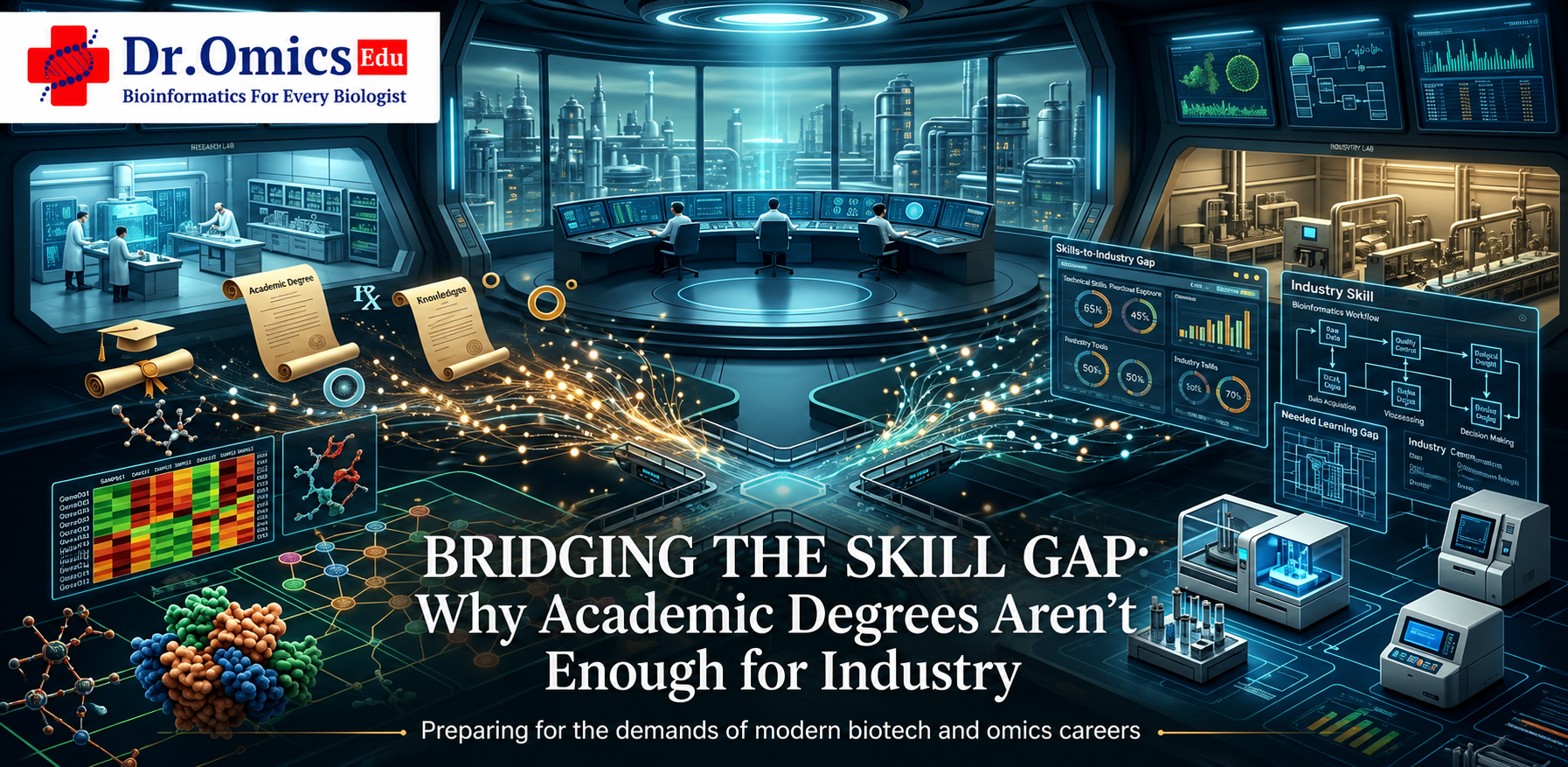
Bridging the Skill Gap: Why Academic Degrees Aren't Enough for Industry
Dr. Omics Edu Team ·
The life sciences are experiencing a massive, data-driven transformation. Driven by rapid advancements in high-throughput sequencing, single-cell genomics, and multi-omics integration, biology has fundamentally transitioned into a computational discipline. Yet, despite a soaring market demand for skilled data analysts, thousands of biotech and biotechnology graduates face a tough job market. This paradox highlights a persistent roadblock: the widening mismatch in the industry vs academic bioinformatics ecosystem.
While university curricula provide an essential foundation in baseline molecular biology, genetics, and conceptual programming, they frequently stop short of market readiness. In a commercial setting, companies do not just look for individuals who understand biological theories; they demand professionals who can manage massive, messy biological datasets and turn raw sequences into actionable pipeline insights from day one.
The Structural Divide: Theory vs. Production-Grade Execution
To understand why traditional academic degrees are no longer a golden ticket to employment, we have to look at how data is treated in both environments. In a university classroom, practical assignments typically leverage clean, pre-curated datasets designed to run smoothly on a personal desktop or a basic RStudio notebook. The goal is conceptual clarity, and time constraints are relatively flexible.
In contrast, commercial operations operate on strict, agile production sprints. Industry datasets are often noisy, incomplete, raw, and plagued by batch effects or sequencing artifacts. Furthermore, commercial analysis does not happen on a local desktop; it requires deploying algorithms across cloud architectures (like AWS or Google Cloud) or high-performance computing (HPC) clusters. This divide means graduates must actively pivot from academic coding to industry execution.
Practical Bioinformatics Skills for Jobs
If you want to secure a technical role in today’s life sciences market, your portfolio needs to showcase specific, functional capabilities. Recruiters look for candidate proficiency in these core areas:
- Command-Line Automation: Advanced text processing using Linux utilities like Awk and Sed to rapidly parse gigabytes of genomics files without breaking memory limits, backed by robust Bash scripting.
- Workflow Frameworks & Containers: Building reproducible, end-to-end data workflows using industry-standard pipeline languages like Nextflow or Snakemake, and packaging them cleanly inside Docker or Singularity containers.
- Production Coding & Collaborative Git: Moving away from messy, unoptimized scripts toward clean, documented, version-controlled code on GitHub that follows team-based software development standards.
- Industrial NGS & RNA-Seq Pipelines: Mastering complete downstream processing—from raw FASTQ quality control, alignment, and variant calling (such as GATK workflows) to differential expression and pathway enrichment analysis.
- Translational CADD & Structural Workflows: For biopharma trajectories, mastering automated virtual screening, structure-based/ligand-based drug design (SBDD/LBDD), and 3D molecular structures interpretation via PyMOL.
Systemic Interventions: The Impact of the LSSSDC
Bridging this skills gap cannot rely entirely on individual self-learning; it requires systemic, industry-aligned training structures. In India, a major driver of this alignment is the LSSSDC skill development council (Life Sciences Sector Skill Development Council). Operating under the aegis of the Ministry of Skill Development and Entrepreneurship, the LSSSDC directly maps out National Occupational Standards (NOS) alongside top-tier biotech employers.
By shifting focus away from rote memorization and toward certified, competency-based training frameworks, the council addresses the precise technical needs of the commercial sector. LSSSDC-aligned programs emphasize hands-on laboratory experience, cloud infrastructure navigation, and real-world compliance standards—helping transition academic science students into highly functional, industrial professionals.
Conclusion & Actionable Strategy
An academic degree is an excellent starting point, but employment in computational biology requires a deliberate focus on practical upskilling. If you want to bridge the gap between your degree and your career goals, start treating your public portfolio as your true resume. Move beyond standard course assignments: build containerized workflows, automate your data parsing scripts, contribute to open-source projects, and align your training with industry-vetted skill programs. Stop chasing static certificates—start building functional code.
