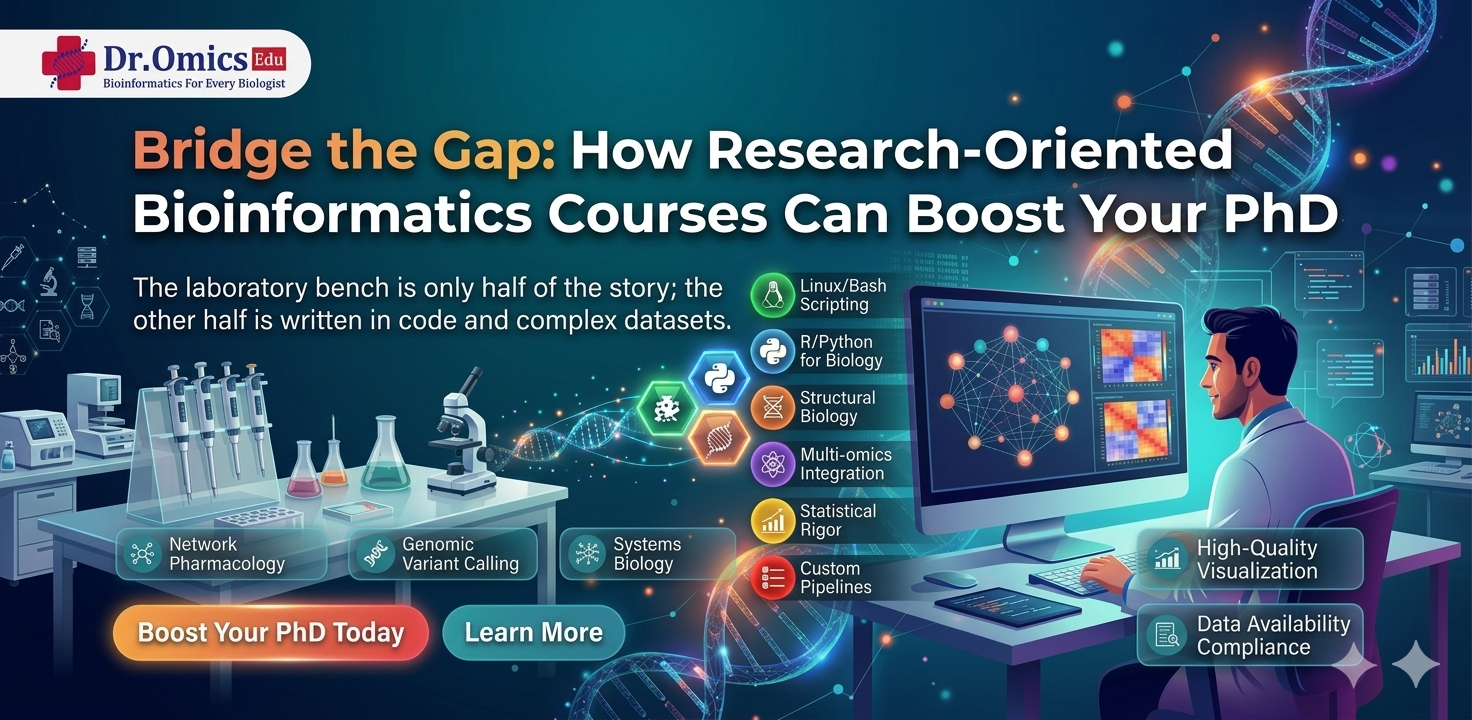
Bridge the Gap: How Research-Oriented Bioinformatics Courses Can Boost Your PhD
Dr. Omics Edu Team · · Updated
The landscape of biological research has shifted. In 2026, the laboratory bench is only half of the story; the other half is written in code and complex datasets. For PhD scholars, the pressure to produce high-impact results in record time is higher than ever. This is where research-oriented bioinformatics courses become the ultimate catalyst for your doctoral journey.
Whether you are studying oncology, plant biotechnology, or microbiology, integrating computational biology for thesis support can be the difference between a standard dissertation and a groundbreaking one.
Why PhD Scholars Need Research-Oriented Training
Traditional bioinformatics tutorials often stop at teaching you how to "click a button" on a web server. However, a PhD requires deep, in silico research methodology—the ability to design experiments, customize pipelines, and interpret multi-omics data with statistical rigor.
- Customized Workflows: Move beyond "off-the-shelf" tools to build pipelines specifically for your unique biological questions.
- Statistical Credibility: Master the R and Python libraries (like Bioconductor or Scikit-learn) that provide the mathematical backbone for your findings.
- Data Autonomy: Stop waiting for a bioinformatician to analyze your data. Do it yourself and accelerate your timeline.
The Power of In Silico Research Methodology
In 2026, the "In Silico" approach is no longer just a preliminary step; it is often a core component of the thesis. Research-oriented courses focus on:
- Network Pharmacology & Molecular Docking: Predicting how drug molecules interact with targets before you spend a penny on wet-lab reagents.
- Genomic Variant Calling: Analyzing NGS data to identify mutations linked to specific phenotypes.
- Systems Biology: Modeling entire cellular pathways to see how a single knock-out affects the whole system.
Direct Publication Support in Bioinformatics
One of the most significant hurdles for a PhD student is the peer-review process. Publication support in bioinformatics is a key feature of advanced research courses. These programs often provide:
- High-Quality Visualization: Creating publication-ready heatmaps, Circos plots, and 3D protein structures that grab reviewers' attention.
- Methodology Writing: Helping you articulate complex computational steps in a way that meets the standards of high-impact journals like Nature Communications or Briefings in Bioinformatics.
- Data Availability Compliance: Ensuring your data is correctly deposited in repositories like NCBI’s GEO or PRIDE, a mandatory requirement for most journals today.
Skills Checklist for the Modern PhD Scholar
To truly bridge the gap, focus on these essential areas during your training:
- Linux/Bash Scripting: Managing large-scale genomic files efficiently.
- R/Python for Biology: Performing custom statistical tests and data mining.
- Structural Biology: Understanding protein-ligand interactions via in silico modeling.
- Multi-omics Integration: Combining transcriptomics, proteomics, and metabolomics for a holistic view.
Boost Your PhD Today
Bioinformatics is no longer a niche skill—it is the language of modern science. By enrolling in bioinformatics for PhD scholars, you aren't just learning to use a computer; you are learning to view biology through a high-resolution, data-driven lens.
