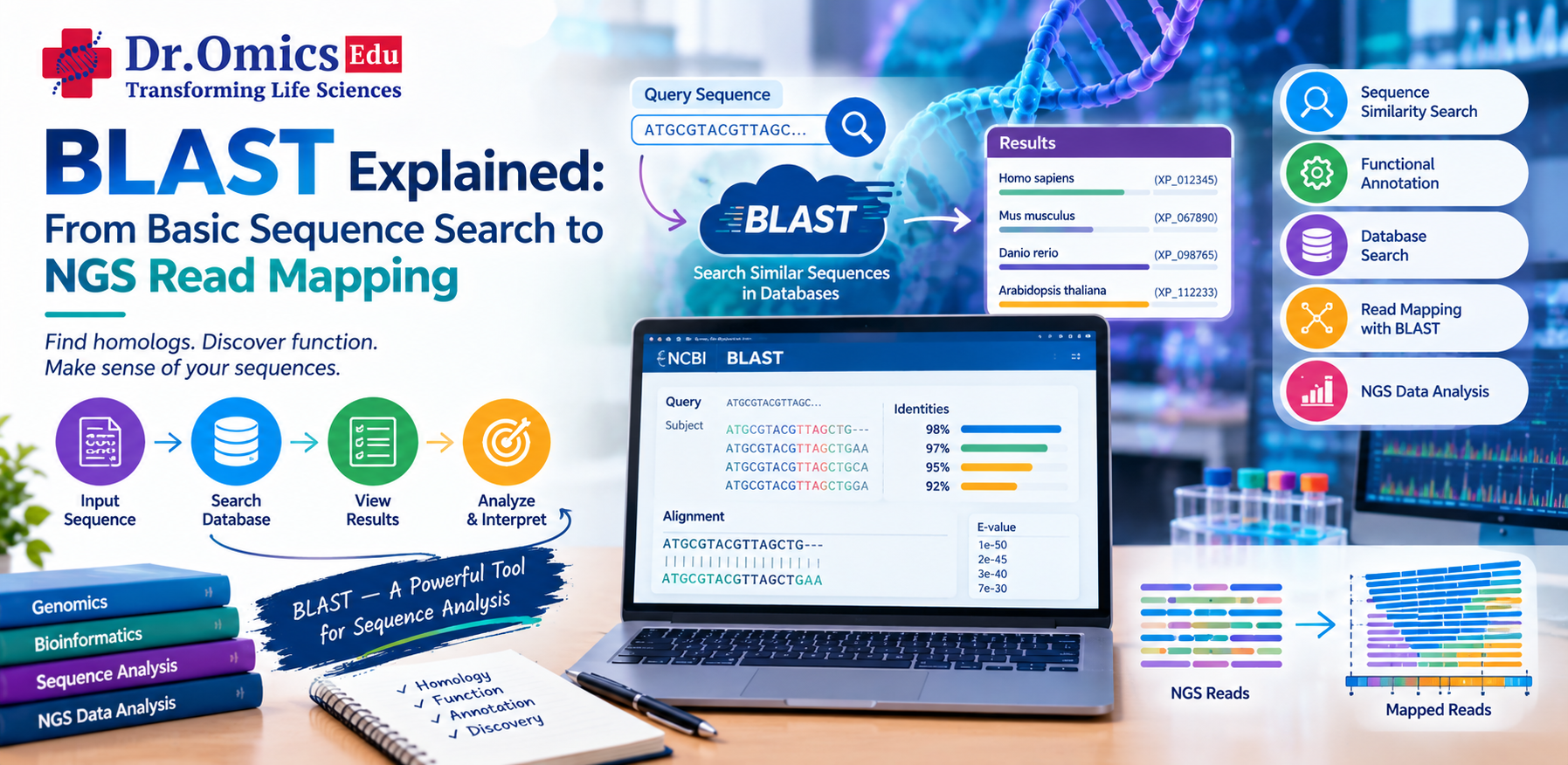
BLAST Explained: From Basic Sequence Search to NGS Read Mapping
Dr. Omics Edu Team ·
In modern bioinformatics, comparing DNA, RNA, or protein sequences against biological databases is one of the most fundamental computational tasks. BLAST bioinformatics provides one of the most widely used approaches for identifying sequence similarities, annotating unknown sequences, and investigating evolutionary relationships. From beginners performing their first sequence search to researchers analyzing genomic datasets, understanding BLAST is an essential bioinformatics skill.
What Is BLAST?
BLAST, or Basic Local Alignment Search Tool, is a sequence similarity search algorithm developed to identify regions of local similarity between biological sequences. Instead of comparing two sequences across their entire length, BLAST searches for shorter matching regions and extends promising matches.
A typical BLAST search involves three components:
Query sequence → BLAST algorithm → Reference database → Similar sequences
Depending on the biological question, researchers can perform nucleotide searches such as BLASTn, protein searches such as BLASTp, translated searches, or searches involving genomic sequences.
How Does the BLAST Algorithm Work?
The BLAST algorithm explained in simple terms involves three major stages: seeding, extension, and statistical evaluation.
First, BLAST identifies short matching words between the query and database sequences. These initial matches act as seeds. Promising seeds are then extended in both directions to generate longer local alignments.
Finally, BLAST evaluates the significance of the resulting matches using alignment scores and statistical measures such as the E-value. A lower E-value generally indicates that obtaining a match of similar quality by chance is less likely.
This heuristic strategy makes BLAST substantially faster than exhaustive sequence comparison while still providing highly useful similarity information.
BLAST Tutorial for Beginners: A Typical Workflow
A basic BLAST tutorial for beginners can be summarized as:
Obtain sequence → Select BLAST program → Choose database → Submit sequence → Examine alignments → Interpret results
For example, if you have an unknown DNA sequence, BLASTn can be used to search nucleotide databases. Important results include the percentage identity, query coverage, alignment score, and E-value.
However, sequence similarity should not automatically be interpreted as proof of identical biological function. Experimental evidence, conserved domains, genomic context, and other annotation information may also be required.
BLAST and NGS: Are They the Same as Read Mapping?
This distinction is particularly important when learning NGS read mapping.
BLAST is primarily designed for finding biologically meaningful local sequence similarities. NGS read mapping, on the other hand, involves aligning potentially millions or billions of sequencing reads against a reference genome.
Modern genome mapping tools, such as BWA, Bowtie2, and minimap2, are specifically optimized for high-throughput read alignment. They use specialized indexing and alignment strategies that make large-scale mapping computationally practical.
Therefore, in BLAST vs alignment tools, the choice depends on the biological question.
BLAST:
Sequence similarity, annotation, homolog identification, exploratory searches
Read aligners:
NGS read mapping, variant analysis, RNA-seq workflows, reference-guided analysis
BLAST vs Modern Sequence Alignment Tools
BLAST belongs to the broader family of sequence alignment tools, but it should not be considered a universal replacement for specialized aligners.
For example, when analyzing a small unknown sequence and searching for homologous sequences, BLAST can be highly effective. When processing millions of short sequencing reads, specialized NGS aligners are generally more appropriate.
Understanding this distinction helps beginners select the right computational method rather than simply choosing the most familiar tool.
Why Learn BLAST?
If you are planning to learn BLAST online, BLAST provides an excellent entry point into computational sequence analysis. It introduces fundamental concepts such as local alignment, sequence similarity, databases, scoring matrices, gaps, E-values, and alignment interpretation.
These concepts are foundational for anyone taking a bioinformatics crash course or beginning a career in genomics, molecular biology, or computational biology.
From Sequence Similarity to Genomics
BLAST represents an important bridge between basic sequence analysis and advanced genomic workflows. Learning how to perform a sequence similarity search, interpret alignment statistics, and distinguish similarity from biological function prepares researchers for more complex applications involving genome analysis, NGS read mapping, variant detection, and comparative genomics.
The key lesson is simple: BLAST helps answer “What sequence is similar to mine?” while modern mapping tools help answer “Where do these sequencing reads belong in a reference genome?”
Mastering both concepts provides a strong foundation for practical bioinformatics and next-generation sequencing analysis.
