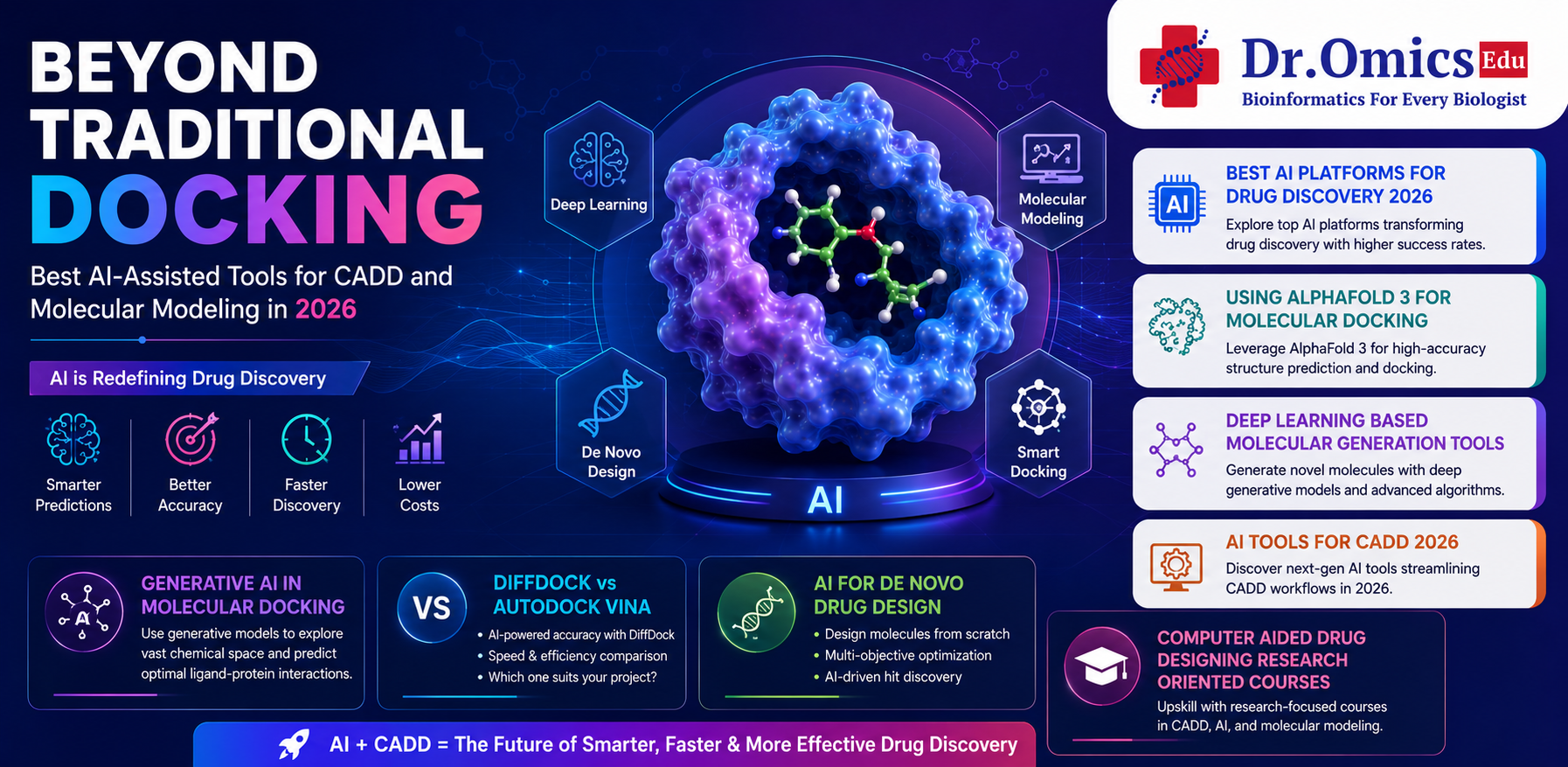
Beyond Traditional Docking: Best AI-Assisted Tools for CADD and Molecular Modeling in 2026
Dr. Omics Edu Team ·
Artificial Intelligence is rapidly transforming Computer-Aided Drug Design (CADD). While traditional molecular docking remains important, researchers are now leveraging advanced AI models to accelerate target identification, molecular generation, docking, and lead optimization. In 2026, AI is no longer a futuristic concept—it's becoming an essential part of modern drug discovery.
Why AI is Changing Drug Discovery
Conventional docking methods can predict how a molecule binds to a protein, but AI can go much further. Today's AI tools for CADD 2026 can generate novel compounds, predict protein structures, optimize drug candidates, and improve binding predictions with unprecedented speed.
Top AI-Assisted Tools in 2026
1. AlphaFold 3
One of the most significant breakthroughs in structural biology, using AlphaFold 3 for molecular docking helps researchers obtain highly accurate protein structures, improving downstream docking and interaction studies.
2. DiffDock
DiffDock uses deep learning to predict ligand binding poses directly, reducing dependence on traditional search algorithms. The growing discussion around DiffDock vs AutoDock Vina highlights how AI-powered docking is complementing classical docking approaches.
3. Generative AI Platforms
Modern deep learning-based molecular generation tools can design entirely new molecules with desired biological properties. These systems are advancing AI for de novo drug design, enabling researchers to explore chemical space more efficiently.
4. AI-Powered Drug Discovery Platforms
Several companies are developing some of the best AI platforms for drug discovery 2026, integrating target prediction, virtual screening, molecular generation, and lead optimization into unified workflows.
Generative AI and Molecular Docking
The rise of generative AI in molecular docking allows researchers to not only predict binding interactions but also create novel compounds specifically optimized for target proteins. This significantly reduces the time and cost associated with early-stage drug discovery.
Building Skills for the Future
As AI becomes deeply integrated into pharmaceutical research, professionals with expertise in molecular modeling, machine learning, and computational biology will be in high demand. Enrolling in computer-aided drug designing research-oriented courses can help students and researchers gain practical experience with these cutting-edge technologies.
Final Thoughts
The future of CADD lies in combining traditional molecular modeling techniques with AI-driven innovation. Tools like AlphaFold 3, DiffDock, and generative AI platforms are reshaping how drugs are discovered, optimized, and developed.
Researchers who embrace AI-assisted molecular modeling today will be better prepared to lead the next generation of drug discovery breakthroughs.
