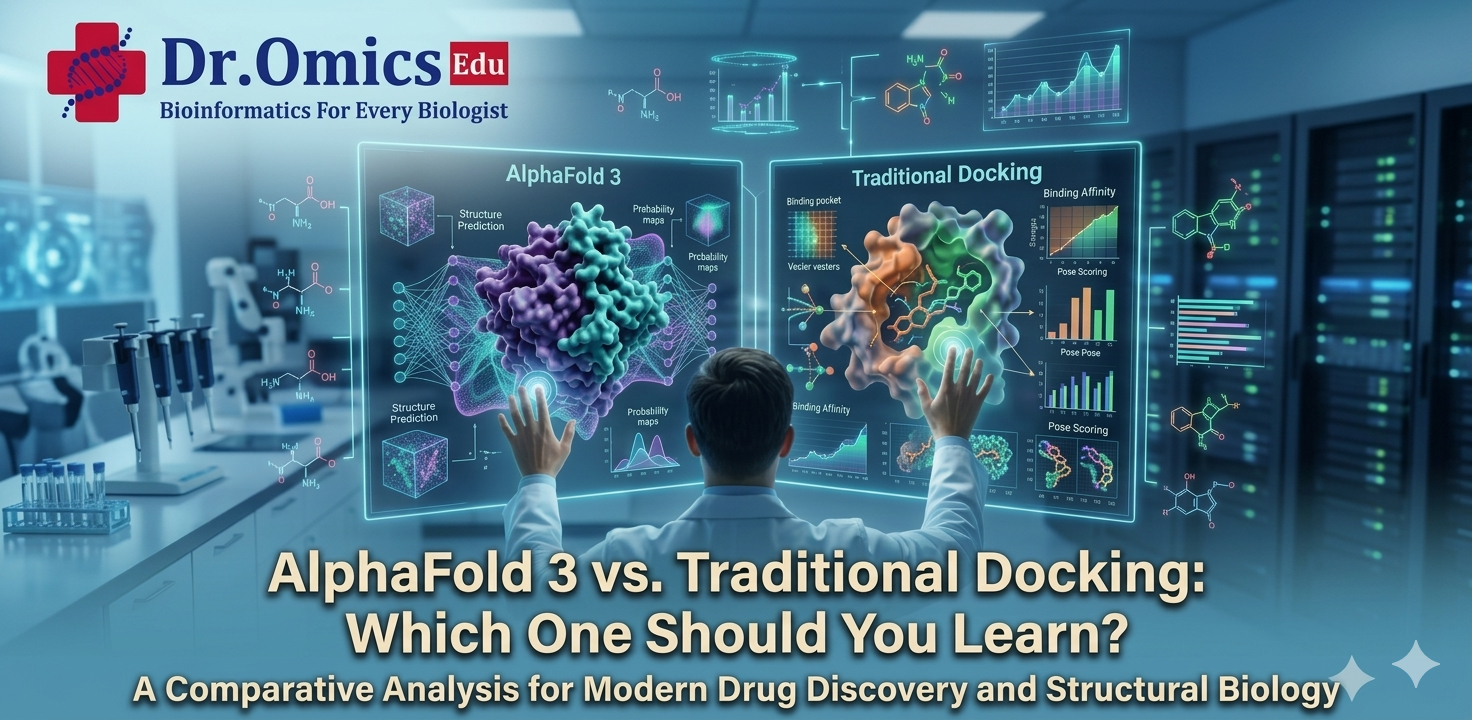
AlphaFold 3 vs. Traditional Docking: Which One Should You Learn?
Dr. Omics Edu Team · · Updated
The year 2026 marks a historic turning point in Computer-Aided Drug Design (CADD). With the release and widespread adoption of AlphaFold 3, the scientific community is facing a pivotal question: Should researchers stick to the tried-and-true methods of physics-based docking, or pivot entirely to AI-driven co-folding?
If you are a student or researcher looking at CADD research oriented courses, understanding this shift is critical for your career.
The Evolution: AlphaFold 3 Protein Structure Prediction
For years, the "holy grail" of structural biology was predicting how a protein folds from its amino acid sequence. AlphaFold 2 solved that. However, AlphaFold 3 protein structure prediction has gone a step further. It doesn't just fold the protein; it models the entire "molecular conversation."
- Co-folding Paradigm: Unlike earlier versions, AF3 can simultaneously predict the 3D structures of proteins, DNA, RNA, and small-molecule ligands in a single "diffusive" step.
- Beyond Static Models: It accounts for some level of protein flexibility—a major hurdle in older methods where the protein was treated as a rigid "stone" and the drug as a "key."
Molecular Docking vs. AI Prediction: The Head-to-Head
When we compare molecular docking vs. AI prediction, we are comparing two different philosophies: Physics vs. Pattern Recognition.
Traditional Molecular Docking (e.g., AutoDock Vina, Glide)
- The Logic: Uses force fields to calculate the actual energy $(\Delta G)$ of a binding interaction.
- The Strength: Excellent for High-Throughput Virtual Screening (HTVS). If you need to rank 10 million compounds to find the top 100, traditional docking is still the "gold standard" for speed and thermodynamic ranking.
- The Weakness: It requires a high-quality 3D structure of the protein (PDB file) to begin. If the structure is unknown or highly flexible, traditional docking often fails.
AI Prediction (AlphaFold 3)
- The Logic: Uses deep learning to "guess" the most likely arrangement based on millions of known structures.
- The Strength: It can predict binding even if you don't have a crystal structure. It is a "blind docking" powerhouse.
- The Weakness: It can "hallucinate" interactions that look pretty but are physically impossible. It also lacks a true "affinity score" to tell you exactly how strong a drug binds compared to another.
Which One Should You Learn?
The answer is neither—and both. In 2026, the most sought-after skill is Hybrid Workflow Management.
| If your goal is... | Prioritize... |
| New Target Discovery | AlphaFold 3 (to build models from sequences) |
| Lead Optimization | Traditional Docking (to refine and rank small variations) |
| Academic Publishing | Both (using AF3 for the model and Docking for validation) |
Why Enroll in CADD Research Oriented Courses Now?
The best CADD research oriented courses today are moving away from teaching software in isolation. Instead, they focus on:
- Validation: Using tools like PoseBusters to check if an AlphaFold 3 prediction follows the laws of physics.
- Integration: Using AF3 to generate a "Holo" structure (protein with ligand) and then using that structure for massive virtual screening campaigns in AutoDock Vina.
- Refinement: Coupling AI predictions with Molecular Dynamics (MD) to see if the predicted drug-protein "handshake" remains stable over time.
Final Verdict
AlphaFold 3 is the architect that builds the house, but Traditional Docking is the inspector that checks if the doors actually lock. To be a successful bioinformatician in 2026, you must master the synergy between the two.
